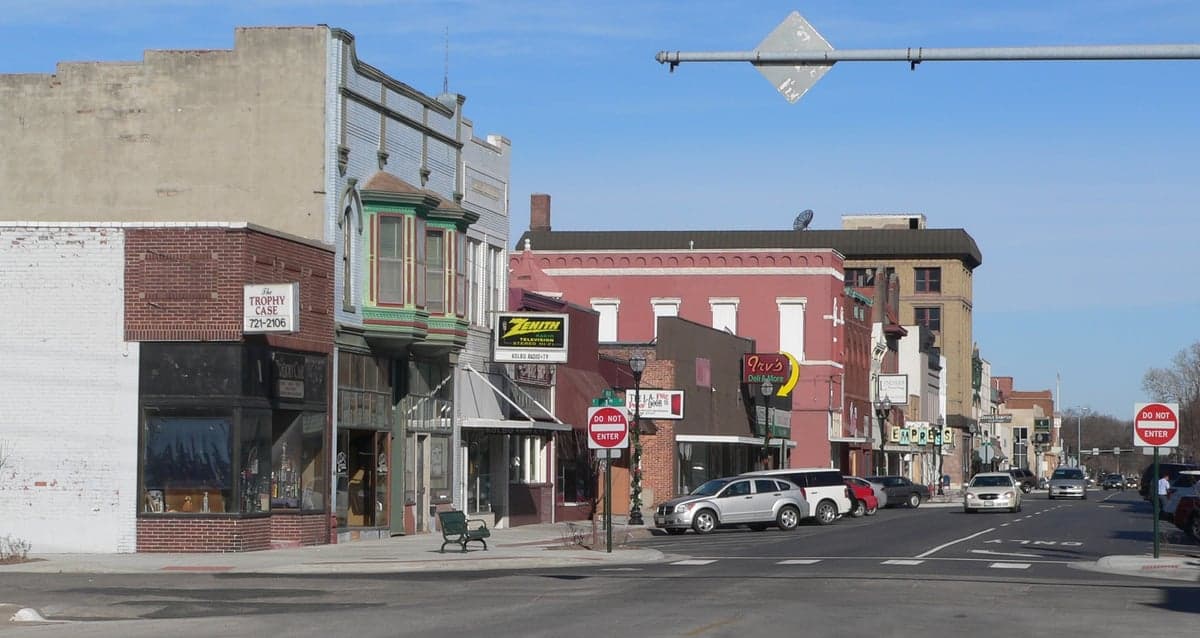
Photo: Wikipedia
Demographics of Fremont, NE
Affluence Level in Fremont, NE
A middle-class area roughly in line with national averages across income, home values, education, and employment.
People of Fremont, NE
Fremont, Nebraska, is a predominantly white, family-oriented city of 27,321 residents, where a strong sense of Midwestern community is paired with a growing Hispanic population that now makes up nearly one in five residents. The city’s character is shaped by its agricultural and manufacturing roots, a low foreign-born rate of 4.6%, and a college-educated share of 21.5% that reflects a workforce oriented toward skilled trades and local industry. Fremont is a place where traditional values and a slow pace of life remain central, even as its demographic makeup gradually diversifies.
How the city was settled and grew
Fremont was founded in 1856 as a railroad town, its growth driven by the arrival of the Union Pacific Railroad and the promise of fertile farmland along the Platte River. The first wave of settlers were predominantly white, native-born Americans from the Midwest and Northeast, drawn by the Homestead Act and the opportunity to farm or work in the rail yards. By the late 19th century, German and Czech immigrants arrived, establishing themselves in neighborhoods like West Fremont and South Fremont, where they built churches, schools, and small businesses that anchored the community. The city’s early economy also relied on a flour mill and a brickyard, which attracted laborers to the Downtown and North Fremont areas. These original European ethnic groups largely assimilated within a generation, leaving a cultural imprint in local festivals and Lutheran and Catholic parishes but not in distinct ethnic enclaves today.
Modern era (post-1965)
After the 1965 Immigration Act, Fremont saw a modest but steady influx of Hispanic workers, primarily from Mexico, who came to fill labor shortages in meatpacking and agriculture. This wave concentrated in the East Fremont and South Fremont neighborhoods, where affordable housing and proximity to industrial employers like the Fremont Beef Company and Hormel Foods provided a foothold. The Hispanic population grew from under 5% in 1990 to 18.6% today, while the white share declined from over 90% to 77.1%. The Black population remains tiny at 0.6%, and East/Southeast Asian communities account for just 0.3%, reflecting limited in-migration from outside the region. Suburbanization in the 1970s and 1980s pushed white families into newer developments like Meadow Ridge and Woodland Hills, while older core neighborhoods near the rail lines and industrial zones became home to a higher concentration of Hispanic residents. The city’s college-educated share of 21.5% is below the national average, indicating that many residents work in manufacturing, construction, or service roles rather than professional or tech sectors.
The future
Fremont’s population is slowly homogenizing in terms of racial identity, with the Hispanic share projected to continue rising as younger families move in and the white population ages. The city’s foreign-born rate of 4.6% is low, suggesting that most Hispanic growth comes from domestic migration or natural increase rather than new international arrivals. The East and South Fremont neighborhoods are likely to remain the primary Hispanic enclaves, while newer subdivisions on the city’s west and north edges will attract white families seeking larger lots and newer schools. The Indian and East/Southeast Asian populations are negligible and show no signs of significant growth, meaning Fremont will remain a biracial city of white and Hispanic residents for the foreseeable future. The city’s low college attainment rate may limit economic diversification, keeping the population tied to manufacturing and agriculture rather than attracting a more diverse professional class.
Fremont is becoming a more Hispanic-influenced community while retaining its core white, working-class identity. For someone moving in now, the city offers a stable, affordable, and family-oriented environment where neighborhoods are relatively homogeneous by income and ethnicity, and where the pace of change is slow enough that newcomers can integrate without cultural friction. The key question for a conservative-leaning resident is whether the gradual demographic shift will alter the city’s political and social character, or whether Fremont will remain a place where traditional Midwestern values persist alongside a growing Hispanic presence.

* Values derived from national, state, county, city and local statistics and may differ in a specific area. Last updated: 2026-10-10T16:27:29.000Z
Narrative content on this page is AI-generated and may contain mistakes. Verify any details that matter before acting on them.
ReloMaps may earn a commission from affiliate links at no extra cost to you.

