Photo: Sherebyah Tisbi via Unsplash
Political ClimatePolitical Climate in Franklin Township, NJ
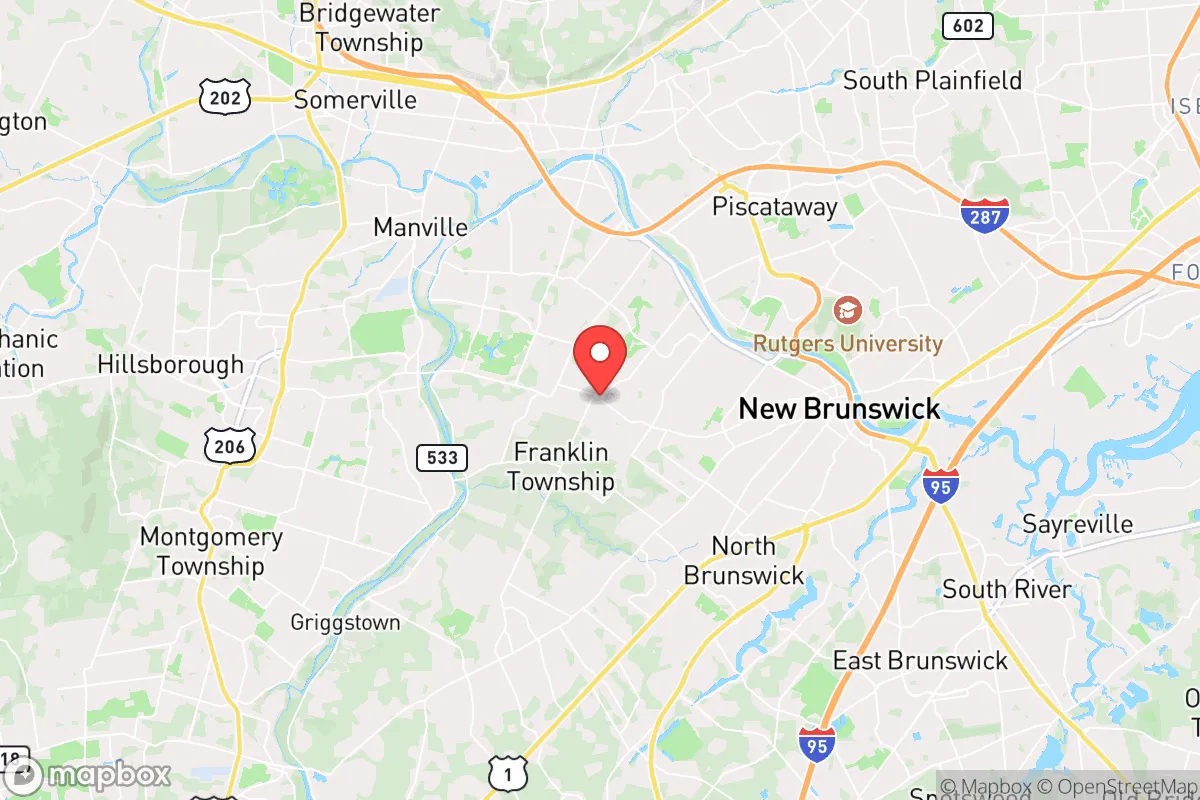
District shown is the primary district for this city’s centroid. Cities may span multiple districts.
Local Political AnalysisPolitical Analysis of Franklin Township, NJ
Franklin Township, NJ, is a solidly Democratic stronghold with a Cook PVI of D+13, making it significantly more liberal than the state of New Jersey as a whole, which sits at D+5. This isn't a recent shift—the township has been reliably blue for decades, driven by its diverse, educated, and suburban population. While statewide races can be competitive, Franklin Township consistently delivers double-digit margins for Democratic candidates, and that trend shows no signs of reversing.
How it compares
To understand Franklin Township's political weight, you have to look at its neighbors. Head west to Hillsborough or south to Manalapan, and you'll find more competitive, swing-like suburbs that lean Republican in local races. Franklin Township, by contrast, is a Democratic anchor in Somerset County, often offsetting the more conservative votes from towns like Bernardsville or Bedminster. The D+13 PVI means a Democratic presidential candidate typically wins Franklin by about 13 points more than the national average, while statewide, New Jersey's D+5 reflects a more balanced mix of urban, suburban, and rural voters. In practical terms, a Republican running for county office here faces an uphill battle, while a Democrat can count on a reliable base of support.
What this means for residents
For liberal residents, the political climate is comfortable and affirming. Local government, school boards, and county commissions are dominated by Democrats, meaning policies around affordable housing, environmental initiatives, and public transit investment tend to move forward with broad support. Conservative residents, however, aren't silenced—they just know they're in the minority. You'll find active Republican clubs and a vocal minority at town hall meetings, but they rarely win major policy battles. The practical effect is that property taxes, which are high across New Jersey, are often debated through a progressive lens, with more focus on equity and services than on cutting spending. For families, this means well-funded schools and parks, but also a tax bill that reflects those priorities.
One cultural distinction worth noting is Franklin Township's strong sense of civic engagement. Voter turnout here regularly exceeds state averages, and local issues like school funding, zoning for new developments, and environmental protections draw passionate crowds. The township's diversity—with significant South Asian, Hispanic, and African American communities—shapes its politics, making it a place where identity and policy are closely linked. Unlike some nearby towns where politics feels like a background noise, in Franklin Township, it's part of daily life. Whether you're a liberal who feels at home or a conservative who feels outnumbered, you'll find a community that takes its civic duties seriously, and that's a rare thing in New Jersey.

State Political ClimatePolitical Climate in New Jersey
State Political AnalysisPolitical Environment in the State
New Jersey is a solidly Democratic state with a Cook PVI of D+5, but that number only tells part of the story. For the past two decades, the state has drifted leftward at the statewide level — no Republican has won a U.S. Senate seat since 1972, and the last GOP presidential win here was George H.W. Bush in 1988. Yet beneath that blue veneer, New Jersey remains one of the most politically complex states in the Northeast, with a powerful suburban swing vote, a resilient Republican machine in certain counties, and a tax revolt movement that keeps the state from going full progressive. If you're moving here, you're stepping into a place where your local politics can feel completely different from what you see on the statewide ballot.
Urban vs. rural divide
The political map of New Jersey is a classic three-layer cake. The urban core — Newark, Jersey City, Paterson, and Camden — delivers massive Democratic margins, often 75-85% of the vote. These cities are powered by dense populations of union households, public-sector workers, and communities of color, and they reliably push the statewide totals blue. The suburbs, particularly in Bergen, Essex, and Middlesex counties, have been trending Democratic since the 1990s, driven by college-educated professionals who lean left on social issues but remain fiscally moderate. The real Republican strongholds are in the northwestern and southern parts of the state: Sussex, Hunterdon, Warren, and Ocean counties routinely vote 55-65% Republican. Ocean County, in particular, is a GOP bastion, fueled by a large population of retirees, law enforcement families, and ex-urban commuters. The divide isn't just geographic — it's cultural. A resident of Montclair (Essex County) and a resident of Toms River (Ocean County) live in different political universes, even though they're only about 60 miles apart.
Policy environment
New Jersey's policy environment is defined by high taxes and heavy regulation, but with notable carve-outs. The state has the highest property taxes in the nation — a median of over $9,500 annually — and a progressive income tax that tops out at 10.75% for income over $1 million. There's no sales tax on clothing or prescription drugs, but the general sales tax is 6.625%. On education, New Jersey consistently ranks in the top 3 nationally for K-12 outcomes, but that comes with a price: school funding is heavily skewed toward urban districts, leaving suburban and rural taxpayers footing a large share of the bill. Healthcare is dominated by the state's Medicaid expansion and a robust individual mandate (the state runs its own exchange). Election laws are among the most accessible in the country: no-excuse mail-in voting, automatic voter registration at the DMV, and same-day registration during early voting. For a conservative-leaning relocator, the tax burden is the single biggest shock — but the quality of schools and infrastructure is genuinely world-class.
Recent policy direction
Over the last five years, New Jersey has moved decisively left on several fronts. In 2022, Governor Phil Murphy signed a package of gun laws that included a ban on carrying firearms in "sensitive places" like parks, libraries, and public transit — a direct response to the Bruen decision. The state also passed a "red flag" law allowing courts to temporarily seize firearms from individuals deemed a threat. On education, the state expanded its "Parents Bill of Rights" in 2023, but it's a mixed bag: it guarantees parental access to curriculum materials, but also explicitly protects LGBTQ+ students' privacy from parental disclosure if they feel unsafe. On medical and bodily autonomy, New Jersey has codified abortion rights into state law (the Freedom of Reproductive Choice Act, 2022) and passed a shield law protecting providers who serve out-of-state patients. Property rights are constrained by the state's strict rent control laws in many municipalities and a powerful eminent domain framework. On voting, the state moved to all-mail-in-ballot eligibility during COVID and made it permanent, though with some pushback from Republicans. For a conservative, the trend is clear: the state is tightening gun laws, expanding abortion access, and maintaining high taxes. For a liberal, it's a state that's actively protecting rights many see as under threat elsewhere.
Civil unrest & political movements
New Jersey has a long history of organized political activism, but it's rarely the kind that makes national headlines. The most visible flashpoint in recent years has been the parental rights movement, particularly in suburban districts like Westfield, Ridgewood, and Marlboro, where school board meetings became battlegrounds over COVID masking, critical race theory, and LGBTQ+ curriculum. These fights have energized a new wave of conservative activists, but they've largely failed to flip school boards — the Democratic machine in most counties is too entrenched. On the left, the Working Families Party has a strong presence in Newark and Jersey City, pushing for rent control expansions and police reform. Immigration politics are a constant undercurrent: New Jersey is a sanctuary state (since 2018, via executive order), and cities like Elizabeth and Perth Amboy have large immigrant populations. There's been no serious secession or nullification rhetoric — New Jersey is too small and too economically integrated with New York and Philadelphia for that. Election integrity controversies have been minimal compared to swing states; the 2020 and 2022 elections were largely uncontested in terms of fraud claims, though some GOP county committees have pushed for tighter ballot security measures. A new resident will notice that political signs are everywhere during election season, but actual street protests are rare outside of Newark or Trenton.
Projection
Over the next 5-10 years, New Jersey's political trajectory is likely to continue its slow leftward drift, but with important caveats. The state is losing population to lower-tax states like Florida and Texas — about 30,000 net residents per year — and those leaving are disproportionately higher-income, older, and more conservative. The people moving in are younger, more diverse, and more liberal, often from New York City. This demographic shift will likely keep the state's PVI at D+5 or even push it to D+6 or D+7 by 2030. However, the tax revolt is real: in 2023, a ballot question to allow early voting passed easily, but a proposal to raise the income tax on millionaires was rejected by voters. The state's massive pension liability ($100 billion+ unfunded) will force either tax increases or service cuts in the next decade, and that could spark a backlash. For a conservative moving in now, expect to be a permanent minority in statewide elections, but you'll find plenty of like-minded neighbors in Ocean, Sussex, and Hunterdon counties. For a liberal, the state will continue to be a policy laboratory for progressive governance, but the cost of living will remain a constant pressure.
Bottom line for a new resident: New Jersey is a state where your local politics can feel like a different country from your statewide representation. If you're conservative, you can find a comfortable community in the exurbs or the shore counties, but you'll be paying for policies you didn't vote for. If you're liberal, you'll enjoy a state that actively protects your rights, but you'll also be paying the highest property taxes in America. The practical takeaway is simple: know your county, know your town, and budget for the tax bill before you fall in love with the house. The politics are real, but they're also local — and in New Jersey, local still matters a lot.
* Values derived from national, state, county, city and local statistics and may differ in a specific area. Last updated: 2026-09-20T15:54:40.000Z
Narrative content on this page is AI-generated and may contain mistakes. Verify any details that matter before acting on them.
ReloMaps may earn a commission from affiliate links at no extra cost to you.

