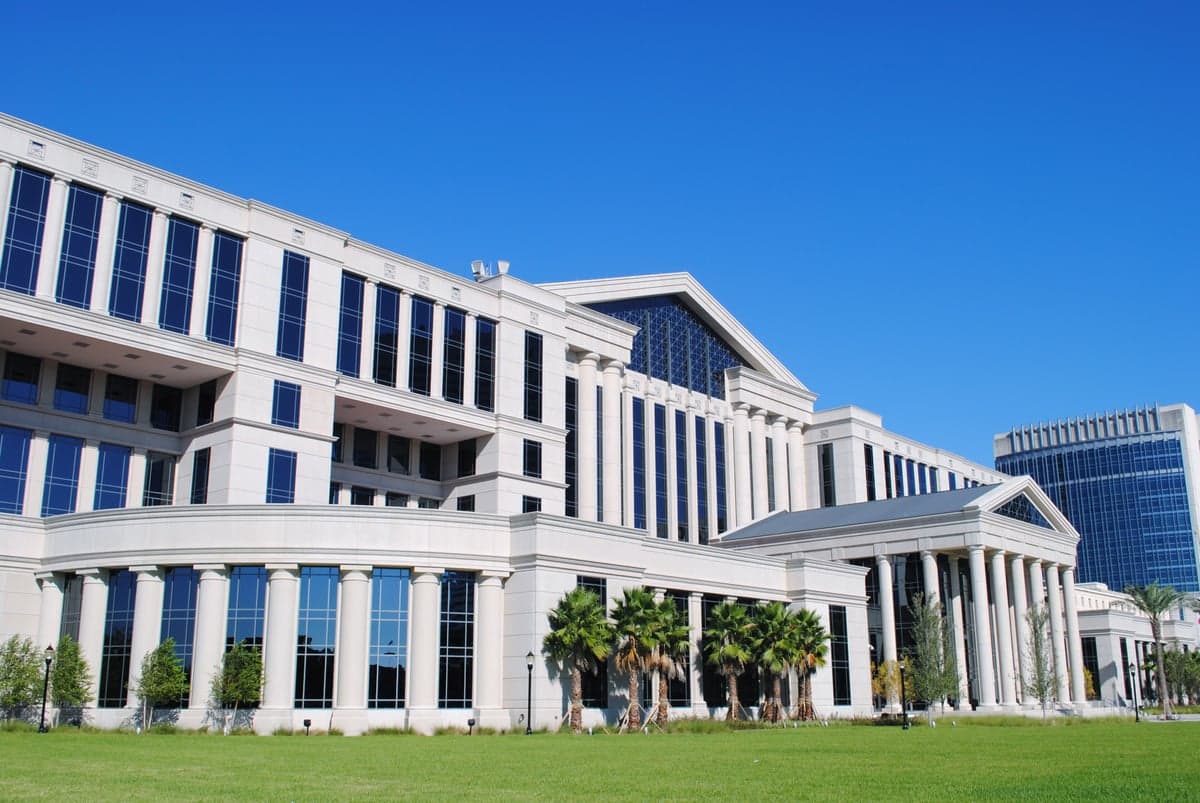
Photo: Wikipedia
Political ClimatePolitical Climate in Duval County
Showing district-level results — no local-only data available.
Local Political AnalysisPolitical Analysis of Duval County
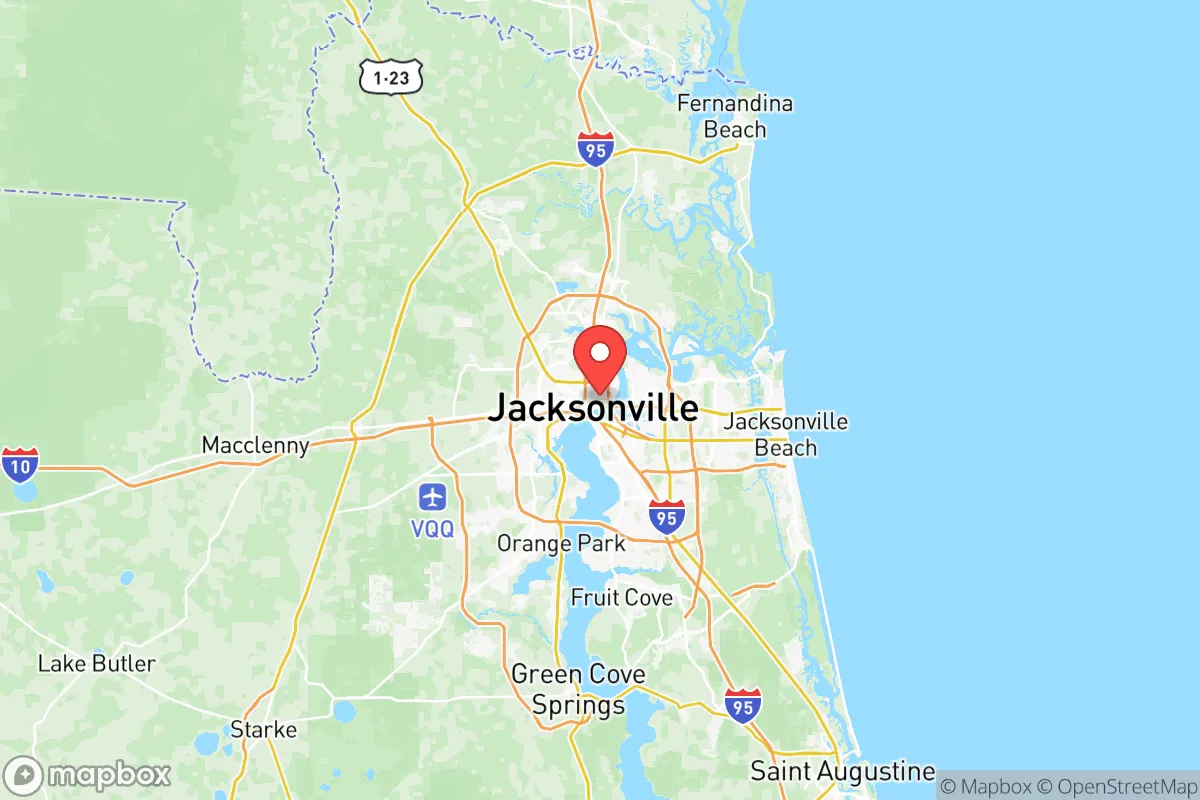
Duval County, Florida, is a classic swing county that has been steadily shifting right, carrying a Cook PVI of R+5 as of 2026. This means the county now leans about five points more Republican than the national average, a notable change from its purple status just a decade ago. Jacksonville, the county seat and by far its largest city, still provides a Democratic stronghold, but the surrounding suburban and rural areas—places like Jacksonville Beach, Neptune Beach, and Atlantic Beach—have been trending redder, while Fernandina Beach in the northern part of the county remains a more moderate, sometimes blue-leaning enclave. The overall trajectory is clear: Duval is no longer the battleground it was in 2016 or 2020, but it’s still competitive enough that neither party takes it for granted.
How it compares
Compared to the rest of Florida, Duval County is a microcosm of the state’s broader political divide, but with a few key differences. Florida as a whole has no official Cook PVI, but it’s widely considered a lean-Republican state after 2022 and 2024 elections, with a PVI estimated around R+3 to R+5. Duval’s R+5 puts it right in line with the state average, meaning it’s not an outlier like Miami-Dade (which has shifted right but remains Democratic-leaning) or Alachua County (solidly blue). What sets Duval apart is its urban-rural split: Jacksonville’s core neighborhoods—like Riverside, Avondale, and San Marco—vote heavily Democratic, often by 20-30 points, while the sprawling suburbs in Mandarin, Bartram Park, and the Westside are reliably Republican. The swing precincts are mostly in the Southside and Arlington areas, where moderate voters decide countywide races. In contrast, much of Florida’s interior is more uniformly red, and the coastal counties are more polarized between liberal beach towns and conservative inland areas.
What this means for residents
For conservative residents, Duval’s rightward shift means their votes carry more weight in local elections than they did a decade ago. The county commission and school board have become more reliably Republican, and issues like tax policy, growth management, and school choice tend to reflect conservative priorities. Liberal residents, meanwhile, still have strong representation in Jacksonville’s city council and in state legislative districts that cover the urban core, but they face an uphill battle in countywide races. The practical effect is that policy debates in Duval are often more moderate than in deep-red counties—the need to appeal to swing voters in the Southside means both parties avoid extreme positions. For example, the city’s consolidated government (Jacksonville and Duval County are one and the same) means that the mayor’s race is the most important local contest, and recent mayors have been moderate Republicans or Democrats who focus on infrastructure, public safety, and economic development rather than culture war issues.
Culturally, Duval County feels like a blend of the urban South and coastal Florida. Jacksonville’s downtown is undergoing a slow revival, with new breweries, the Riverfront Plaza, and the Museum of Science & History drawing younger, more liberal crowds, while the beaches and suburbs remain family-oriented and conservative. The county’s military presence—Naval Air Station Jacksonville and Mayport—adds a transient, patriotic element that leans Republican but isn’t monolithic. One notable policy distinction: Duval has a strong-mayor system with a 19-member city council, which means local politics are more personal and less partisan than in many other Florida counties. You’ll see Democrats and Republicans co-sponsoring bills on affordable housing, drainage improvements, and pension reform more often than you’d expect. The bottom line: Duval is a place where your vote really matters, but the political temperature is lower than in the rest of Florida—at least for now.

State Political ClimatePolitical Climate in Florida
State Political AnalysisPolitical Environment in the State
Florida has transformed from a quintessential swing state into a solidly Republican-leaning powerhouse over the last decade, with the GOP now holding a voter registration advantage of over 800,000 and winning the 2024 presidential race by a comfortable 13 points. The state’s political character is a unique blend of Sun Belt conservatism, libertarian-leaning individualism, and a growing Hispanic electorate that has shifted rightward, particularly among Cuban and Venezuelan communities in South Florida. This trajectory, driven by massive domestic migration from blue states and a concerted Republican legislative agenda, has made Florida a national laboratory for conservative governance, though its urban cores remain stubbornly Democratic.
Urban vs. rural divide
The political map of Florida is a study in stark contrasts. The sprawling Miami-Dade County, once a Democratic stronghold, has flipped dramatically—Biden won it by only 7 points in 2020 after Hillary Clinton carried it by 29 in 2016, and Trump nearly tied it in 2024. This shift is driven by Cuban and Nicaraguan exiles in Hialeah and Doral who are deeply skeptical of socialism, alongside a growing Venezuelan community in Kendall. Meanwhile, Orlando (Orange County) and Tampa (Hillsborough County) remain reliably blue, powered by younger, diverse populations and a strong tourism and service economy. The rural Panhandle—places like Panama City and Pensacola—is deeply red, with Trump winning many of those counties by 40+ points. The I-4 corridor, stretching from Tampa through Lakeland to Orlando, is the traditional battleground, but even here, Republican gains in suburban Lakeland and Ocala have shifted the balance. The Jacksonville metro area (Duval County) is a microcosm: the city itself leans blue, but the surrounding suburbs in St. Johns and Clay counties are among the most conservative in the state.
Policy environment
Florida’s policy environment is defined by a low-tax, low-regulation posture that has attracted a flood of new residents. There is no state income tax, a major draw for high-earners and retirees. Property taxes are moderate, with a $50,000 homestead exemption and a 3% annual cap on assessed value increases (Save Our Homes). The regulatory climate is business-friendly, with right-to-work laws and minimal zoning restrictions in many areas. Education policy has shifted sharply right: Governor Ron DeSantis’s “Parental Rights in Education” law (HB 1557, often called “Don’t Say Gay”) restricts classroom instruction on sexual orientation and gender identity through 8th grade, and the state has expanded school choice dramatically, with nearly 1.3 million students using vouchers or tax-credit scholarships. Healthcare policy is mixed: Florida did not expand Medicaid, leaving roughly 800,000 low-income adults in a coverage gap, but it has a robust private insurance market. Election laws have been tightened: mail-in ballot requests expire every two years, drop boxes are restricted to early voting sites and hours, and a new election police force (Office of Election Crimes and Security) was created to investigate fraud.
Recent policy direction
The last five years have seen a torrent of legislation that has reshaped the state’s legal landscape. On gun and self-defense law, Florida enacted permitless carry (HB 543) in 2023, allowing any legal gun owner to carry a concealed firearm without a permit, though open carry remains illegal. Parental and education rights have been expanded: the “Stop WOKE Act” (HB 7) restricts workplace and school training on race and gender, and the “Individual Freedom Act” limits how race can be discussed in classrooms. Speech is broadly protected, with the state preempting local “hate speech” ordinances and passing a law (SB 1780) that allows residents to sue school districts for violating parental rights. Privacy and surveillance are a mixed bag: the state banned TikTok on government devices and passed a social media age verification law (HB 3) for minors under 16, but local police have broad surveillance powers. Medical and bodily autonomy is sharply restricted: a 6-week abortion ban (HB 5) took effect in 2024, with no exceptions for rape or incest, only for life of the mother or fatal fetal anomalies. Property rights are strong, with no state-level rent control allowed and a “Property Rights” amendment in the state constitution. Taxation remains low, but sales tax has crept up to 6% (plus local options), and the state relies heavily on tourism and real estate transaction taxes. Voting and ballot access has been tightened, but early voting is still generous (up to 14 days) and voter turnout in 2024 was high at 72%.
Civil unrest & political movements
Florida has seen its share of political flashpoints. The 2020 Black Lives Matter protests in Miami and Tampa were large but largely peaceful, though the state responded with an “anti-rioting” law (HB 1) that enhanced penalties for blocking roads and created a new crime of “mob intimidation.” Immigration politics are front and center: Governor DeSantis has bused migrants from Texas to Martha’s Vineyard and signed a law (SB 1718) that requires hospitals to ask about immigration status and makes it a felony to transport undocumented immigrants into the state. There is no sanctuary city policy—in fact, the state preempts any local “sanctuary” ordinances. Election integrity remains a hot-button issue: the 2020 and 2022 elections were certified without major fraud findings, but the new election police unit has investigated hundreds of cases, mostly involving double voting or felon voting. The “Don’t Say Gay” law sparked national boycotts and protests, but also energized conservative parents. A new resident will notice political polarization in everyday life—yard signs, bumper stickers, and heated local Facebook groups are common, but the state’s transient population means many people are less entrenched than in older, more stable communities.
Projection
Over the next 5-10 years, Florida is likely to become even more Republican, driven by continued in-migration from high-tax states like New York, Illinois, and California. The Hispanic electorate, now about 20% of voters, is trending right, particularly among younger Cuban and Venezuelan men. The Democratic Party in Florida is in disarray, with weak state leadership and a shrinking base in rural and suburban areas. However, the state’s urban cores—Miami, Orlando, Tampa, and Fort Lauderdale—will remain blue, and the growing Puerto Rican population in Central Florida (especially around Kissimmee) could provide a counterweight if Democrats can mobilize them. Climate change and insurance costs are wild cards: rising homeowners’ insurance premiums (now the highest in the nation) could slow migration and create economic pressure that shifts political priorities. A new resident moving in now should expect a state that is increasingly conservative on social issues, with a low-tax, low-service model that works well for the affluent but leaves gaps in healthcare and infrastructure. The political culture is combative but effective—things get done, but often in a way that feels like a culture war battlefield.
For a new resident, the bottom line is this: Florida offers a low-tax, high-freedom environment that rewards individual initiative, but you will need to navigate a polarized landscape where your neighbors may hold very different views. If you value school choice, gun rights, and a light regulatory touch, you’ll feel at home. If you prioritize abortion access, strong public services, or a more communal ethos, you may find the state frustrating. The political reality is that Florida is now a Republican-dominated state, and its trajectory suggests that will remain true for the foreseeable future, but the diversity of its cities and the constant churn of new arrivals mean it’s never a monolith. Come for the weather and the taxes, but be ready for a place that takes its politics seriously.
* Values derived from national, state, county, city and local statistics and may differ in a specific area. Last updated: 2026-08-19T21:21:33.000Z
Narrative content on this page is AI-generated and may contain mistakes. Verify any details that matter before acting on them.
ReloMaps may earn a commission from affiliate links at no extra cost to you.

