Photo: Wikipedia
Demographics of Fairplay, CO
Affluence Level in Fairplay, CO
An upper-middle-class area. Household wealth, education levels, and homeownership run ahead of national benchmarks.
People of Fairplay, CO
Fairplay, Colorado, is a small, tight-knit mountain community of 851 residents that remains overwhelmingly white (88.0%) with a modest Hispanic minority (6.3%) and a negligible foreign-born population (1.2%). The town’s character is defined by its historic mining roots, a strong ranching tradition, and a growing appeal as a quiet, affordable alternative to the resort towns of Summit County. With a third of adults holding a college degree, Fairplay attracts a mix of remote workers, retirees, and outdoor enthusiasts who value its low-key, conservative-leaning atmosphere over the bustle of Breckenridge or Frisco.
How the city was settled and grew
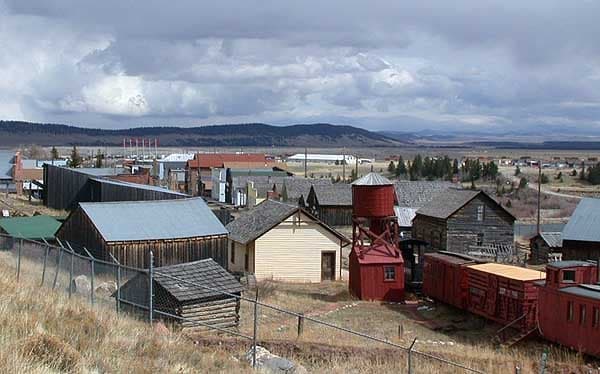
Fairplay was founded in 1859 during the Pike’s Peak Gold Rush, when prospectors flooded the South Park basin after gold was discovered in nearby streams. The town’s name came from a miners’ code of conduct — “fair play” — meant to prevent claim-jumping and violence. The original population was almost entirely Anglo-American, drawn from the eastern United States and Europe, with a small number of Chinese laborers who worked on railroad and mining infrastructure in the 1870s. The historic Front Street district (now part of the National Register-listed South Park City museum) was the commercial heart where miners, merchants, and saloonkeepers built the first wooden storefronts. By the 1880s, the Boreas Pass area became a hub for hard-rock mining camps, while the Fourmile Creek corridor saw placer mining operations that attracted families seeking steady work. The town’s population peaked around 1,200 in the 1890s, then declined sharply after the silver crash of 1893 and the eventual closure of most mines by the 1920s. For the next four decades, Fairplay survived as a small ranching and county-seat town, with the Jefferson Hill neighborhood housing the families who worked the surrounding cattle ranches.
Modern era (post-1965)
Fairplay’s modern demographic story is one of slow, steady growth driven by domestic in-migration rather than immigration. The 1965 Hart-Cellar Act had virtually no effect here — the foreign-born share remains just 1.2%, and the town has never had a significant immigrant community. Instead, the post-1965 era saw Fairplay transform from a fading mining town into a bedroom community for Summit County’s ski economy. The Bison Ridge subdivision, developed in the 1970s and 1980s, attracted middle-class families and second-home buyers seeking cheaper land than Breckenridge offered. The Fairplay Heights area (east of Highway 9) grew in the 1990s and 2000s with single-family homes for workers in the service and construction industries. The Hispanic population, now 6.3%, began growing in the 1990s as Mexican-American families moved in to work in construction, landscaping, and hospitality — a pattern seen across rural Colorado. These families settled primarily in the South Park Estates mobile home park and older rentals along Main Street. The Black population (1.8%) and East/Southeast Asian population (0.0%) remain negligible, reflecting the town’s lack of urban amenities and limited job diversity. The college-educated share (33.1%) has risen steadily since 2000 as remote workers and retirees from Denver and the Front Range discovered Fairplay’s lower cost of living.
The future
Fairplay’s population is likely to remain small and predominantly white, with modest growth driven by two forces: remote-work migration from Colorado’s Front Range and the continued expansion of Summit County’s workforce housing shortage. The town’s zoning allows for new subdivisions like the Placer Valley project (approved in 2023), which could add 200-300 homes over the next decade, attracting more families and professionals. The Hispanic share may grow slowly as service-sector workers seek affordable housing, but the foreign-born population is unlikely to rise significantly given the lack of established immigrant networks. The town is not tribalizing into distinct ethnic enclaves — the small Hispanic community is dispersed rather than concentrated. Instead, the emerging divide is economic: between long-time ranching families and newer remote workers, with tensions over development and water rights. For a conservative-leaning newcomer, Fairplay offers a stable, homogeneous community where change comes slowly and the traditional mountain lifestyle remains intact.
Fairplay is becoming a quieter, more residential version of its Summit County neighbors — a place where the mining past still shapes the culture, but the future belongs to those who value space, solitude, and a slower pace. For someone moving in now, the town offers a genuine small-town experience with minimal demographic flux and a strong sense of local identity.

* Values derived from national, state, county, city and local statistics and may differ in a specific area. Last updated: 2026-05-11T22:14:19.000Z
Narrative content on this page is AI-generated and may contain mistakes. Verify any details that matter before acting on them.
ReloMaps may earn a commission from affiliate links at no extra cost to you.

