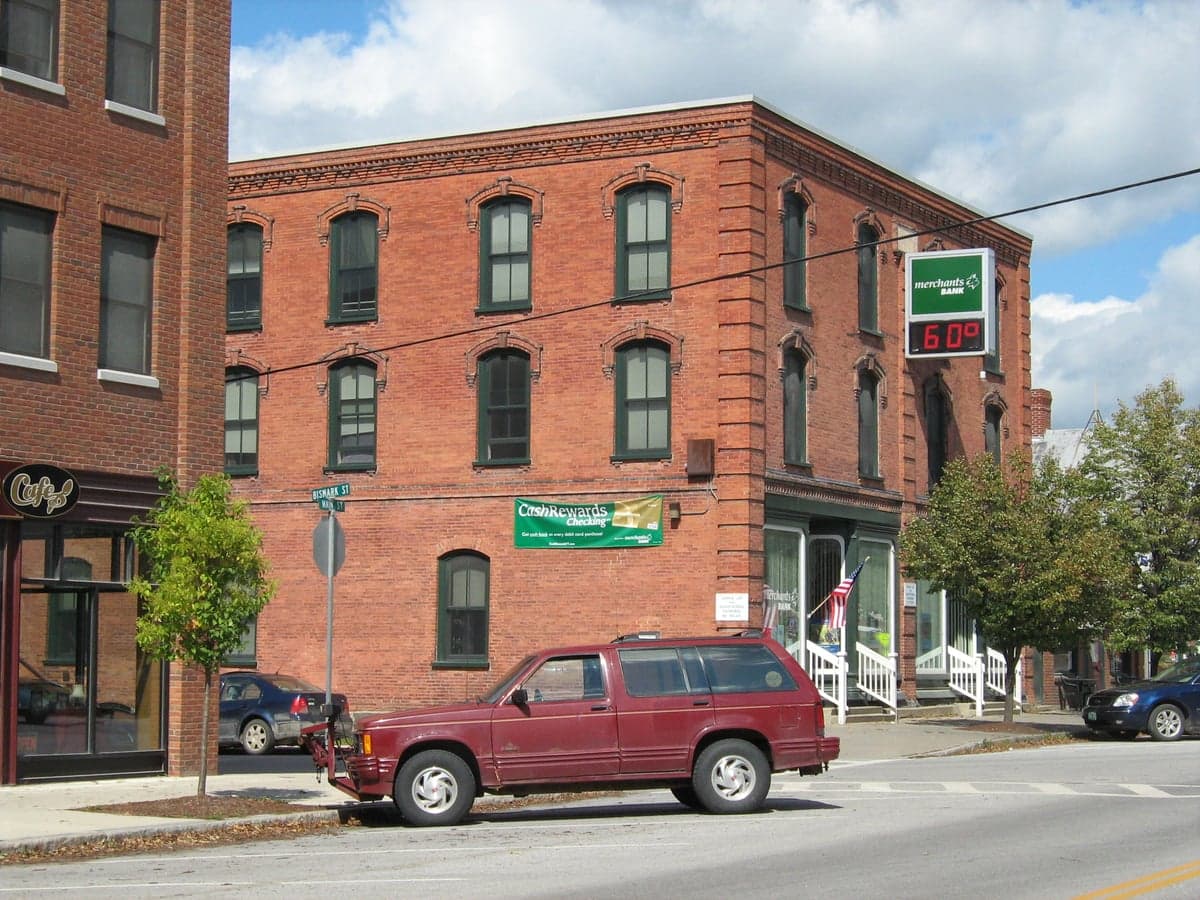
Photo: Wikipedia
Personal Sovereignty in Enosburg Falls, VT
Moderate friction. Expect trade-offs in some aspect of personal liberty and independence.
What does Personal Sovereignty tell us?
Personal Sovereignty measures your capacity for self-reliance and independence with minimal government friction. Higher scores mean fewer barriers between you and the way you want to live... but it assumes you have the space you need and good neighbors.
What does this tell us?
Personal Sovereignty measures your capacity for self-reliance and independence with minimal government friction. Higher scores mean fewer barriers between you and the way you want to live... but it assumes you have the space you need and good neighbors.
State Policy
Energy independence: Importer (15% of energy produced in-state)
Personal Liberty
Homesteading

Personal Liberty Analysis
Enosburg Falls, Vermont, offers a mixed bag for those prioritizing personal sovereignty, with the town’s rural character and small population providing a tangible buffer against the more intrusive policies found in Burlington or Montpelier. While the state’s political leanings tilt left, the day-to-day reality in Franklin County is one of relative autonomy—neighbors keep to themselves, and the local government has neither the resources nor the inclination to micromanage daily life. For a survivalist or prepper, the key question is whether Vermont’s state-level overreach outweighs the practical freedoms of living in a town of roughly 1,400 people, where the nearest Walmart is 20 minutes away and the ethos of self-reliance still holds.
Tax burden and regulatory posture in Franklin County
Vermont’s tax burden is among the highest in the nation, and Enosburg Falls is not exempt. Property taxes here hover around 2.1% of assessed value, which on a median home price of roughly $200,000 means an annual bill of about $4,200—steep for a town with limited services. The state income tax is progressive, topping out at 8.75%, and sales tax is 6%. For a prepper, the real sting comes from the regulatory posture: Vermont has strict Act 250 land-use laws that can complicate building a bunker, adding a pond, or clearing timber without permits. However, Enosburg Falls itself is a small, unzoned village in parts, meaning many residential lots fall outside the most onerous state oversight. The local selectboard is pragmatic and unlikely to chase down a homeowner for an unpermitted shed or a backyard chicken coop, as long as it doesn’t bother neighbors. Compared to Chittenden County, the regulatory drag here is lighter, but anyone planning significant off-grid infrastructure should budget for legal consultation to navigate Act 250 exemptions.
Self-defense and gun law specifics in Vermont
Vermont has historically been one of the most gun-friendly states in the Northeast, and that legacy still holds in Enosburg Falls. The state allows constitutional carry without a permit for anyone 18 or older who can legally possess a firearm—no license, no training requirement, no registration. This is a significant plus for personal sovereignty. However, the landscape has shifted since 2018, when the legislature passed S.55, which raised the purchase age to 21, banned bump stocks, and limited magazine capacity to 10 rounds for long guns and 15 for handguns. A 2023 law (S.4) added a 72-hour waiting period for handgun purchases and expanded the state’s “red flag” law, allowing law enforcement to seize firearms based on a complaint without a criminal conviction. In Franklin County, sheriff’s deputies are generally supportive of Second Amendment rights, and local gun culture is strong—there are no extra local restrictions. For a prepper, the practical takeaway is that you can carry openly or concealed without paperwork, but stockpiling standard-capacity magazines requires out-of-state purchases, and the red flag law means keeping a low profile if you’re vocal about political views. Self-defense in the home is protected under Vermont’s Castle Doctrine, but there is no “stand your ground” statute—duty to retreat applies in public spaces.
Self-reliance and homesteading viability: lot sizes, zoning, and off-grid feasibility
Enosburg Falls sits in the heart of dairy country, and the surrounding area offers genuine opportunities for self-reliance. Residential lots in the village are typically a quarter-acre to half-acre, but just outside town, parcels of 5 to 20 acres are common and affordable, often selling for $3,000 to $5,000 per acre. Zoning is minimal in the unincorporated parts of the town; there are no county-level building codes, and the state’s residential building code only applies to new construction over 600 square feet. Off-grid living is legally feasible: Vermont has no state law requiring grid connection, and many rural homes already rely on private wells and septic systems. Solar panels are widely accepted, and net metering is available through Green Mountain Power, though the utility’s rates are high (around $0.18/kWh). Rainwater collection is legal for outdoor use, but potable rainwater systems require a permit from the Vermont Department of Environmental Conservation. For a prepper, the biggest hurdle is the state’s ban on new wood-burning stoves in certain air quality zones (Enosburg Falls is not in one), and the requirement that any new dwelling have a septic system approved by the state—an expensive process that can run $10,000 to $20,000. Still, compared to southern New England or the West Coast, the regulatory barriers to homesteading here are low. You can raise chickens, goats, and even a few pigs without a permit, as long as you’re not in the village center. The growing season is short (about 120 days), so serious food production requires a greenhouse or root cellar.
Personal liberties: parental rights, medical autonomy, speech, and property
Vermont’s state-level policies on parental rights and medical autonomy are a concern for conservative-leaning residents. The state mandates comprehensive sex education in public schools, and parents cannot opt their children out of LGBTQ-inclusive curriculum—a point of friction for families who want more control over what their kids are taught. Enosburg Falls Elementary and Missisquoi Valley Union High School are small, and local school boards have historically been responsive to parent input, but they must follow state law. On medical autonomy, Vermont was an early adopter of vaccine mandates for school attendance (no philosophical exemption), and during the COVID-19 pandemic, the state imposed some of the longest-lasting emergency orders in the country. For a prepper, this means that if another public health crisis hits, state-level mandates could override local sentiment. Free speech is protected under the First Amendment, and there’s no local ordinance restricting political expression, but Vermont’s “malicious harassment” law is broad and has been used to prosecute speech deemed threatening. Property rights are generally strong—eminent domain is rarely used in Franklin County—but the state’s land-use laws can feel like a backdoor infringement. For example, you cannot cut down more than 10 acres of forest without a state permit, and wetlands regulations can restrict building on your own land. The silver lining is that Enosburg Falls is far enough from the state capital that enforcement is lax; most residents simply do what they need to do and avoid drawing attention.
In the broader landscape of personal sovereignty, Enosburg Falls occupies a middle ground. It offers more practical freedom than any urban area in Vermont or the Northeast corridor—lower population density, less surveillance, and a culture that values self-sufficiency. The tax burden and state-level regulatory creep are real, but they are offset by the ability to own land, carry a firearm without a permit, and live off-grid with minimal interference. For a survivalist or prepper who is willing to navigate Vermont’s legal quirks and accept a short growing season, this town provides a viable base of operations. It is not a libertarian paradise—the state government will still reach into your life on education, health mandates, and land use—but it is a place where a determined individual can carve out a high degree of autonomy, especially compared to the heavily regulated states to the south and west. The key is to buy land outside the village, keep a low profile, and build relationships with neighbors who share your values. In that sense, Enosburg Falls is less a sanctuary and more a strategic outpost—one that rewards preparation and vigilance.

* Values derived from national, state, county, city and local statistics and may differ in a specific area. Last updated: 2026-04-30T08:10:15.000Z
Narrative content on this page is AI-generated and may contain mistakes. Verify any details that matter before acting on them.
ReloMaps may earn a commission from affiliate links at no extra cost to you.

