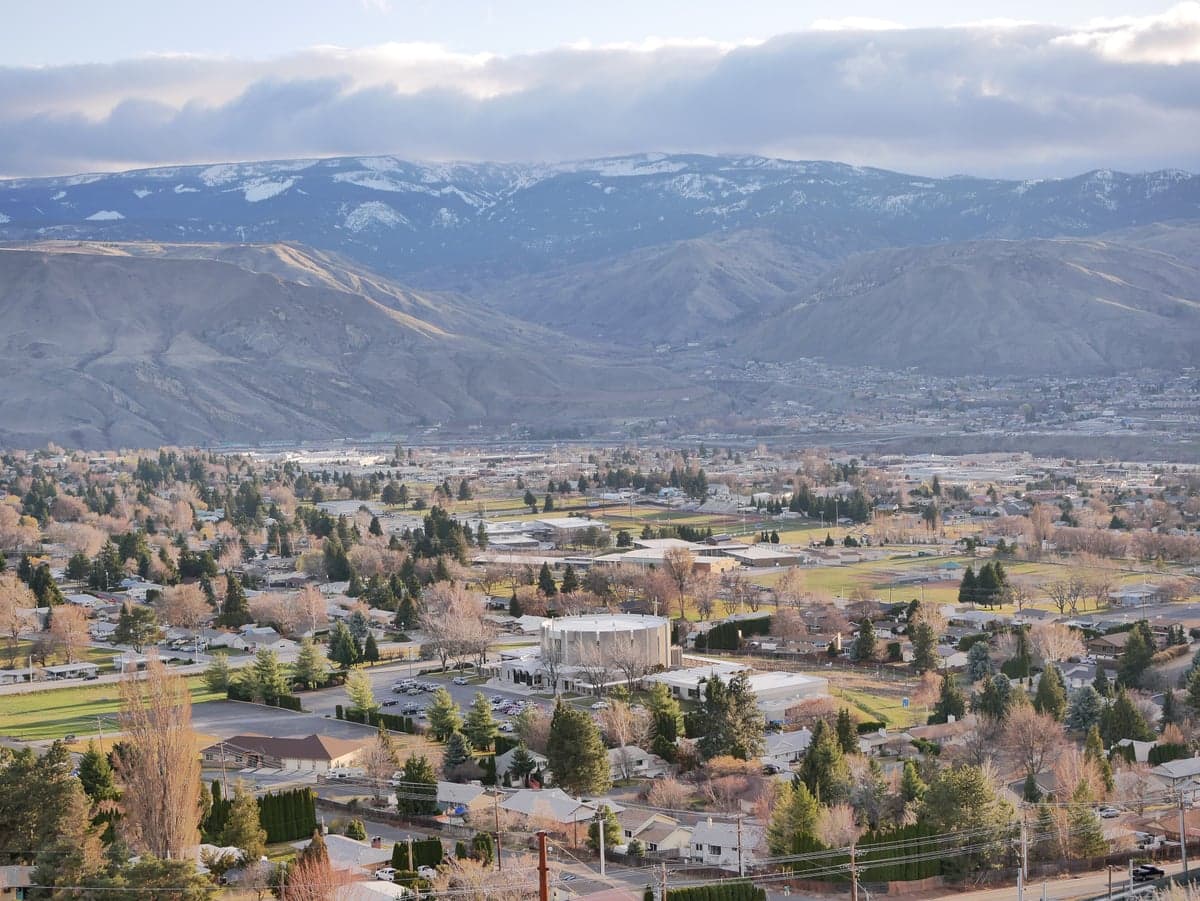
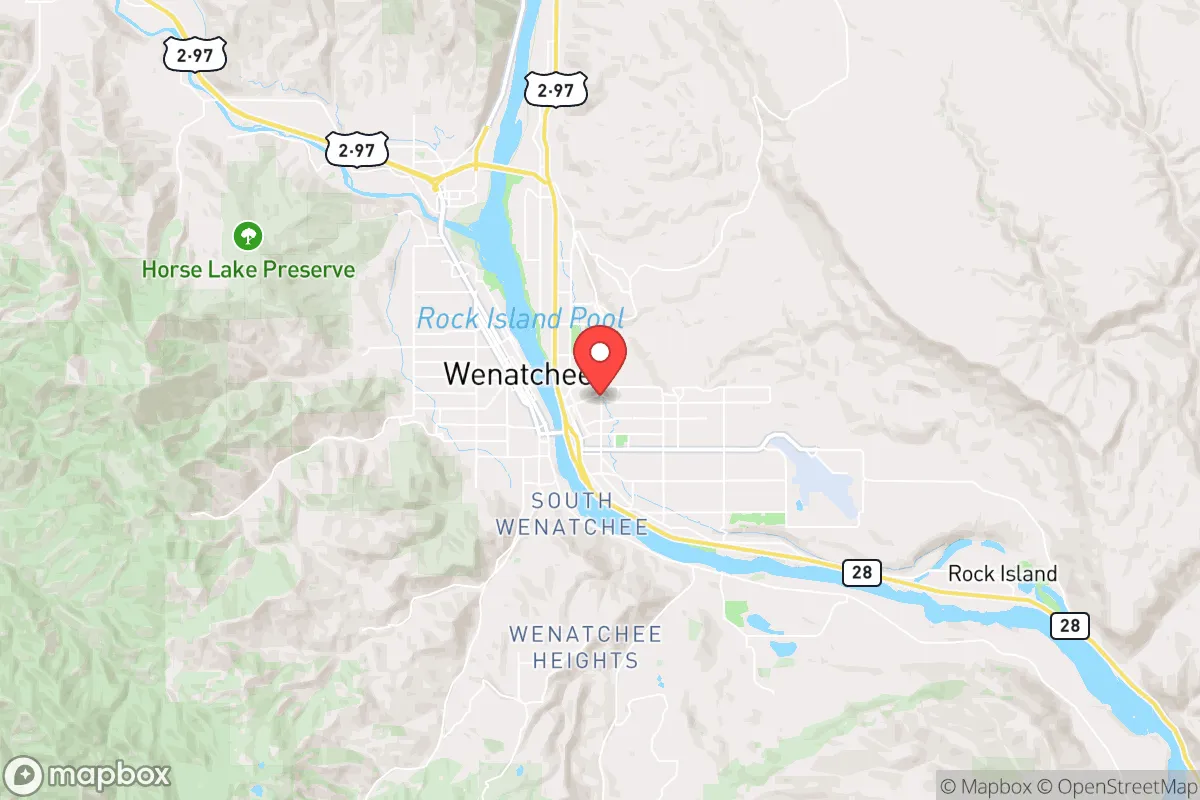
Photo: Wikipedia
Political ClimatePolitical Climate in East Wenatchee, WA
District shown is the primary district for this city’s centroid. Cities may span multiple districts.
Local Political AnalysisPolitical Analysis of East Wenatchee, WA
East Wenatchee leans reliably Republican, with a Cook Partisan Voting Index of R+10 that places it firmly in conservative territory compared to the rest of Washington state. The area has held this right-leaning character for decades, though the margin has tightened slightly as more commuters from King County discover the lower cost of living here. You’ll find that local elections in Douglas County consistently favor GOP candidates, and the city council tends to lean center-right, but it’s not a monolith—there’s a noticeable libertarian streak that keeps things interesting.
How it compares
East Wenatchee’s R+10 rating stands in stark contrast to the political landscape of Washington state as a whole, which has voted Democratic in every presidential election since 1988 and now carries a Cook PVI of D+8. The difference is stark when you drive just 15 miles west over the Columbia River into Chelan County, where the city of Leavenworth leans more moderate, or head 30 miles north to the liberal enclave of Bellingham. Even Wenatchee, the larger city directly across the river, shows a slightly more balanced mix—though still conservative by state standards. The real contrast comes when you compare East Wenatchee to the Puget Sound region: Seattle’s King County votes D+30, while Spokane County to the east is R+12, making East Wenatchee a kind of middle ground between the two extremes. What this means on the ground is that a Republican candidate can expect to win East Wenatchee by about 10 points in a typical statewide race, while the same candidate might lose the state by 8 points. That gap has widened over the past decade as Washington’s urban centers have grown more liberal, while East Wenatchee’s rural and exurban character has held steady.
What this means for residents
For conservative residents, the local political climate means their values are reflected in city council decisions, school board policies, and county-level governance. You’ll see lower property tax rates than in liberal-leaning counties, and Second Amendment rights are generally respected without the kind of restrictions you’d find in Seattle or King County. For liberal residents, life here is still comfortable—there’s no overt hostility, but you’ll notice fewer progressive candidates on the ballot and a community that tends to prioritize fiscal conservatism and individual liberty over expansive government programs. The practical effect is that local issues like zoning, water rights, and agricultural policy get handled with a light regulatory touch, while statewide initiatives on topics like carbon pricing or police reform often face local pushback. The trajectory I see is a slow drift toward purple as more remote workers from the west side move in, but the R+10 rating suggests that shift will take another decade or more to meaningfully change the balance.
Culturally, East Wenatchee feels more like a small-town Western community than a Pacific Northwest suburb. There’s a strong emphasis on self-reliance, outdoor recreation, and neighborly help—think community potlucks and volunteer fire departments rather than city-funded programs. The policy distinction that stands out most is the area’s approach to growth: while Washington state pushes for denser housing and transit-oriented development, East Wenatchee has kept a slower, more property-rights-focused stance, with larger lot sizes and fewer zoning restrictions. That’s likely to remain the norm as long as the R+10 lean holds, even as the state’s overall politics continue to drift left. If you’re moving here, expect a place where your vote carries more weight locally than it would in a deep-blue city, but where statewide elections will feel like an uphill battle for conservative candidates.

State Political ClimatePolitical Climate in Washington
State Political AnalysisPolitical Environment in the State
Washington state has been a reliably blue stronghold for over a decade, but its politics are far more complex than a simple "liberal state" label suggests. The Democratic Party holds a trifecta in state government, and no Republican has won a statewide race since 2012. However, this lean is driven almost entirely by the Seattle metro area, while vast swaths of eastern and central Washington vote as red as any state in the South. Over the last 20 years, the state has shifted leftward on social and environmental policy, but a growing populist conservative movement in rural areas has hardened the urban-rural divide.
Urban vs. rural divide
The political map of Washington is a study in extremes. King County, home to Seattle, casts roughly one-third of the state's total votes and consistently delivers margins of 70-80% for Democratic candidates. This single county is the engine of the state's blue lean. Neighboring Snohomish and Pierce counties (Tacoma) have also trended blue, though less overwhelmingly. In contrast, the eastern half of the state is deeply red. Spokane County, the state's second-most populous, is a perennial battleground that has shifted rightward in recent cycles, while rural counties like Yakima, Grant, and Stevens vote Republican by 20-30 point margins. The Columbia River Gorge area, including Klickitat County, has seen a modest leftward drift as Portland exurbs spill over, but the overall pattern is stark: the I-5 corridor from Olympia to the Canadian border is blue; everything east of the Cascades is red. This divide isn't just electoral—it shapes daily life, with Seattle-area residents often feeling disconnected from the concerns of farmers and ranchers in the Palouse.
Policy environment
Washington's policy environment is defined by a progressive tax structure and a heavy regulatory hand. The state has no personal income tax, relying instead on a high sales tax (averaging 8-10% depending on the locality) and a business-and-occupation tax. Property taxes are moderate. This system is regressive, meaning lower-income residents pay a larger share of their income in taxes than the wealthy—a frequent point of contention. On education, the state has fully funded a "basic education" mandate through the McCleary decision, but per-pupil spending still lags behind national averages. Healthcare is heavily regulated, with a robust state-based insurance exchange and expanded Medicaid under the Affordable Care Act. Election laws are among the most accessible in the nation: same-day voter registration, automatic voter registration via the DMV, and a vote-by-mail system that has been in place for over a decade. There is no voter ID law, which conservatives frequently criticize as a security risk.
Recent policy direction
Washington's recent legislative sessions have pushed the state decisively leftward on a wide range of issues. On guns, the state passed a ban on "assault weapons" (defined by features, not function) in 2023, along with a 10-day waiting period and a requirement for a safety training certificate to purchase a semi-automatic rifle. Magazine capacity is capped at 10 rounds. Self-defense law is governed by a "reasonable belief" standard, with no "stand your ground" statute. On parental and education rights, the state has expanded LGBTQ+ inclusive curriculum mandates and passed a law allowing minors to receive gender-affirming care without parental consent, which has become a major flashpoint. Speech is broadly protected under the state constitution, but the state has enacted a law prohibiting "hate speech" in public schools that some free-speech advocates argue is overly broad. Privacy and surveillance laws are relatively strong: the state has a strict biometric privacy law and limits on warrantless cell-phone tracking. Medical and bodily autonomy is fully protected, with no gestational limits on abortion and a shield law protecting providers from out-of-state prosecution. Property rights are constrained by the Growth Management Act, which forces cities to plan for density and limits rural development. On voting, the state has expanded ballot access with pre-paid postage and ballot drop boxes, but conservatives have raised concerns about ballot harvesting and signature verification standards.
Civil unrest & political movements
Washington has a long history of political activism, from the WTO protests in 1999 to the 2020 Black Lives Matter demonstrations in Seattle, which included the six-week Capitol Hill Autonomous Zone (CHAZ). That event remains a national symbol of progressive governance and a rallying cry for conservatives. On the right, the "Three Percenters" and other militia-style groups have a visible presence in rural counties, particularly around Spokane and Stevens County, where there have been armed standoffs over land-use disputes. Immigration politics are a major fault line: Washington is a "sanctuary state" by statute, limiting local law enforcement cooperation with federal immigration authorities. This has led to tensions in agricultural areas like Yakima and the Tri-Cities, where the farm labor force is heavily immigrant. Election integrity controversies have been relatively muted compared to other states, but conservative activists have filed lawsuits over the state's vote-by-mail system, alleging insufficient signature verification. Secession rhetoric is common in eastern Washington, with "Liberty State" movements periodically gaining traction, though no serious legislative effort has materialized.
Projection
Over the next 5-10 years, Washington is likely to become more, not less, Democratic at the state level. In-migration from California and other blue states is concentrated in the Seattle suburbs and the I-5 corridor, while rural counties continue to lose population. The state's Democratic supermajority in the legislature is likely to hold, and further leftward moves on gun control, environmental regulation, and tax policy are probable. However, the urban-rural divide will deepen, and conservative voters in places like Spokane Valley and Wenatchee will feel increasingly alienated from state government. A new resident moving in now should expect a state where the political center of gravity is firmly in Seattle, with policies that reflect that city's values, but where the lived experience varies dramatically depending on whether you're in a dense urban core or a small farming town.
For a conservative-leaning relocator, the bottom line is this: Washington offers a high quality of life in terms of natural beauty and economic opportunity, but you will be living under a government that is actively hostile to many of your political values. You'll pay high sales taxes, face strict gun laws, and see your children taught a curriculum that may conflict with your beliefs. If you're moving to a rural county like Stevens or Ferry, you'll find a like-minded community, but you'll have little political power at the state level. If you're moving to the Seattle suburbs, you'll need to be comfortable being in the minority politically. For a liberal relocator, Washington is a near-ideal environment: your values are reflected in state law, your taxes are manageable if you're wealthy, and your rights are broadly protected. Either way, the state's political reality is not subtle—it's a blue state that is only getting bluer, and the red parts are increasingly isolated.
* Values derived from national, state, county, city and local statistics and may differ in a specific area. Last updated: 2026-08-15T00:47:05.000Z
Narrative content on this page is AI-generated and may contain mistakes. Verify any details that matter before acting on them.
ReloMaps may earn a commission from affiliate links at no extra cost to you.

