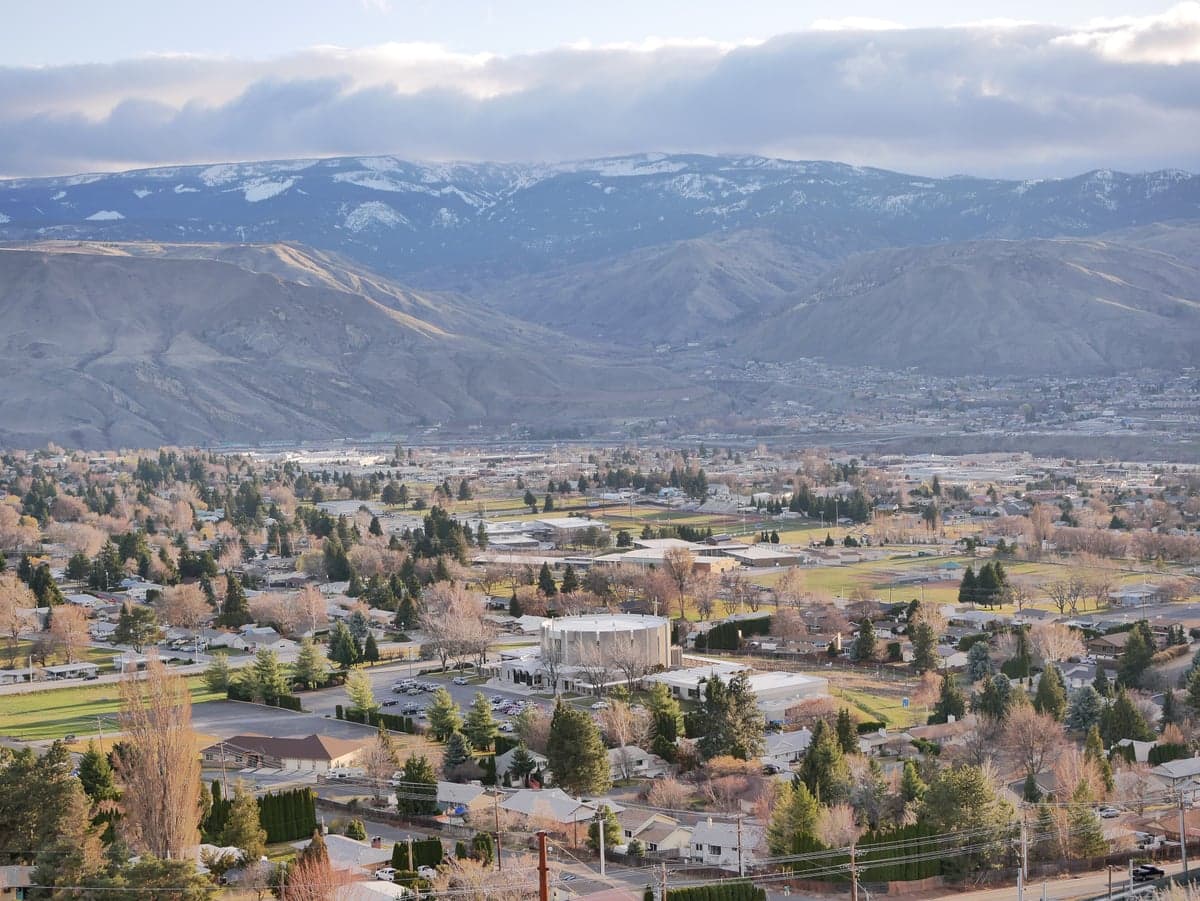
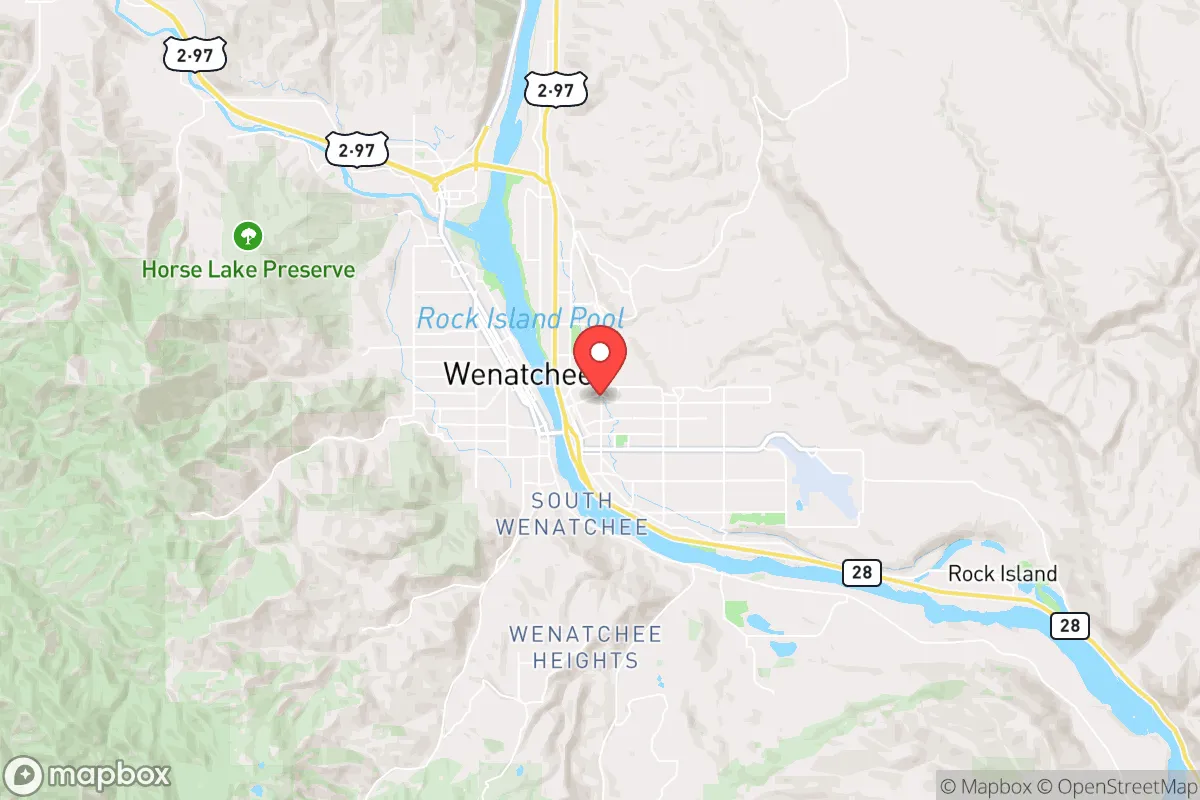
Photo: Wikipedia
Demographics of East Wenatchee, WA
Affluence Level in East Wenatchee, WA
A middle-class area roughly in line with national averages across income, home values, education, and employment.
People of East Wenatchee, WA
Today, East Wenatchee is a predominantly White and Hispanic community of 14,114 residents, shaped by successive waves of agricultural labor, suburban expansion, and cross-state migration. The city’s character is distinctly working-class and family-oriented, with a median age of 36 and a homeownership rate near 65%. Its identity is rooted in the apple and pear orchards that still ring the city, but increasingly defined by commuters who cross the Columbia River to work in Wenatchee’s healthcare, retail, and tech sectors.
How the city was settled and grew
East Wenatchee’s population history begins not with pioneers but with irrigation. The area was sparsely inhabited by the Wenatchi people before European settlement, but the city itself is a product of the early 20th century. The 1905 completion of the Wenatchee Reclamation Project turned arid sagebrush into fertile orchard land, drawing Anglo-American homesteaders from the Midwest and Great Plains. These early settlers—many of them second-generation German and Scandinavian farmers—established the first residential blocks along Grant Road and 9th Street Northeast, an area still known locally as Old Town East Wenatchee. By 1930, the population had reached roughly 1,000, almost entirely White and native-born. The Great Depression slowed growth, but World War II brought a second wave: workers for the nearby Alcoa aluminum smelter in Malaga and the Army Air Corps base at Pangborn Field. These newcomers, mostly White families from the rural Pacific Northwest, settled in the Pangborn Heights neighborhood, named for the airfield. The city was formally incorporated in 1935, and by 1950 the population had climbed to 2,500.
Modern era (post-1965)
The 1965 Hart-Cellar Act had little immediate effect on East Wenatchee; the city remained overwhelmingly White through the 1970s. The real demographic shift began in the 1980s, driven by the expansion of tree-fruit agriculture. Orchards surrounding Eastmont Avenue and Valley Mall Parkway began hiring Mexican and Central American laborers, many of whom settled in the Sunrise Village area, a cluster of mobile-home parks and modest single-family homes east of the mall. By 2000, the Hispanic share of the population had reached 18%. The 2010s brought a second domestic in-migration wave: retirees and remote workers from the Seattle metro area, drawn by lower housing costs and dry climate. These newcomers concentrated in the newer subdivisions of Cascade View Estates and Ridgeview Heights, built on former orchard land along the city’s eastern edge. Today, the city’s foreign-born population stands at 9.1%, nearly all of Hispanic origin. The White share has fallen to 56.3%, while Hispanic residents now make up 36.2% of the population. East and Southeast Asian communities account for 0.8%, Black residents 0.4%, and Indian-subcontinent residents 0.0%. The college-educated share is 20.0%, well below the Washington state average of 37%, reflecting the city’s blue-collar economic base.
The future
East Wenatchee’s population is projected to grow to roughly 18,000 by 2040, driven by continued spillover from the Seattle-Bellevue corridor and natural increase among the Hispanic population. The city is becoming more diverse, but slowly: the Hispanic share is expected to reach 42-45% by 2040, while the White share will continue to decline. New construction is concentrated in the Eastmont Ridge master-planned community, a 400-acre development that will add roughly 1,200 homes and a new elementary school. This area is attracting a mix of young families and older couples, but its price point—homes starting at $450,000—is creating a socioeconomic divide between the newer subdivisions and older neighborhoods like Sunrise Village, where median home values remain below $300,000. Culturally, the city is evolving from a quiet orchard town into a bilingual, bicultural community. Spanish is increasingly heard in grocery stores and at Eastmont High School sporting events, and the annual Fiesta East Wenatchee celebration now draws over 5,000 attendees. The next decade will likely see continued Hispanic population growth, modest Asian in-migration (particularly Filipino and Vietnamese workers in healthcare), and a slow but steady influx of White remote workers from the west side of the state.
For someone moving to East Wenatchee now, the city offers a stable, family-oriented environment with a growing Hispanic cultural presence and a still-dominant White working-class identity. It is not a place of rapid demographic transformation, but of gradual, organic change—a community where orchard land is slowly giving way to subdivisions, and where the future looks more diverse, more suburban, and more connected to the broader Pacific Northwest economy.

* Values derived from national, state, county, city and local statistics and may differ in a specific area. Last updated: 2026-08-15T00:47:05.000Z
Narrative content on this page is AI-generated and may contain mistakes. Verify any details that matter before acting on them.
ReloMaps may earn a commission from affiliate links at no extra cost to you.

