Photo: Wikipedia
Strategic Assessment of Easley, SC
Meaningful friction. Expect exposure to either population pressure, blast zones, or natural disaster risk. Consider buying a retreat property.
What does the Strategic Assessment tell us?
Our Strategic Assessment grades tactical survivability of an area. Major population centers, military targets, fallout zones, natural disasters, and border exposure all drive risk — lower exposure means a more defensible position in a crisis.
This is heavily inspired by Joel Skousen's Strategic Relocation book. Highly recommended you checkout the book ($)What does this tell us?
Our Strategic Assessment grades tactical survivability of an area. Major population centers, military targets, fallout zones, natural disasters, and border exposure all drive risk — lower exposure means a more defensible position in a crisis.
This is heavily inspired by Joel Skousen's Strategic Relocation book. Highly recommended you checkout the book ($)Strategic Pillars

Key Distances
Regional Safe Places
Below is our recommended "safe zones" in South Carolina and the surrounding area based on our strategic heuristics. For most people, it's unrealistic to live in a “safe zone” full-time due to work, family or other personal reasons. They tend to be more rural. However, many of these areas are perfect for second homes and retreat properties that double as a vacation home or even a short-term rental.
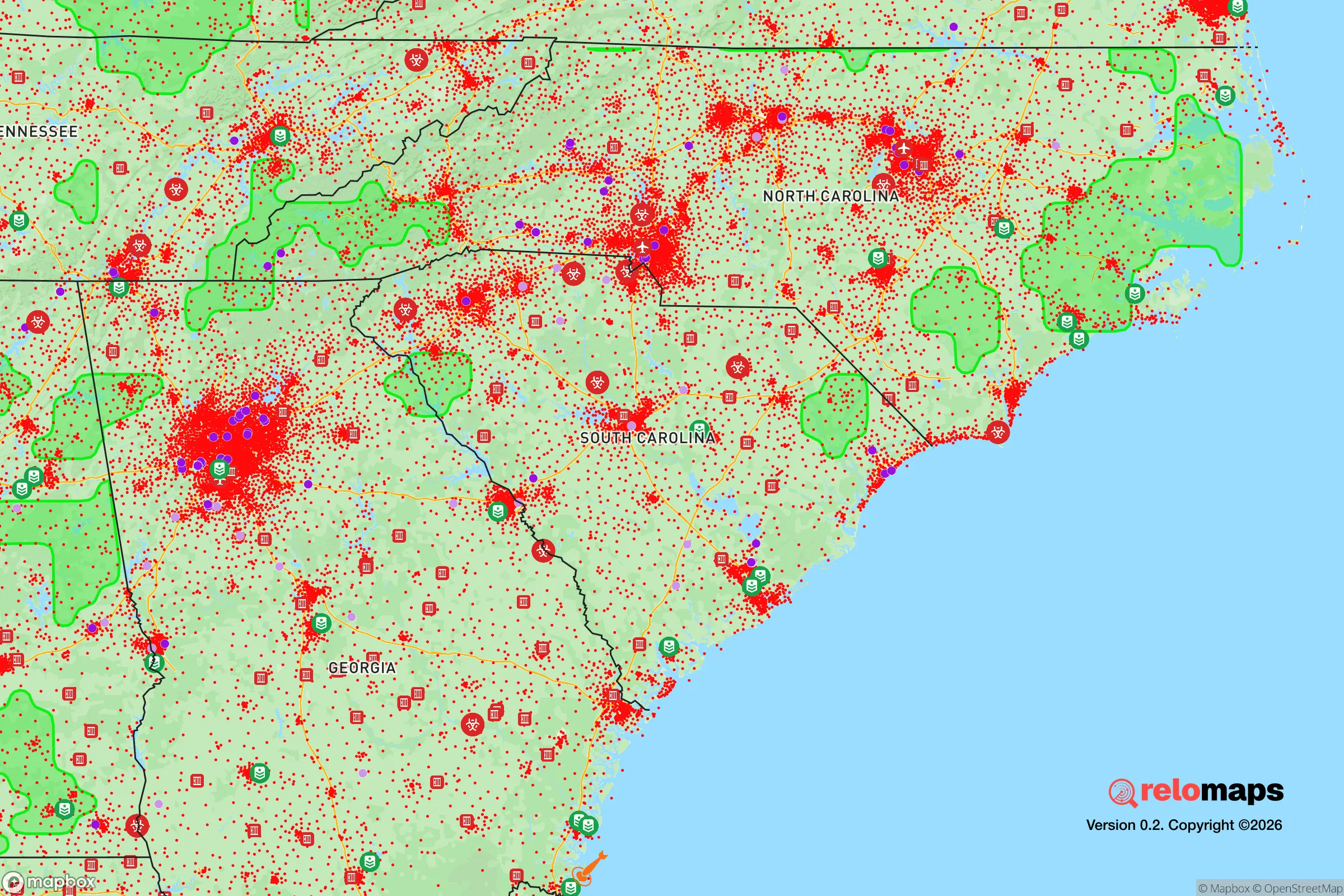
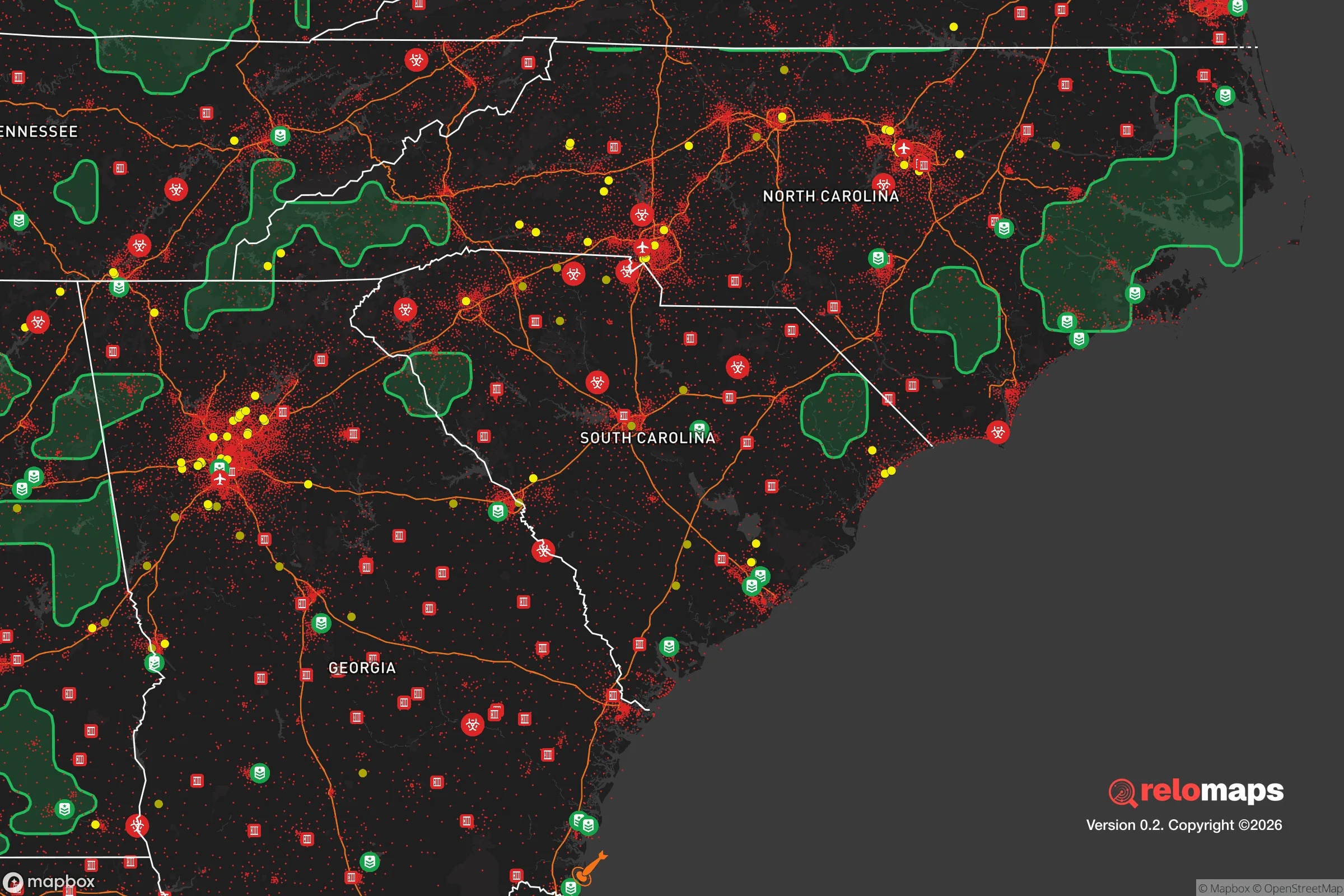


Important Note: For informational purposes only. This does not mean nothing bad ever happens in the green zones. Please use common sense. This is based on public data and modeled with AI. We tried to take a conservative approach but mistakes happen. We update this regularly as new information becomes available.
Solar Generator Recommendations
Backup power matters more here than in safer locations. We've picked three solar generators across budgets and capacity tiers — start with the budget unit if you only need a few essentials, or step up if you want to run a fridge and HVAC for days at a time.

Jackery Portable Power Station Explorer 300
Budget OptionPower on the Go: Weighing only 11 lbs, it's convenient to set up and store with book-sized foldable solar panels

BLUETTI Portable Power Station AC180
Designed for both indoor and outdoor scenarios, AC180 is highly capable as it has a robost capacity and continuous output power.

EF ECOFLOW DELTA Pro Ultra Power Station
Upgraded PickEcoFlow DELTA Pro Ultra is a whole-home energy system designed to grow with your family. Integrated with the Smart Home Panel 2, it scales to meet your evolving energy needs — keeping your home powered, intelligent, and secure through every stage of life.
We earn a commission, at no additional cost to you.
Strategic Assessment Analysis
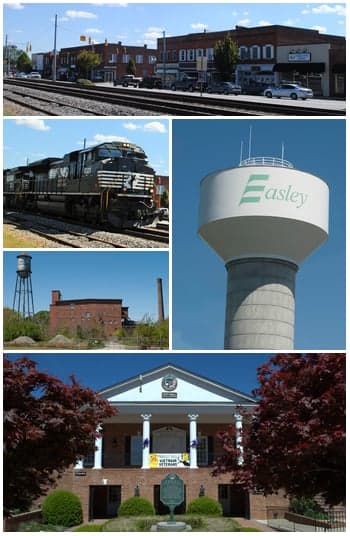
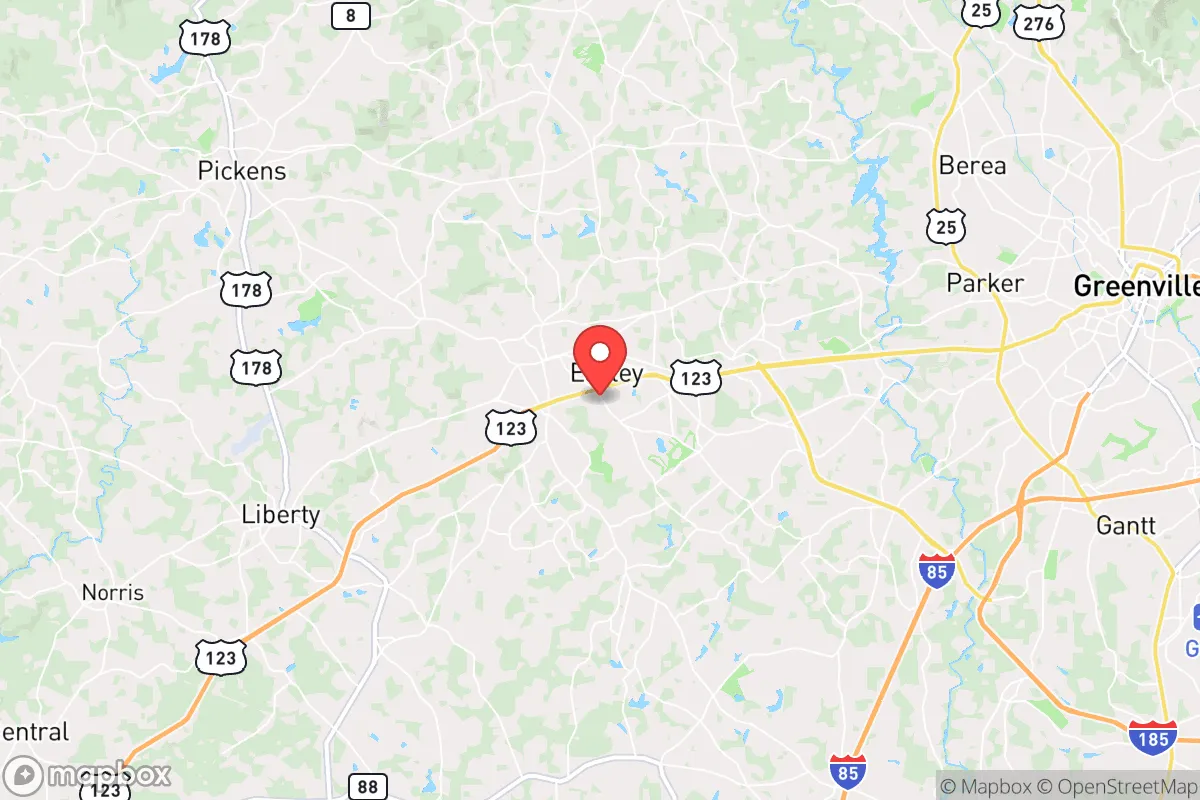
Easley, South Carolina, sits in a sweet spot that few relocators fully appreciate until they map the fallout zones and supply chains. Nestled in Pickens County at the foothills of the Blue Ridge Mountains, this town of roughly 22,000 offers a rare combination: proximity to the economic muscle of Greenville (about 15 miles east) without being close enough to absorb a direct hit from a major urban disaster. The area’s resilience stems from its geography—elevation buffers against floodplain risks, and the surrounding national forest land provides both a natural barrier and a resource cache. For a conservative-leaning individual or family thinking long-term about civic unrest, grid collapse, or mass casualty events, Easley checks boxes that suburban sprawl cannot.
Geographic position and natural advantages for long-term security
Easley’s location at the edge of the Southern Appalachian foothills gives it a defensive posture that flatland suburbs lack. The terrain rises gently from the Piedmont into the mountains, meaning retreat routes north into the Sumter National Forest and the Blue Ridge Escarpment are viable on foot or by vehicle if major highways like I-85 or I-385 become compromised. The area sits outside the 50-mile blast radius of any major nuclear target—Greenville’s downtown is a secondary economic hub, not a primary strategic target, and the nearest major military installation (Fort Jackson near Columbia) is over 100 miles south. That distance matters. In a scenario involving electromagnetic pulse (EMP) or coordinated infrastructure attacks, Easley is far enough from the likely primary targets (Atlanta, Charlotte, Washington D.C.) to avoid the worst of the initial chaos, yet close enough to those markets to have maintained pre-collapse supply lines. The local water table is robust—Lake Keowee and the Saluda River watershed are within a 20-minute drive, and the area’s annual rainfall averages 50 inches, meaning well-dependent properties are viable without deep drilling. The clay-heavy soil, while a nuisance for gardening, provides excellent natural filtration for septic systems and reduces the risk of groundwater contamination from surface events.
Risks, exposures, and proximity to fallout-relevant landmarks
No location is a fortress, and Easley has vulnerabilities that a strategic relocator must weigh. The most immediate concern is the Oconee Nuclear Station, located roughly 25 miles northwest near Seneca. While the plant has a solid safety record, any nuclear facility within 30 miles is a liability in a grid-down or sabotage scenario. Prevailing winds in the region blow from the west and southwest, meaning a release would push contamination toward Easley rather than away from it. That said, the mountainous terrain between the plant and Easley provides some shielding—the fallout would not travel in a straight line unimpeded. The second risk is transportation corridor dependency. Easley’s economy and food supply rely on I-85 and I-185, which feed into the Greenville-Spartanburg metro area. A major bridge failure or coordinated highway blockade could isolate the town within 48 hours. The local grocery stores—Walmart, Publix, and Food Lion—carry about three days of shelf stock for the immediate population. After that, the area’s agricultural base is thin; Pickens County is not a major farming region, so reliance on backyard gardens and hunting (deer and turkey are plentiful in the surrounding forests) becomes critical. Finally, the proximity to Clemson University (10 miles west) introduces a population density spike of 25,000 students who would likely evacuate toward Easley if Clemson became untenable, straining local resources. A savvy relocator should plan for a temporary influx of refugees from the college town, not from Greenville itself.
Practical resilience for a relocator: food, water, energy, and defensibility
For a family or individual serious about self-sufficiency, Easley offers a workable baseline that requires deliberate upgrades. Water is the strongest asset. The area’s numerous creeks and streams—including the Twelve Mile River and Brushy Creek—are perennial and generally clean, though testing for agricultural runoff (poultry farms are common in the region) is advisable before relying on them long-term. Rainwater catchment is straightforward given the precipitation patterns; a 1,000-square-foot roof yields roughly 600 gallons per inch of rain. On the energy side, Duke Energy’s grid is reliable but centralized. Solar potential is moderate—the region gets about 4.5 peak sun hours per day, enough for a 5kW array to cover a modest home’s baseload, but winter cloud cover can stretch for days. Battery backup is essential; grid-tied systems without storage are useless in a blackout. Propane is widely available from local suppliers like Blossman Gas, and many homes already have propane tanks for heating, which can be adapted for generator use. Defensibility is where Easley shines compared to flatter, more open areas. The rolling hills and tree cover provide natural concealment and chokepoints. Rural properties on the outskirts—toward Pumpkintown or Sunset—offer long sightlines and limited access roads, making them easier to secure. The local sheriff’s office is well-funded and has a reputation for pro-Second Amendment enforcement; Pickens County is a constitutional carry jurisdiction, and the culture is overwhelmingly supportive of private firearm ownership. For a relocator concerned about civil unrest, this means the community is likely to self-police rather than descend into chaos. The downside is that outsiders are noticed quickly; building trust with neighbors before a crisis is not optional—it’s survival logistics.
The overall strategic picture for Easley is cautiously optimistic for a prepper or conservative relocator. It avoids the fatal flaws of deep-rural isolation (no hospital, no supply lines) and urban proximity (target risk, congestion). The town has a functional hospital (Prisma Health Baptist Easley), a municipal water system that draws from the Keowee River, and a local government that has historically resisted overreach—Pickens County was one of the first in the state to declare itself a Second Amendment sanctuary. The biggest strategic gap is food production: the area imports nearly all of its calories. A relocator who arrives without a plan for gardening, livestock, or long-term food storage will be dependent on trucked-in supplies within a week of a disruption. That said, the climate supports three-season gardening, and the local extension office at Clemson offers soil testing and seed banks. For someone willing to put in the work—digging a well, installing solar, stocking ammunition, and building community relationships—Easley provides a defensible, resource-rich base that is close enough to civilization to matter but far enough to survive its collapse. It is not a bunker; it is a launch point for a sustainable post-disaster life, and that is exactly what a strategic relocation should aim for.

* Values derived from national, state, county, city and local statistics and may differ in a specific area. Last updated: 2026-04-22T02:40:25.000Z
Narrative content on this page is AI-generated and may contain mistakes. Verify any details that matter before acting on them.
ReloMaps may earn a commission from affiliate links at no extra cost to you.

