
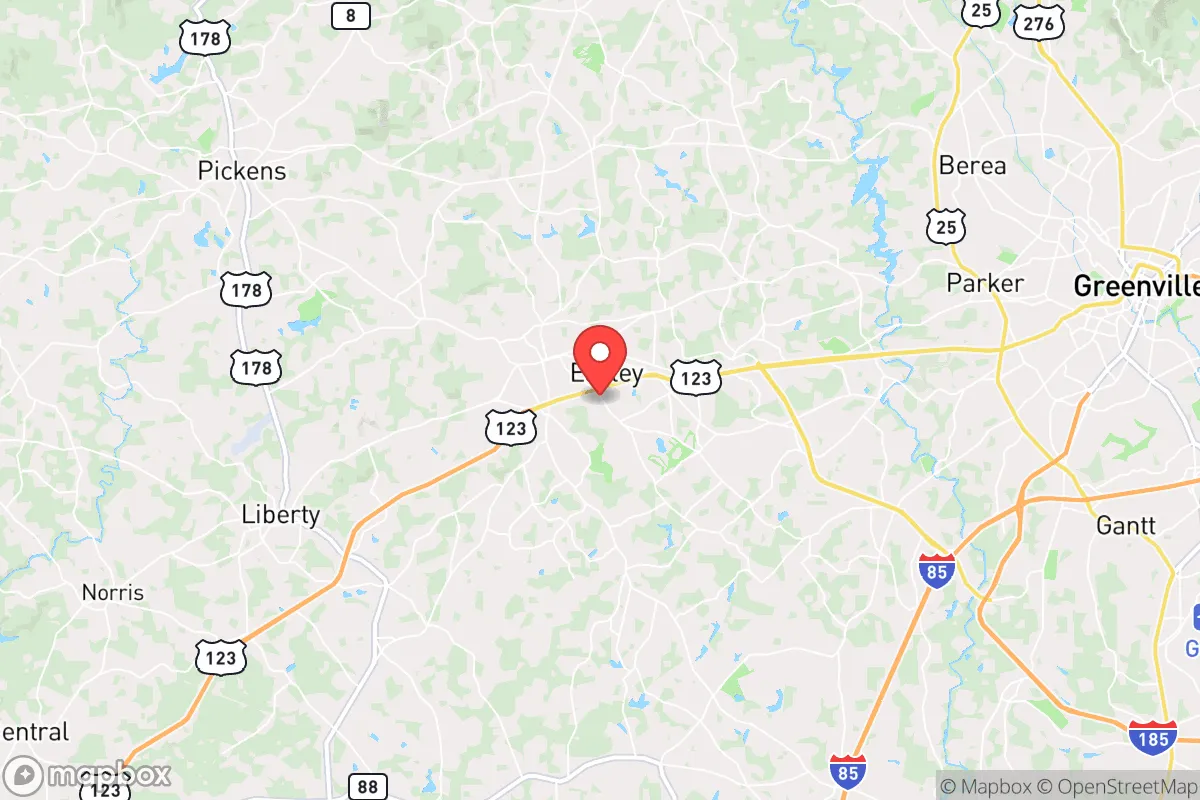
Photo: Wikipedia
Personal Sovereignty in Easley, SC
Viable for self-reliance. Generally workable, though some barriers may limit total independence.
What does Personal Sovereignty tell us?
Personal Sovereignty measures your capacity for self-reliance and independence with minimal government friction. Higher scores mean fewer barriers between you and the way you want to live... but it assumes you have the space you need and good neighbors.
What does this tell us?
Personal Sovereignty measures your capacity for self-reliance and independence with minimal government friction. Higher scores mean fewer barriers between you and the way you want to live... but it assumes you have the space you need and good neighbors.
State Policy
Energy independence: Importer (25% of energy produced in-state)
Personal Liberty
Homesteading

Personal Liberty Analysis
For the individual or family prioritizing personal sovereignty above all else, Easley, South Carolina, offers a strategic foothold in the Upstate that balances small-town autonomy with access to regional resources. The broader political and legal environment in South Carolina is decidedly favorable to those who wish to minimize government entanglement in daily life, and Easley sits within Pickens County—a jurisdiction that generally reflects this ethos. While no location is a libertarian utopia, the combination of state-level preemption laws, a tax structure that rewards property ownership and work, and a cultural baseline of self-reliance makes Easley a serious contender for those evaluating relocation through a survivalist or prepper lens. The key is understanding where the state’s protections end and where local ordinances or practical constraints begin.
Tax burden and regulatory posture: how South Carolina’s fiscal climate supports autonomy
South Carolina’s tax structure is one of the more favorable in the Southeast for those seeking to keep more of their own resources. The state’s income tax is a flat 3% as of 2026, following a phased reduction from a previous top marginal rate of 7%. This is a significant improvement for earners who previously faced higher brackets. Property taxes in Pickens County are assessed at a relatively low rate—roughly 0.5% to 0.6% of fair market value for owner-occupied homes, thanks to the state’s 4% assessment ratio for primary residences. This means a $300,000 home in Easley would carry an annual tax bill around $1,500 to $1,800, which is well below national averages. The state also offers a homestead exemption for those over 65 or permanently disabled, further reducing the burden. On the regulatory side, South Carolina is a right-to-work state with minimal business licensing requirements for small-scale operations, and there is no state-level property tax on business inventory. However, be aware that Pickens County does enforce standard building codes and septic system regulations, so off-grid construction requires proper permitting. The overall regulatory posture is light compared to states like California or New York, but it is not absent—expect reasonable oversight rather than a free-for-all.
Self-defense and gun law specifics: what the Second Sanctuary status means for Easley residents
South Carolina is a strong Second Amendment state, and Pickens County has formally declared itself a Second Amendment Sanctuary, meaning local officials have pledged not to enforce any future state or federal infringements on the right to keep and bear arms. For the resident of Easley, this translates into practical freedoms: no state permit is required to openly carry a handgun, and concealed carry is legal with a permit that requires a background check and a training course—though permitless concealed carry (constitutional carry) has been debated and is not yet law as of 2026. The state does not require registration of firearms, and there is no waiting period for purchases from private sellers. Stand-your-ground laws are fully in effect, with no duty to retreat in any place where the individual has a legal right to be. Castle doctrine protections extend to occupied vehicles and workplaces, not just homes. For the prepper, this means you can maintain a personal armory without bureaucratic hurdles, and you can defend your property and person without fear of prosecution for exercising that right. The only notable restriction is that carrying a firearm into a church or place of worship requires explicit permission from the church leadership, so plan accordingly. Overall, Easley offers one of the more permissive legal environments for self-defense in the eastern United States.
Self-reliance and homesteading viability: lot sizes, zoning, and off-grid feasibility in Easley
For those looking to reduce dependence on centralized systems, Easley’s zoning and land availability present a mixed but workable picture. Within the city limits, residential lots are typically smaller—quarter-acre to half-acre—and subject to standard municipal codes regarding setbacks, outbuildings, and livestock. However, the unincorporated areas of Pickens County, particularly to the north and west of Easley toward Lake Keowee and the Blue Ridge foothills, offer parcels ranging from one to twenty acres with far fewer restrictions. In these rural zones, keeping chickens, goats, or even a small herd of cattle is generally permissible without a special permit, provided the property meets minimum acreage requirements (usually two acres for livestock). Gardening, rainwater collection, and composting are unrestricted. Off-grid living is legally feasible, but with caveats: South Carolina law requires a septic system permit from the county health department for any dwelling, and the state’s building code applies to new construction. Solar panels, wind turbines, and battery storage are all allowed, and net metering is available through Duke Energy, the primary utility. That said, going fully off-grid—disconnecting from the power grid entirely—is technically allowed but may complicate financing and insurance. For the serious prepper, the best strategy is to purchase land in the unincorporated county, build a pole barn or workshop first, and then construct a residence that meets code while incorporating redundant systems. The soil in the area is generally suitable for gardening, and the growing season runs from April to October, allowing for substantial food production.
Personal liberties: parental rights, medical autonomy, speech, and property protections
South Carolina has been proactive in codifying certain personal liberties that resonate with a conservative, sovereignty-minded audience. Parental rights in education are explicitly protected under state law, with a Parents’ Bill of Rights that affirms the right to direct a child’s upbringing, education, and healthcare. This means Easley parents can opt their children out of specific curriculum content, access all educational records, and make medical decisions without state override, except in cases of imminent danger. Medical autonomy is less clear-cut: while the state does not mandate COVID-19 vaccines for adults or children, and has banned vaccine passports for government services, there is no broad medical freedom law protecting the right to refuse treatment or use alternative therapies. The state’s tort laws are generally favorable to property owners, with a three-year statute of limitations for most claims and a cap on noneconomic damages in medical malpractice cases. Free speech is robustly protected under the state constitution, and there are no hate speech laws that criminalize political or religious expression. Property rights are strong: South Carolina is a “Dillon’s Rule” state, meaning local governments only have powers explicitly granted by the state, which limits municipal overreach into land use and zoning. Eminent domain is restricted to public uses like roads and utilities, and the state has laws requiring just compensation well above market value. For the individual who values the right to speak, worship, and build without government interference, Easley’s legal framework provides a solid foundation.
In the broader context of the Southeast, Easley and Pickens County rank favorably for personal sovereignty when compared to more restrictive areas like Atlanta’s suburbs or Charlotte’s Mecklenburg County. The tax burden is lower, gun laws are more permissive, and the cultural expectation of self-reliance is higher. However, it is not a haven of absolute freedom—state building codes, septic regulations, and utility monopolies still impose constraints. For the strategic relocator who wants a balance of legal protections, affordable land, and a community that largely minds its own business, Easley represents a solid, defensible choice in an increasingly uncertain national landscape.

* Values derived from national, state, county, city and local statistics and may differ in a specific area. Last updated: 2026-04-22T02:40:25.000Z
Narrative content on this page is AI-generated and may contain mistakes. Verify any details that matter before acting on them.
ReloMaps may earn a commission from affiliate links at no extra cost to you.

