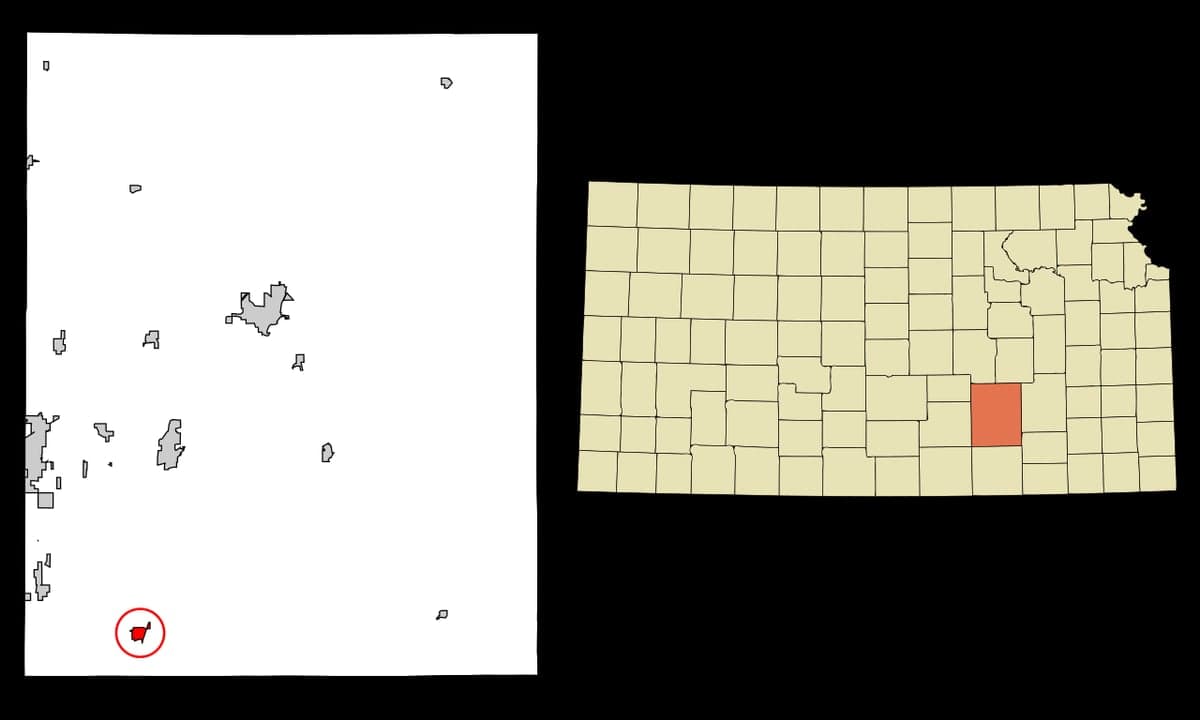
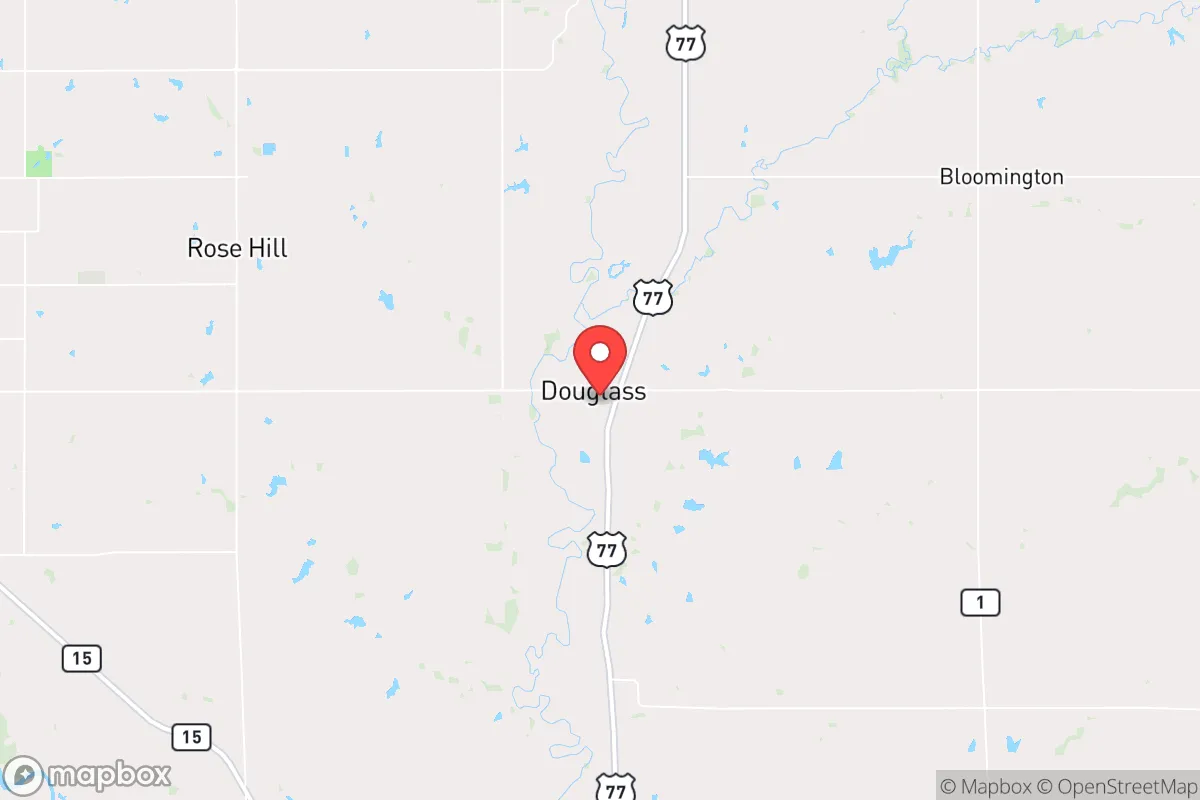
Photo: Wikipedia
Political ClimatePolitical Climate in Douglass, KS
District shown is the primary district for this city’s centroid. Cities may span multiple districts.
Local Political AnalysisPolitical Analysis of Douglass, KS
Douglass, Kansas, leans solidly Republican, with a Cook Partisan Voting Index (PVI) of R+12, making it noticeably more conservative than the state of Kansas as a whole, which sits at R+9. This isn't a recent shift; the area has long been a stronghold for conservative values, and the margin has held steady through the last few election cycles. If you're coming from a more moderate part of the state, like Johnson County or the Kansas City suburbs, you'll feel the difference right away in local conversations and campaign signs.
How it compares
That three-point gap in the PVI is more significant than it sounds. While Kansas as a whole has trended slightly more competitive in recent years—especially in races for governor and the state legislature—Douglass and the surrounding rural areas of Butler County have stayed deeply red. Nearby towns like Augusta and El Dorado lean conservative too, but Douglass tends to be a bit more consistent in its voting patterns. In contrast, the city of Wichita, about 30 minutes west, is a blue dot in a red sea, with a much more mixed political makeup. So if you're used to the political diversity of Wichita or the Kansas City metro, Douglass will feel like a different world politically.
What this means for residents
For conservative residents, the political climate in Douglass means their views are the norm in local government, school board decisions, and community events. You'll find that local policies tend to align with small-government principles, and there's little pushback on issues like gun rights or tax limitations. For liberal or moderate residents, it can feel isolating. You might not find many like-minded neighbors, and local political discussions can be one-sided. That said, the community is generally polite and neighborly; political disagreements rarely turn into personal conflicts, but they do shape the tone of local governance and public meetings.
One cultural distinction worth noting is the strong influence of local churches and agricultural organizations in Douglass. These groups often set the social and political agenda, from school board decisions to community events. The area's political lean also means that state-level policies from Topeka—like abortion restrictions or school funding formulas—tend to be well-received here, even when they're controversial elsewhere in Kansas. For anyone moving to Douglass, understanding that the local political culture is deeply rooted in tradition and community ties will help you navigate both the social and civic landscape.

State Political ClimatePolitical Climate in Kansas
State Political AnalysisPolitical Environment in the State
Kansas is a solidly Republican state with a Cook PVI of R+9, meaning it typically votes about nine points more conservative than the national average in presidential elections. Over the past 20 years, the state has shifted rightward in statewide races, but the path has been anything but smooth — a bitter internal war between mainstream conservatives and a hardline populist wing has defined Kansas politics since the early 2010s. The result is a state that reliably sends Republicans to Washington while its own capitol in Topeka cycles through dramatic tax experiments, school funding battles, and cultural flashpoints that make it a fascinating, if occasionally exhausting, place to live.
Urban vs. rural divide
The political map of Kansas is a textbook study in the urban-rural split. The two major population centers — Johnson County (suburban Kansas City) and Sedgwick County (Wichita) — are where statewide elections are won or lost. Johnson County, home to Overland Park, Olathe, and Lenexa, has been trending purple for a decade; it voted for Hillary Clinton in 2016 and Joe Biden in 2020, and its state legislative seats have slowly flipped to Democrats. Wichita remains more conservative but is not as reliably red as it once was, with its urban core electing Democrats to the statehouse. Meanwhile, the rest of the state — the vast agricultural expanse from Dodge City in the southwest to Manhattan in the Flint Hills — votes overwhelmingly Republican. Douglas County, home to Lawrence and the University of Kansas, is the state's deep-blue anchor, routinely delivering 70%+ margins for Democrats. The practical effect: a Republican governor can win by running up margins in rural counties while keeping Johnson County close, while a Democrat needs to blow the doors off in Johnson and Douglas while limiting losses everywhere else.
Policy environment
Kansas's policy environment reflects its conservative lean but also its internal divisions. The state has no income tax on Social Security benefits and a flat state income tax rate of 5.7% after the 2024 tax reform package, down from a progressive structure a decade ago. Sales tax is relatively high at 6.5% state rate, with local add-ons pushing it over 10% in some cities. The state is a "right-to-work" state and has some of the weakest labor union protections in the country. On education, Kansas has a long history of school funding litigation — the Kansas Supreme Court has repeatedly ordered the legislature to increase funding for K-12 schools, leading to a tense relationship between the judicial and legislative branches. Healthcare policy is mixed: the state did not expand Medicaid under the Affordable Care Act, leaving roughly 150,000 low-income adults in a coverage gap, though bipartisan expansion efforts have gained traction in recent sessions. Election laws are moderately restrictive — voters must show photo ID at the polls, and the state has a two-week early voting period. Kansas also has a voter registration deadline 21 days before an election, which is earlier than many states.
Recent policy direction
The last five years have seen Kansas lurch rightward on cultural and liberty issues, even as fiscal policy has stabilized after the disastrous "Brownback tax experiment" of 2012-2017. In 2022, the legislature passed a near-total abortion ban via a constitutional amendment, but Kansas voters shocked the political world by rejecting it in a statewide referendum — the first such vote after Dobbs. Abortion remains legal in Kansas up to 22 weeks, making the state a regional destination for women from Missouri, Oklahoma, and Texas. On gun rights, Kansas is a constitutional carry state (permitless carry since 2015) and has a "stand your ground" law. The 2023 session saw passage of a Parents' Bill of Rights, which requires school districts to notify parents of curriculum changes and allows them to opt children out of certain instruction. On transgender issues, the 2023 legislature overrode Governor Laura Kelly's veto to ban transgender athletes from girls' sports and restrict gender-affirming care for minors. Property rights remain strong — Kansas has no statewide zoning preemption, but local control is generally respected. The state also passed a law in 2023 prohibiting the enforcement of federal gun laws that violate the Second Amendment, a symbolic but notable assertion of state sovereignty. Voting access has tightened slightly: the 2021 election integrity law added signature verification requirements for mail ballots and limited drop box locations, though it stopped short of the restrictions seen in Georgia or Texas.
Civil unrest & political movements
Kansas has not seen the large-scale protests of coastal states, but political activism is real and organized. The most visible flashpoint in recent years was the 2022 abortion referendum, which drew massive grassroots organizing from both sides — Planned Parenthood and Kansans for Constitutional Freedom built a formidable door-knocking operation, while anti-abortion groups like Kansans for Life mobilized church networks. The result was a 59-41 defeat of the amendment, a result that stunned national observers and showed that Kansas's conservative label masks a more libertarian streak on personal autonomy. On the right, the Kansas Republican Party has been riven by infighting between the "Mainstream" and "MAGA" factions, with the latter gaining control of the state party apparatus in 2020. This has led to primary challenges against incumbent Republicans deemed insufficiently conservative, particularly in rural districts. Immigration politics are less heated than in border states, but Garden City and Dodge City have seen tensions over meatpacking plant workforces that are heavily immigrant. There have been no sanctuary city policies; in fact, a 2024 law requires local law enforcement to cooperate with federal immigration authorities. Election integrity controversies have been muted compared to states like Arizona or Georgia — the 2020 election in Kansas was administered smoothly, though a 2022 audit of Johnson County's election systems found no evidence of fraud.
Projection
Over the next 5-10 years, Kansas is likely to remain a Republican-leaning state, but the margin will narrow. The key driver is Johnson County's continued suburbanization and demographic shift — it's growing faster than the rest of the state, and its voters are becoming more moderate and more Democratic. If Johnson County continues its leftward drift, Kansas could become a true swing state by the early 2030s, similar to what happened in Colorado or Virginia. However, rural depopulation is accelerating, which could amplify the rural conservative vote share even as raw numbers decline. The state's in-migration is modest but growing, with people moving from California and Colorado to the Kansas City suburbs for lower housing costs. The internal Republican civil war will likely continue, with the hardline faction pushing for further tax cuts and cultural legislation, while the business-friendly wing tries to stabilize the budget and attract employers. Medicaid expansion is probably coming within five years, as rural hospitals continue to close and bipartisan support grows. A new resident moving in now should expect a state that is culturally conservative in its rural areas, increasingly moderate in its suburbs, and politically volatile at the state level — but with a strong tradition of pragmatism that has so far prevented the most extreme outcomes seen in other red states.
For a new resident, the bottom line is this: Kansas offers a low-cost, low-regulation environment with genuine personal freedom on guns and property, but you'll need to navigate a state government that is deeply divided between its conservative base and its moderate suburbs. If you're conservative, you'll find a welcoming policy environment and a like-minded community in most of the state. If you're liberal, you'll find safe havens in Lawrence, parts of Kansas City, and increasingly in Johnson County — but you'll also face a legislature that is consistently to the right of the governor. The state's political drama is real, but it rarely disrupts daily life in the way it does in more polarized states. Most Kansans just want to be left alone, and the state's politics, for all its noise, largely delivers that.
* Values derived from national, state, county, city and local statistics and may differ in a specific area. Last updated: 2026-07-26T15:58:54.000Z
Narrative content on this page is AI-generated and may contain mistakes. Verify any details that matter before acting on them.
ReloMaps may earn a commission from affiliate links at no extra cost to you.

