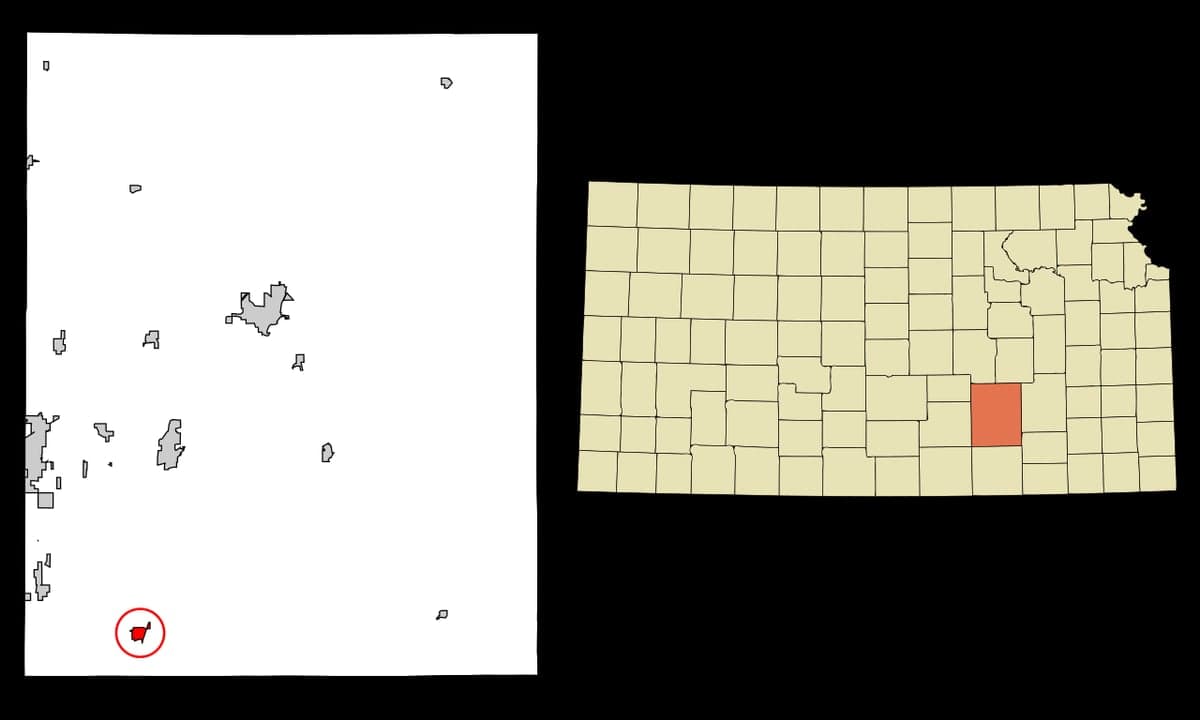
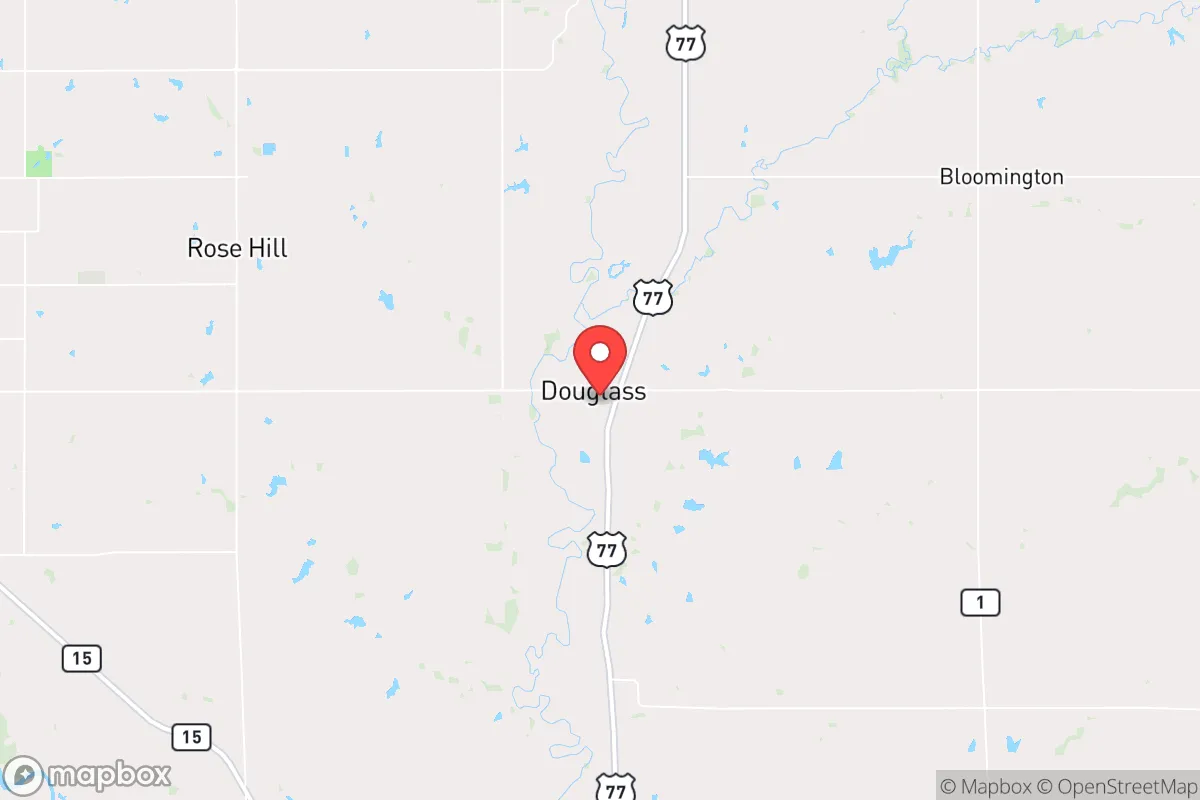
Photo: Wikipedia
Demographics of Douglass, KS
Affluence Level in Douglass, KS
A middle-class area roughly in line with national averages across income, home values, education, and employment.
People of Douglass, KS
The people of Douglass, Kansas, today form a small, tight-knit community of roughly 1,523 residents, characterized by a strong sense of local identity and a predominantly white, non-diverse demographic profile. With 89.0% of the population identifying as white and a foreign-born share of just 0.3%, the city remains one of the most ethnically homogeneous in Butler County. The population is notably less college-educated than state averages (24.3% holding a bachelor’s degree or higher), and the community’s character is rooted in its agricultural and small-town heritage, with a quiet, family-oriented atmosphere that appeals to those seeking a slower pace of life within commuting distance of Wichita.
How the city was settled and grew
Douglass was founded in 1869 as a stop on the fledgling Atchison, Topeka and Santa Fe Railway, which drew the first wave of settlers—primarily Anglo-American farmers and merchants from the Midwest and Upper South. The town was originally platted around the railroad depot, and the earliest neighborhoods, such as Old Town Douglass (the original grid along Main Street) and the Depot District (the area immediately surrounding the train station), were built by these pioneer families. The Homestead Act of 1862 and the railroad’s land grants were the primary draws, offering cheap, fertile prairie land for wheat and cattle operations. A second wave arrived in the 1880s and 1890s, when a small number of German and Czech immigrant families settled on the outskirts, particularly in the North Side Farming Community (the area north of the railroad tracks, now largely absorbed into the city limits). These groups established the town’s early grain elevators and blacksmith shops. By 1900, Douglass had stabilized as a rural service center, with a population hovering around 400, and remained overwhelmingly white and native-born through the mid-20th century.
Modern era (post-1965)
After the 1965 Hart-Cellar Act, Douglass saw virtually no immigration-driven diversification. The foreign-born share has never risen above 1%, and the city’s demographic story since the 1970s is one of slow, steady domestic in-migration from other parts of Kansas and the rural Midwest. The most significant shift was the suburbanization of the 1990s and 2000s, when Wichita’s expanding metro area pushed some families southward along US-81. These newcomers—mostly white, middle-class families seeking larger lots and lower taxes—settled in newer subdivisions like Prairie View Estates (a late-1990s development on the city’s west side) and Sunset Ridge (a 2000s-era neighborhood south of the old downtown). The historic Depot District and Old Town remain home to longer-resident families, many of whom trace their roots back to the original settlers. The city’s Hispanic population (0.9%) and Black population (0.5%) are tiny and dispersed, with no identifiable ethnic enclave. The East/Southeast Asian share (0.9%) is similarly negligible, likely representing a handful of professionals or business owners. The Indian-subcontinent population is 0.0%. In short, Douglass’s modern era has reinforced its homogeneity rather than diversifying it.
The future
The population of Douglass is projected to remain stable or grow very slowly, with no major demographic shifts on the horizon. The city’s low housing costs and proximity to Wichita (about 30 miles north) will likely continue to attract a modest number of white, family-oriented in-migrants, particularly to the Prairie View Estates and Sunset Ridge areas, where new single-family construction is most active. However, the aging of the existing population—many of the original farming families are now in their 60s and 70s—could lead to a slight decline in the next decade if younger adults continue to leave for larger cities. The foreign-born share is unlikely to rise significantly, as the local economy (dominated by agriculture, small retail, and light manufacturing) offers few jobs that attract international migrants. The city’s cultural identity will likely remain rooted in its rural, conservative, and family-centric character, with little pressure to change. For a newcomer, this means moving into a place where neighbors know each other, community events (like the annual Douglass Fall Festival) are central, and the population is stable and predictable.
Douglass is becoming a quiet, slow-growing bedroom community for Wichita, with a population that is overwhelmingly white, native-born, and family-oriented. For someone moving in now, the city offers a low-cost, low-crime, and culturally homogeneous environment where the biggest changes are likely to be new subdivisions on the west side, not new faces from abroad. It is a place for those who value stability and tradition over diversity and urban energy.

* Values derived from national, state, county, city and local statistics and may differ in a specific area. Last updated: 2026-07-26T15:58:54.000Z
Narrative content on this page is AI-generated and may contain mistakes. Verify any details that matter before acting on them.
ReloMaps may earn a commission from affiliate links at no extra cost to you.

