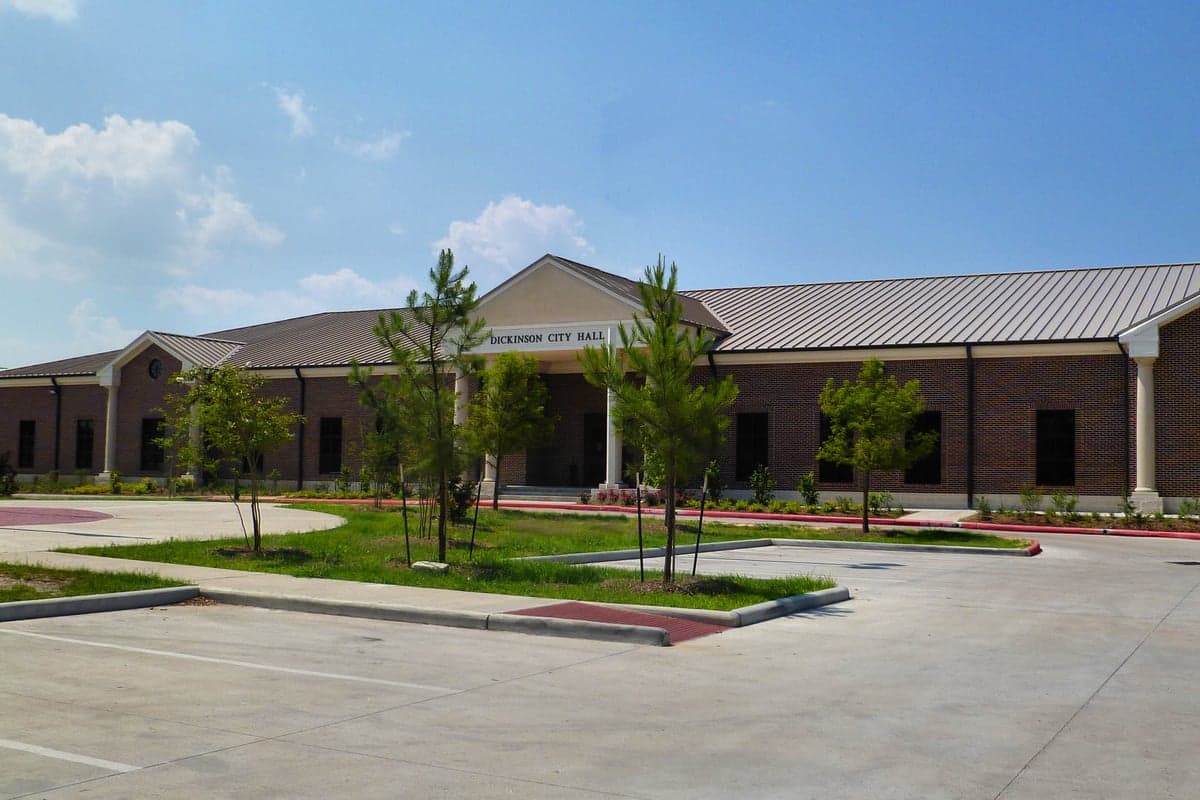
Photo: Wikipedia
Political ClimatePolitical Climate in Dickinson, TX
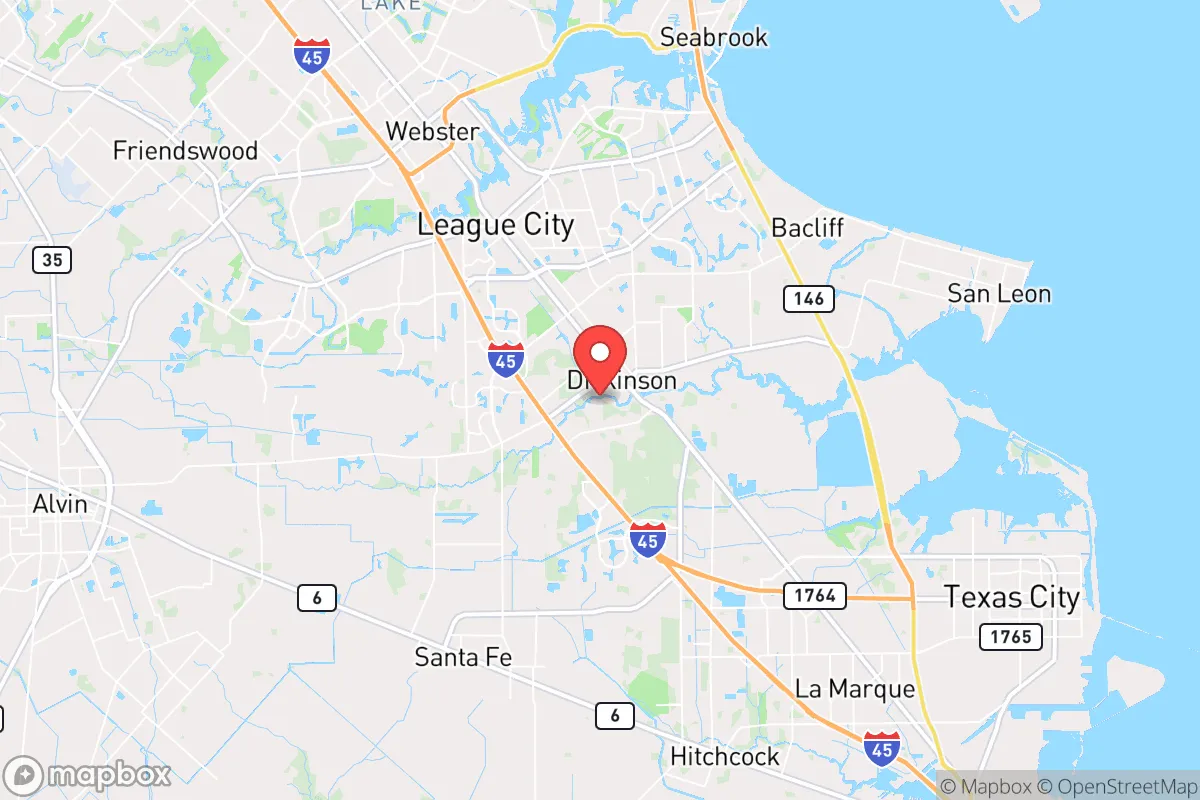
District shown is the primary district for this city’s centroid. Cities may span multiple districts.
Local Political AnalysisPolitical Analysis of Dickinson, TX
Dickinson, Texas, is a reliably conservative community, and that’s been the case for as long as most folks around here can remember. The Cook Partisan Voting Index (PVI) for the area sits at R+17, meaning it votes about 17 points more Republican than the national average. That’s a solid red lean, and it’s not just a fluke of one election—it’s a consistent pattern. You can see it in local races, state contests, and presidential elections alike. The political trajectory here is stable, not swinging; if anything, the area has gotten a bit more Republican over the last decade as growth from the Houston metro has brought in families looking for more space and lower taxes, which tends to reinforce the existing conservative tilt.
How it compares
Comparing Dickinson to the rest of Texas is interesting because the state itself is a red-leaning place, but it’s not as uniformly conservative as this pocket of Galveston County. Texas as a whole has a Cook PVI that’s unknown in the data you provided, but historically it’s been around R+5 to R+8 in recent cycles—still Republican, but with a much narrower margin. That means Dickinson is significantly more conservative than the state average. For context, drive 15 minutes north to League City or 20 minutes west to Friendswood, and you’ll find similar Republican strongholds, though maybe not quite as deep red. But head south toward Galveston Island itself, and the politics shift noticeably—Galveston is more of a purple-to-blue town, especially in the historic districts and near the university. So Dickinson sits in a kind of conservative bubble within a county that has a few liberal pockets. The surrounding rural areas of Santa Fe and Hitchcock lean red too, but not with the same intensity as Dickinson.
What this means for residents
For conservative residents, the political climate in Dickinson is comfortable and affirming. Local government, school board decisions, and even zoning policies tend to reflect a small-government, pro-business outlook. You’ll see a lot of “Keep Dickinson Safe” signs and strong support for law enforcement. Taxes are relatively low compared to Harris County, and there’s little appetite for new social programs or progressive initiatives. For liberal residents, it can feel isolating. There’s no real organized progressive presence, and social issues like LGBTQ+ rights or environmental regulation are often met with skepticism. That said, most people here are neighborly and won’t make a fuss about politics in daily life—it’s more of a quiet consensus than an aggressive culture war. The practical effect is that if you lean left, you’ll likely keep your opinions to yourself at the local coffee shop or PTA meeting, but you won’t face outright hostility. The area’s growth is bringing in some diversity of thought, but change is slow.
One cultural distinction worth noting: Dickinson is part of the “Bay Area” of Texas, with a strong focus on outdoor recreation, fishing, and family life. That shared lifestyle tends to smooth over political differences. The local economy is driven by petrochemical plants, healthcare, and small businesses, which reinforces a practical, get-the-job-done mentality. Policy-wise, you’ll see strong support for Second Amendment rights and limited regulation on housing and development. The school district is conservative-leaning but not extreme—there’s no book-banning drama like you might see in some other Texas towns. Looking ahead, as more people move from Houston for cheaper housing, the political character might soften slightly, but for the foreseeable future, Dickinson will remain a reliably red spot in a red state, just a little redder than the rest.

State Political ClimatePolitical Climate in Texas
State Political AnalysisPolitical Environment in the State
Texas has been a reliably Republican state for the past three decades, but the margin has been tightening. In 2024, Donald Trump won the state by roughly 9 points, down from the 10-point margin in 2020 and the 16-point margin in 2012. The dominant coalition remains a mix of rural and suburban conservatives, evangelical Christians, and business interests, but a rapidly growing urban and suburban population—particularly in the "Texas Triangle" of Dallas-Fort Worth, Houston, San Antonio, and Austin—is steadily shifting the state’s complexion. The long-term trajectory points toward a competitive two-party state within the next decade, though Republicans still hold every statewide office and control both legislative chambers.
Urban vs. rural divide
The political map of Texas is a stark study in contrasts. The state’s major metros—Houston, Dallas, San Antonio, and Austin—are the engines of Democratic growth. Harris County (Houston) and Dallas County have both flipped from red to blue over the past two cycles, with Harris County going for Biden by 13 points in 2020 and for Harris by 11 in 2024. Austin’s Travis County is the bluest large county in the state, routinely voting 70%+ Democratic. Meanwhile, the vast rural and exurban areas—places like Lubbock, Midland, and the Rio Grande Valley’s interior—vote overwhelmingly Republican. The most notable recent shift has been in the suburbs: Collin County (north of Dallas) and Fort Bend County (southwest of Houston) have moved from solid red to purple, with Collin County voting for Trump by only 4 points in 2024 after a 15-point margin in 2016. The Rio Grande Valley, once a Democratic stronghold, has swung hard toward the GOP, with counties like Starr and Hidalgo flipping to Trump in 2024.
Policy environment
Texas operates under a low-tax, low-regulation model that has defined its economic appeal for decades. There is no state income tax, and property taxes are high—averaging about 1.6% of home value—but the state caps appraisal increases at 10% annually. The regulatory posture is business-friendly, with minimal zoning in many cities and a right-to-work law that limits union power. Education policy is a flashpoint: the state funds public schools through a Robin Hood system that redistributes property tax revenue from wealthy districts to poorer ones, and the school voucher debate is ongoing. In 2023, the legislature passed a school choice bill that created education savings accounts for special-needs students, but a broader universal voucher program failed. Healthcare policy is notably hands-off: Texas did not expand Medicaid under the ACA, leaving roughly 1.5 million uninsured residents, and abortion is effectively banned after six weeks under the 2021 Heartbeat Act and a 2023 trigger law. Election laws were tightened in 2021 with SB 1, which added ID requirements for mail-in ballots, limited drive-through voting, and banned 24-hour polling places.
Recent policy direction
The last three legislative sessions have pushed Texas decisively to the right on a broad set of issues. On gun rights, the state became a permitless carry state in 2021, allowing anyone 21 or older who can legally possess a firearm to carry it without a license. Parental rights in education were strengthened with the 2023 "Parental Bill of Rights" (HB 900), which requires schools to post curriculum materials online and allows parents to opt their children out of certain instruction. On speech and privacy, the state passed a law in 2023 (HB 20) that prohibits social media platforms from moderating content based on viewpoint, though it is tied up in court. Medical and bodily autonomy saw the most dramatic shift: the 2021 Heartbeat Act (SB 8) banned abortion after detection of a fetal heartbeat, and the 2023 trigger law (HB 1280) made abortion a felony from conception with narrow exceptions. Property rights were bolstered by a 2023 law limiting eminent domain for private projects. On voting, SB 1 (2021) remains the biggest change, but a 2023 bill (SB 2) further restricted third-party ballot collection. The overall direction is toward more individual liberty on guns and parental rights, less on reproductive choice, and a continued hands-off approach to taxes and regulation.
Civil unrest & political movements
Texas has seen its share of political flashpoints in recent years. The 2020 protests following George Floyd’s murder in Minneapolis were particularly intense in Austin, where the city council cut the police budget by $150 million, only to restore most of it after a backlash. The 2021 winter storm and the state’s grid failure (ERCOT) sparked widespread anger and a short-lived movement for secession among some conservatives, though it never gained traction. Immigration politics are a constant: Governor Greg Abbott’s Operation Lone Star, launched in 2021, deployed state troopers and National Guard to the border, bused migrants to Democratic-led cities like New York and Chicago, and installed razor wire along the Rio Grande. This has led to legal battles with the Biden administration and a visible militarization of the border that residents in El Paso and the Valley see daily. On the left, the Texas Democratic Party has struggled to build a unified statewide machine, though grassroots groups like the Texas Organizing Project and MOVE Texas have been active in voter registration. Election integrity remains a hot-button issue: after 2020, some rural counties saw calls for hand-counting ballots, and the 2022 primary in Hidalgo County was marred by allegations of fraud that led to a state investigation. The most visible political movement is probably the "Texit" rhetoric from the Texas Nationalist Movement, but it remains a fringe idea with no serious legislative path.
Projection
Over the next 5-10 years, Texas is likely to become a true battleground state. The demographic drivers are clear: the state is growing by about 1,000 people per day, with most new arrivals coming from California and other blue states. These newcomers tend to be younger, more diverse, and more moderate-to-liberal, particularly in the suburbs of Dallas, Houston, and San Antonio. The Hispanic population, which makes up 40% of the state, is not monolithic—it has been trending rightward, especially in the Valley, but still leans Democratic overall. The Republican Party will likely hold the state through the 2028 presidential cycle due to gerrymandered legislative districts and the rural tilt of the Electoral College, but by 2032, Texas could be genuinely competitive. What this means for a new resident: expect continued culture-war battles in the legislature (school vouchers, abortion, immigration enforcement), but also a growing push for pragmatic governance on issues like grid reliability and water infrastructure. The state’s political identity will remain conservative, but the flavor will shift from "hard red" to "purple-leaning-red" as the suburbs continue to diversify.
For someone moving to Texas now, the bottom line is this: you’ll find a state that is still broadly conservative on taxes, guns, and regulation, but where the political winds are shifting. If you’re a conservative, you’ll feel at home in most of the state, especially outside the major cities. If you’re a liberal, you’ll find your community in the urban cores and inner suburbs, but you’ll need to accept that state policy will often run counter to your preferences. The practical takeaway is that Texas is not a monolith—your experience will vary dramatically depending on whether you settle in Austin, Lubbock, or the Rio Grande Valley. The state’s trajectory is toward more competition, more conflict, and more complexity, but that also means more choice for residents who want to find their niche.
* Values derived from national, state, county, city and local statistics and may differ in a specific area. Last updated: 2026-10-01T16:01:46.000Z
Narrative content on this page is AI-generated and may contain mistakes. Verify any details that matter before acting on them.
ReloMaps may earn a commission from affiliate links at no extra cost to you.

