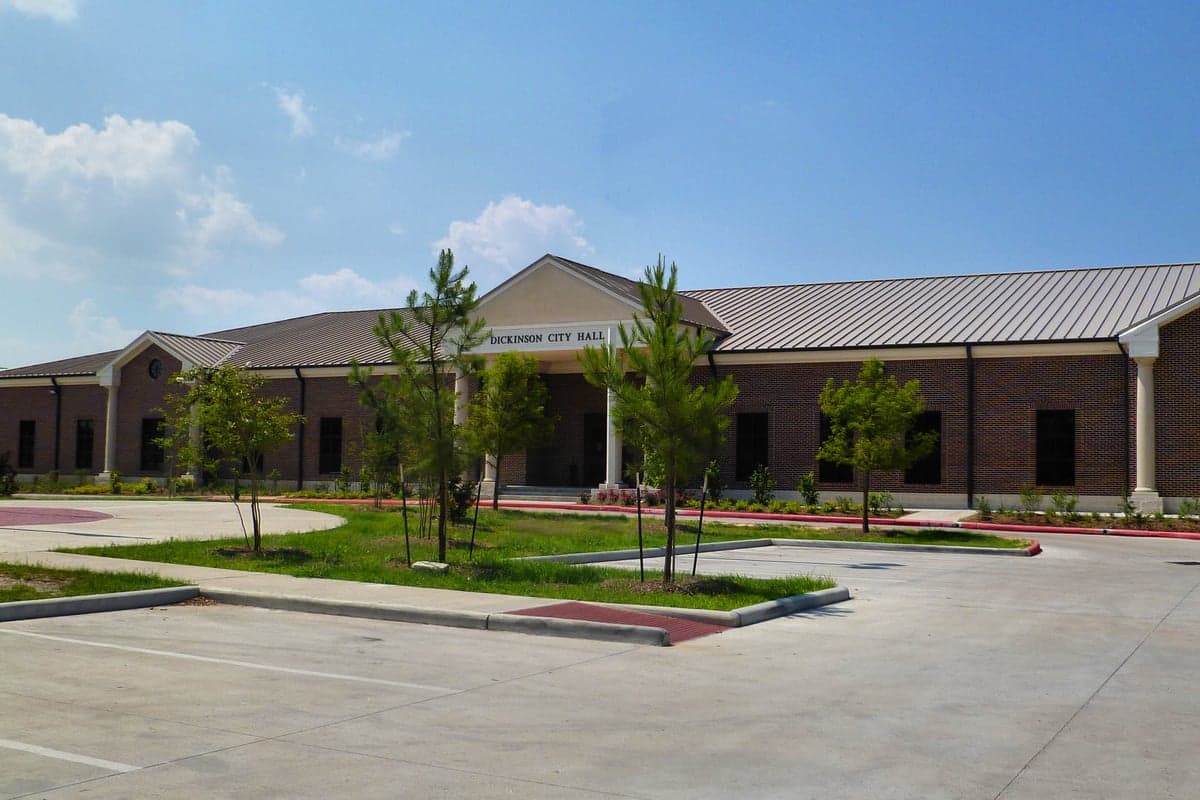
Photo: Wikipedia
Demographics of Dickinson, TX
Affluence Level in Dickinson, TX
A below-average socioeconomic profile. Incomes, home values, and educational attainment trail the U.S., with higher poverty and unemployment.
People of Dickinson, TX
The people of Dickinson, Texas today form a predominantly working- and middle-class community of 21,612 residents, characterized by a near-even split between non-Hispanic white (44.5%) and Hispanic (41.9%) populations, with a significant Black minority (9.0%) and a small East/Southeast Asian presence (0.8%). The city’s identity is rooted in its role as a self-contained suburb of Galveston and Houston, with a noticeably lower college attainment rate (24.1%) than the national average, reflecting a blue-collar and service-oriented workforce. Dickinson’s population is notably less diverse than the broader Houston metro area in terms of Asian and Indian subcontinent representation, but its Hispanic and Black shares are substantial, giving the city a distinct Gulf Coast character that blends Southern, Tejano, and coastal influences.
How the city was settled and grew
Dickinson’s human history begins in the 1820s, when the area was part of Stephen F. Austin’s original land grant colony. The first permanent Anglo settlers arrived in the 1830s, drawn by fertile coastal prairie land suitable for cotton and sugar plantations. The community was named after John Dickinson, a Texas Revolution veteran who received a land grant here. The arrival of the Galveston, Houston and Henderson Railroad in the 1870s transformed Dickinson from a rural crossroads into a shipping point for cotton, timber, and seafood. The historic Old Dickinson neighborhood, centered around the railroad depot and Dickinson Bayou, became the original Anglo settlement core, with modest frame houses built by farmers and railroad workers. A second wave of settlement came in the early 1900s with the expansion of the Gulf Coast rice industry. German and Czech immigrant families, many moving from the Texas Hill Country, established farms in what is now the West Dickinson area, bringing a distinct Central European cultural influence that persists in local church names and family surnames. By 1950, Dickinson remained a small, predominantly white farming and fishing town of roughly 1,500 residents, with a tiny Black population descended from post-Reconstruction sharecroppers who settled in the Bayou Terrace area near the Dickinson Bayou’s southern bank.
Modern era (post-1965)
The post-1965 period brought the most dramatic demographic transformation. The 1965 Hart-Cellar Act opened immigration from Latin America, and the construction of Interstate 45 in the 1970s turned Dickinson into a commuter suburb for NASA’s Johnson Space Center in Clear Lake and the petrochemical plants of Texas City. Hispanic families, primarily of Mexican descent, began moving into the Hillside Terrace and Dickinson Gardens subdivisions in the 1970s and 1980s, drawn by affordable housing and construction jobs. By 2000, the Hispanic share had risen to roughly 30%, and it has since climbed to 41.9%. The Black population, historically small, grew from the 1990s onward as middle-class Black families sought more affordable housing than Galveston or Houston proper, settling primarily in the Bay Colony and Dickinson Estates neighborhoods. The East/Southeast Asian population (0.8%) remains minimal, concentrated in a handful of families in the newer Lakeside subdivision near Dickinson High School, largely Vietnamese and Filipino professionals working at the nearby medical centers. The Indian subcontinent population is effectively zero (0.0%), a notable absence compared to the Houston metro’s large Indian community. The white population, while still the largest single group, has declined from over 70% in 1980 to 44.5% today, with many older Anglo families moving to retirement communities in the Hill Country or to newer exurbs like Santa Fe.
The future
Dickinson’s population is projected to continue growing, reaching an estimated 25,000–27,000 by 2035, driven by spillover development from the booming Texas City and League City areas. The Hispanic share is expected to rise to near 50% within a decade, as younger Hispanic families move into new subdivisions like Dickinson Crossing and Bayou Oaks, while the white share will likely continue its gradual decline. The Black population is stable and may grow modestly as more Black professionals are priced out of Galveston. The East/Southeast Asian and Indian subcontinent populations are expected to remain very small, as Dickinson lacks the high-tech job base and ethnic infrastructure that attract these groups to Sugar Land or Pearland. The city’s cultural identity is evolving from a historically Anglo-Gulf Coast fishing town into a majority-minority, bilingual community with a strong Tejano character, though English remains the dominant language in schools and commerce. The low college attainment rate (24.1%) suggests that Dickinson will remain a blue-collar and service-oriented suburb, not a professional-class enclave.
For someone moving in now, Dickinson offers a stable, affordable, and increasingly Hispanic-influenced community with strong ties to the Galveston Bay economy. The city is becoming more diverse in terms of Hispanic and Black representation, but it remains culturally distinct from the hyper-diverse Houston core, with a slower pace and a stronger sense of local identity. New residents should expect a place where family, church, and outdoor recreation on the bayou are central, and where the demographic future is one of gradual, organic change rather than rapid transformation.

* Values derived from national, state, county, city and local statistics and may differ in a specific area. Last updated: 2026-10-01T16:01:46.000Z
Narrative content on this page is AI-generated and may contain mistakes. Verify any details that matter before acting on them.
ReloMaps may earn a commission from affiliate links at no extra cost to you.

