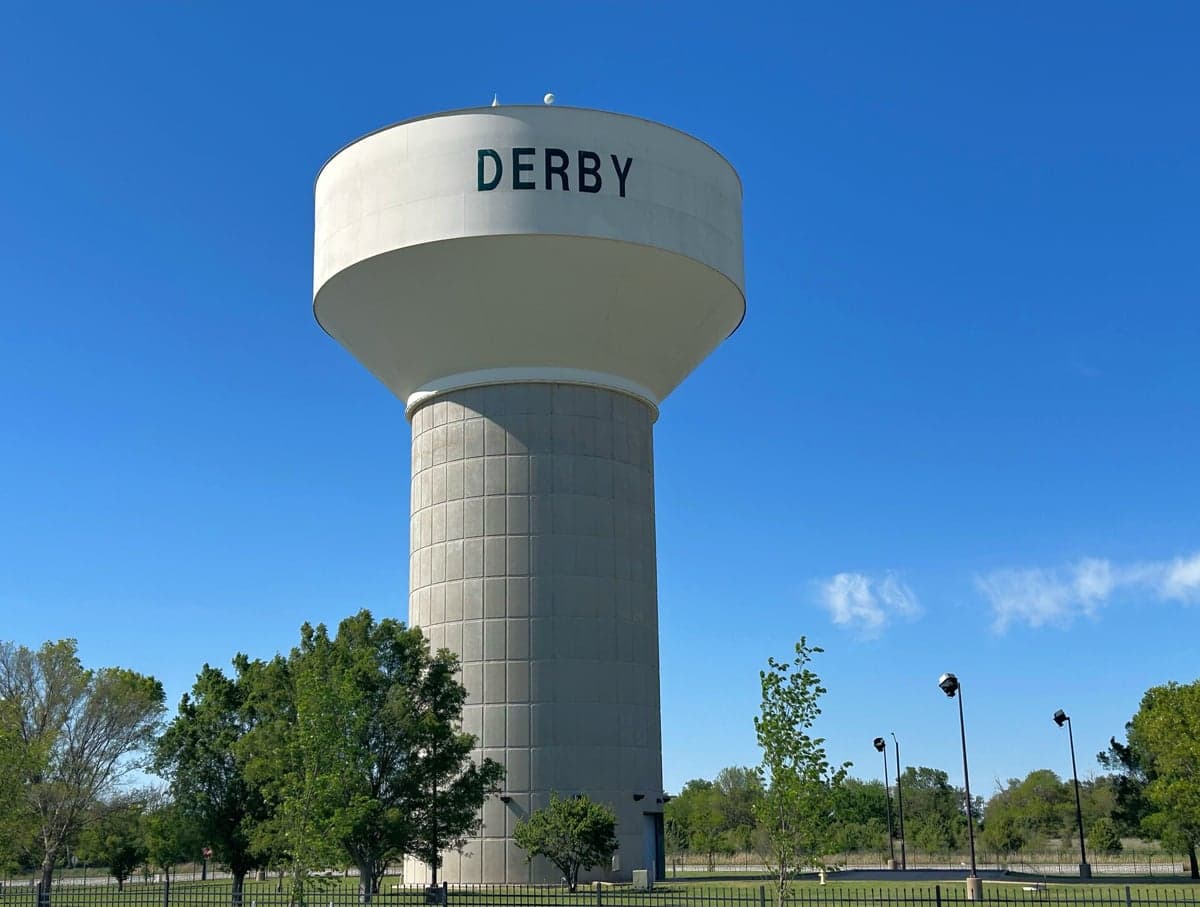
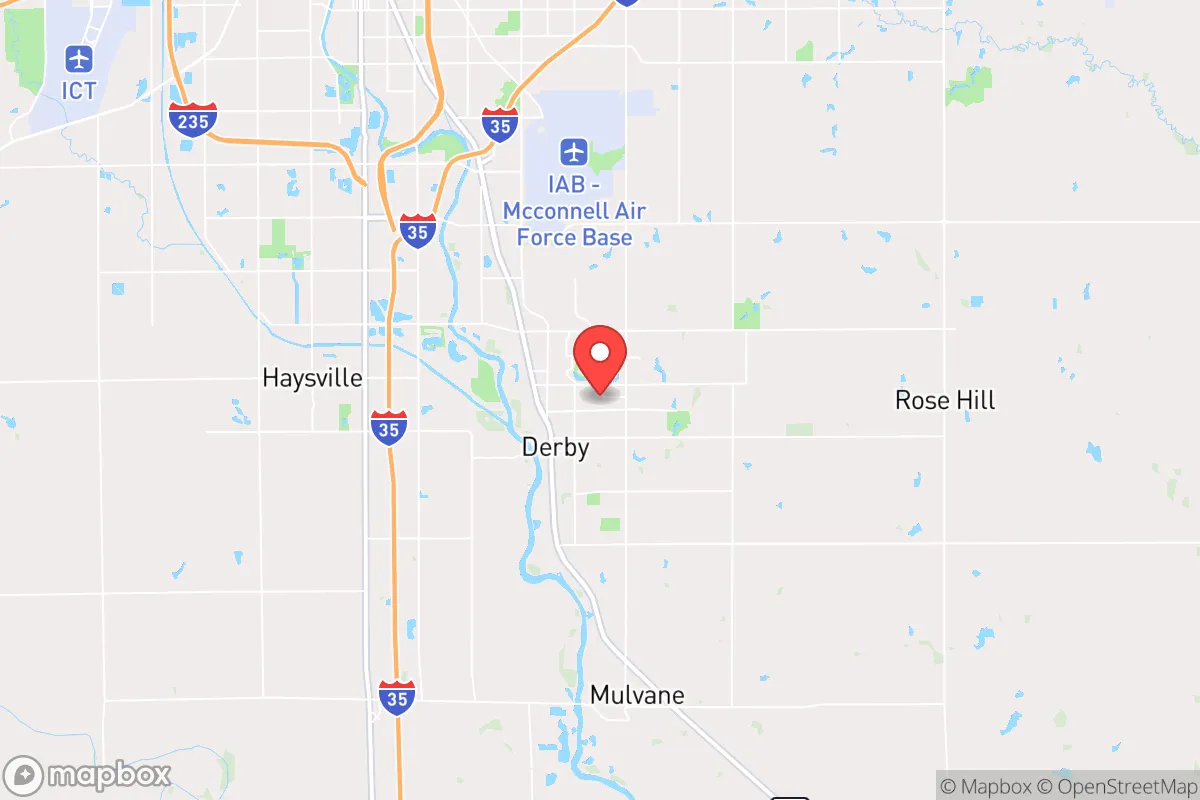
Photo: Wikipedia
Demographics of Derby, KS
Affluence Level in Derby, KS
A middle-class area roughly in line with national averages across income, home values, education, and employment.
People of Derby, KS
The people of Derby, Kansas, today form a predominantly white, family-oriented suburban community of 25,801, characterized by a notably low foreign-born share of just 1.1% and a growing Hispanic population of 13.4%. With 36.8% holding a college degree, the city leans educated and middle-class, yet retains a distinctly blue-collar, aviation-industry backbone. Derby’s identity is shaped by its role as a quiet, safe bedroom community for Wichita, where residents value local schools, low crime, and a strong sense of civic pride centered around High Park and the annual Derby Days festival.
How the city was settled and grew
Derby’s human history begins not with pioneers but with the railroad. Founded in 1871 as a stop on the Atchison, Topeka and Santa Fe Railway, the city was originally called El Paso before being renamed Derby in 1873. The first wave of settlers were Anglo-American farmers and railroad workers drawn by cheap land along the Arkansas River floodplain. These early families built homes in what is now Old Town Derby, the historic core around Madison Avenue and Market Street, where many original wood-frame houses still stand. A second wave arrived in the 1910s and 1920s, fueled by the discovery of oil in nearby Butler County. This brought a mix of Midwestern oil-field laborers and small business owners, who settled in the Rock Island District near the railroad tracks, establishing a modest commercial corridor. Through the mid-20th century, Derby remained a small farming and oil-service town, with a population hovering around 1,500. No significant immigrant enclaves formed during this period; the population was overwhelmingly native-born white, with a handful of African American families working on the railroad living in scattered homes along the southern edge of town.
Modern era (post-1965)
The post-1965 era transformed Derby from a rural hamlet into a Wichita suburb. The Immigration and Nationality Act of 1965 had little direct effect here—the foreign-born share remains minuscule at 1.1%—but the real driver was domestic in-migration tied to the expansion of McConnell Air Force Base and the aircraft manufacturing plants of Boeing and Cessna in Wichita. Starting in the 1970s, white-collar and skilled blue-collar workers moved south from Wichita, seeking larger lots and newer schools. This wave built out the South Derby subdivisions, including the sprawling High Park Estates and Woodlawn Meadows, which feature ranch-style homes and cul-de-sacs built between 1980 and 2000. A smaller but notable influx of Hispanic families began in the 1990s, drawn by construction and service jobs in Wichita’s growing economy. Today, the Hispanic population of 13.4% is concentrated in the West Derby area near Rock Road and 71st Street South, where newer apartment complexes and starter homes have been built. The Black population remains small at 1.8%, with no distinct neighborhood concentration, while East/Southeast Asian residents (0.8%) and Indian-subcontinent residents (0.0%) are virtually absent. The city’s racial homogeneity is a direct result of its late suburbanization—it never served as a primary destination for post-1965 immigration waves, and its housing stock and school reputation have primarily attracted white families from within Kansas.
The future
Derby’s population is heading toward modest diversification, but the pace is slow. The Hispanic share, which grew from roughly 8% in 2010 to 13.4% today, is the only group showing sustained growth, driven by second-generation families aging into homeownership and new arrivals in the service sector. This growth is likely to continue, with projections suggesting a Hispanic share of 18-20% by 2040, concentrated in the Rock Road Corridor and newer developments near 63rd Street South. The white share, while still dominant at 78.1%, will gradually decline as older residents age out and younger families are priced out of the tight housing market. The city is not tribalizing into distinct ethnic enclaves—rather, it is slowly integrating Hispanic families into existing neighborhoods, particularly in West Derby and the newer Tallgrass subdivision. The foreign-born share will likely remain below 3%, as Derby lacks the rental stock, transit links, and entry-level jobs that attract international immigrants. The Black and Asian populations are expected to remain static, as no major employers or cultural institutions draw these groups. The city is homogenizing in terms of income and lifestyle—becoming more uniformly middle-class and family-oriented—while slowly diversifying ethnically through Hispanic growth.
For someone moving in now, Derby is becoming a slightly more diverse, still overwhelmingly white, and deeply suburban community where the dominant culture is rooted in aviation, public schools, and conservative values. The lack of immigrant enclaves means a newcomer will find a socially cohesive, English-dominant environment, but the growing Hispanic presence is adding new restaurants, churches, and community events. The city’s future is one of gradual, organic change—not rapid transformation—making it a stable choice for families seeking predictability and a strong sense of place.

* Values derived from national, state, county, city and local statistics and may differ in a specific area. Last updated: 2026-05-04T02:58:37.000Z
Narrative content on this page is AI-generated and may contain mistakes. Verify any details that matter before acting on them.
ReloMaps may earn a commission from affiliate links at no extra cost to you.

