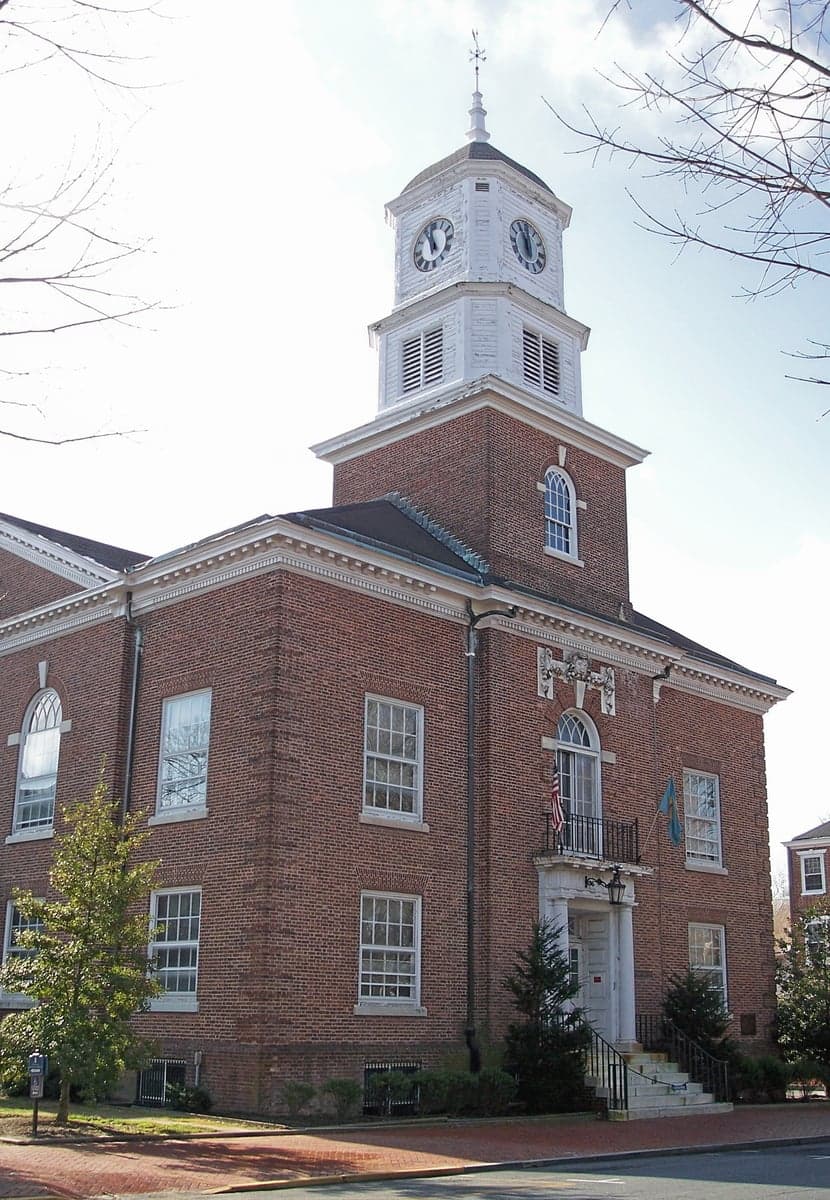
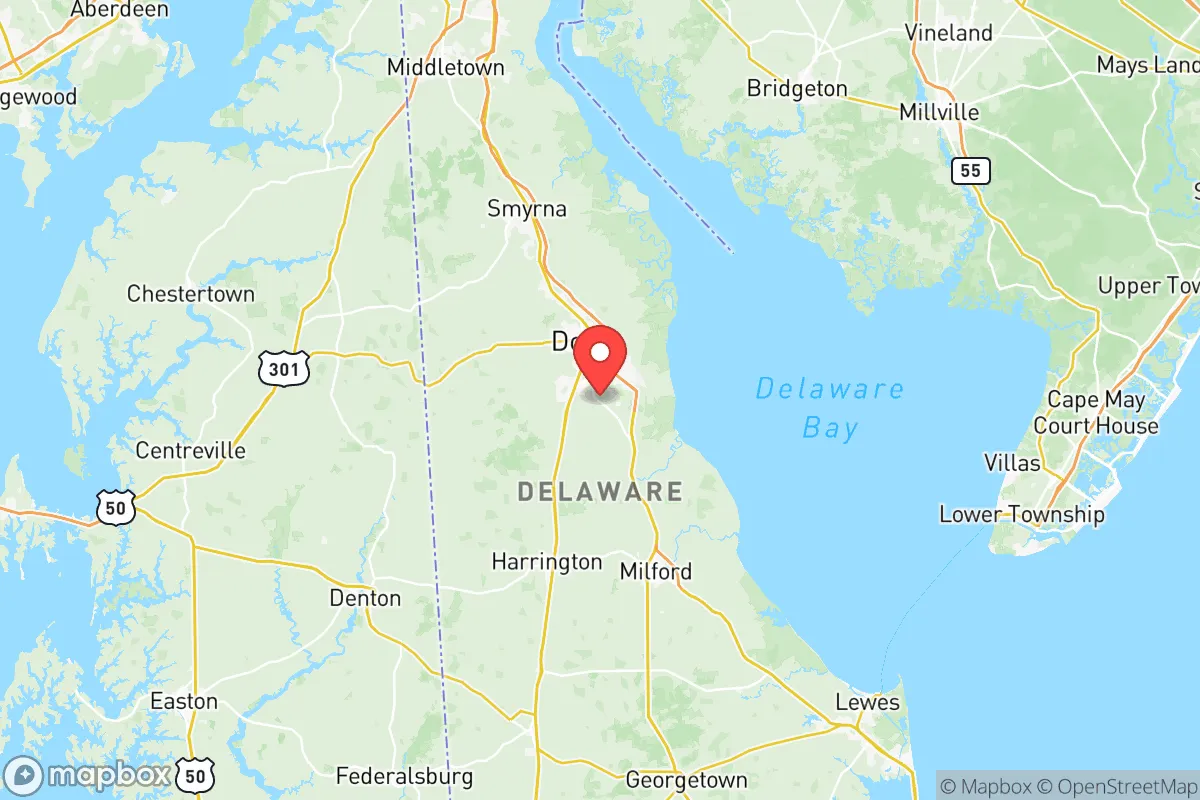
Photo: Wikipedia
Demographics of Kent County
Affluence Level in Kent County
A middle-class area roughly in line with national averages across income, home values, education, and employment.
People of Kent County
Today, the people of Kent County, Delaware form a community shaped by deep historical roots and steady, moderate change. With a population of 185,043, the county is characterized by a majority-white population (57.6%) alongside a substantial Black community (26.4%) and growing Hispanic (7.9%) and Asian (1.2%) populations. Its identity is distinctly suburban and rural, anchored by the state capital of Dover, with a foreign-born population of just 2.8%—far below the national average—reflecting a region where generational ties and local institutions, from Dover Air Force Base to agricultural traditions, remain central to daily life.
Settlement & growth (pre-1960)
The human history of Kent County begins with the Lenape people, who inhabited the region for centuries before European contact, living along the Delaware Bay and the St. Jones and Mispillion Rivers. The first European settlers were the Dutch, who established a short-lived presence in the 1630s, followed by the Swedes at Fort Christina (present-day Wilmington) in 1638. However, it was the English who permanently shaped the county after 1664, when the Duke of York took control of the Delaware colonies. By 1682, William Penn’s proprietorship brought Quaker and Anglican settlers from England and Wales, who established farms and small communities along the tidal creeks. The town of Dover, founded in 1683 as the county seat, became the political and commercial hub, while Smyrna and Milford grew as agricultural and shipbuilding centers in the 18th and 19th centuries.
The 19th century brought two major waves. First, the expansion of agriculture—particularly wheat, corn, and later peaches—attracted English and Scots-Irish farmers who settled the interior, establishing villages like Felton and Harrington. The Delaware Railroad, completed through Kent County in the 1850s, connected these towns to Philadelphia and Baltimore, spurring growth in Clayton and Camden. Second, the post-Civil War period saw a significant influx of freed African Americans, who moved from the rural South to Kent County’s farms and emerging towns, forming tight-knit communities in Dover’s South Street area and in Cheswold. By 1900, the county’s population was roughly 60% white and 40% Black, a ratio that held through the early 20th century as agriculture remained the dominant employer.
The 20th century brought industrial diversification. The establishment of the Dover Air Force Base in 1941 transformed the county’s economy and demographics, drawing military personnel and civilian workers from across the United States. This federal presence, combined with the growth of the poultry industry (centered in Harrington and Milford), stabilized the population through the mid-century decades. Unlike many Northern states, Kent County did not experience a large-scale Great Migration from the South after 1940, as its Black population was already well-established. Instead, the period from 1940 to 1960 saw modest growth, with the county’s population rising from about 40,000 to 65,000, driven by natural increase and the base’s expansion.
Modern era (post-1965)
The 1965 Hart-Cellar Act had a muted effect on Kent County compared to coastal urban centers. The foreign-born population remains low at 2.8%, and the county’s demographic shifts since 1965 have been driven more by domestic migration than international immigration. The most significant change has been the growth of the Hispanic community, which now stands at 7.9%. This population began arriving in the 1990s, primarily from Mexico and Central America, drawn by jobs in the poultry processing plants in Harrington and Milford, as well as construction and landscaping in the Dover area. A small but growing East/Southeast Asian community (1.2%) has also formed, with families settling in Dover and Smyrna, often connected to the medical and engineering sectors at Bayhealth Hospital and the base.
Domestic migration has reshaped the county more profoundly. Since the 1980s, Kent County has attracted retirees and families from the Northeast corridor—particularly New Jersey, New York, and Pennsylvania—seeking lower taxes and a slower pace of life. This wave has concentrated in suburban developments around Dover, Camden, and Wyoming, where new housing tracts have expanded rapidly. The county’s Black population, while stable in share at 26.4%, has seen internal movement from rural areas into Dover and Milford, where employment and services are concentrated. The Indian subcontinent community (1.0%) is a recent addition, largely professionals in healthcare and information technology who have settled in Dover and Smyrna since 2010.
Suburbanization has been the dominant theme of the modern era. The population has grown from 98,000 in 1970 to 185,000 today, with most new housing built on former farmland between Dover and the Chesapeake & Delaware Canal. This growth has been largely white and middle-class, reinforcing the county’s majority-white character while creating distinct enclaves: older, more diverse neighborhoods in central Dover contrast with newer, predominantly white subdivisions in Camden and Wyoming. The Hispanic community has formed a visible presence in Milford and Harrington, where bilingual services and small businesses have emerged.
The future
Kent County’s population is projected to continue growing at a moderate pace, reaching roughly 210,000 by 2040. The county is not homogenizing into a single cultural identity; rather, it is tribalizing into distinct geographic and demographic zones. The suburban corridor from Smyrna to Dover will likely become whiter and more affluent, driven by continued in-migration from the Northeast. Meanwhile, Dover’s core and Milford will remain more diverse, with growing Hispanic and Black populations. The East/Southeast Asian and Indian communities are small but expected to grow slowly, primarily through professional recruitment to the base and healthcare sector.
The foreign-born population, while low, may rise slightly as the poultry and agriculture industries continue to attract immigrant labor. However, Kent County is unlikely to see the rapid diversification of coastal Delaware or the Washington, D.C. suburbs. The cultural identity of the county is absorbing new arrivals into its existing framework—a conservative-leaning, family-oriented, and institutionally stable society centered on the military, agriculture, and local government. The next 10-20 years will likely see a gradual aging of the white population, with younger Hispanic and Black families offsetting declines, keeping the county’s demographic profile relatively stable.
For someone moving in now, Kent County offers a place where tradition and change coexist without friction. The population is rooted, with low turnover and strong community ties, yet open enough to absorb newcomers who respect its rhythms. It is becoming a more suburban, slightly more diverse version of its past—a place where the base, the poultry plants, and the state capital remain the anchors, and where the people, whether fifth-generation or newly arrived, share a pragmatic, unpretentious character.

* Values derived from national, state, county, city and local statistics and may differ in a specific area. Last updated: 2026-06-07T00:50:31.000Z
Narrative content on this page is AI-generated and may contain mistakes. Verify any details that matter before acting on them.
ReloMaps may earn a commission from affiliate links at no extra cost to you.

