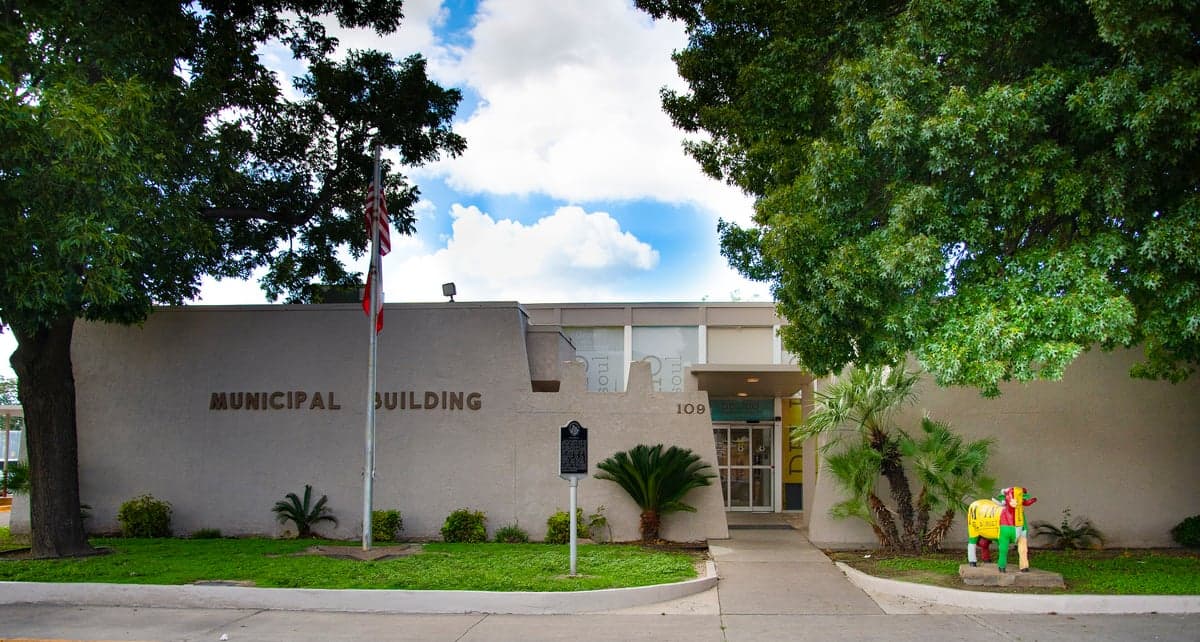

Photo: Wikipedia
Political ClimatePolitical Climate in Del Rio, TX
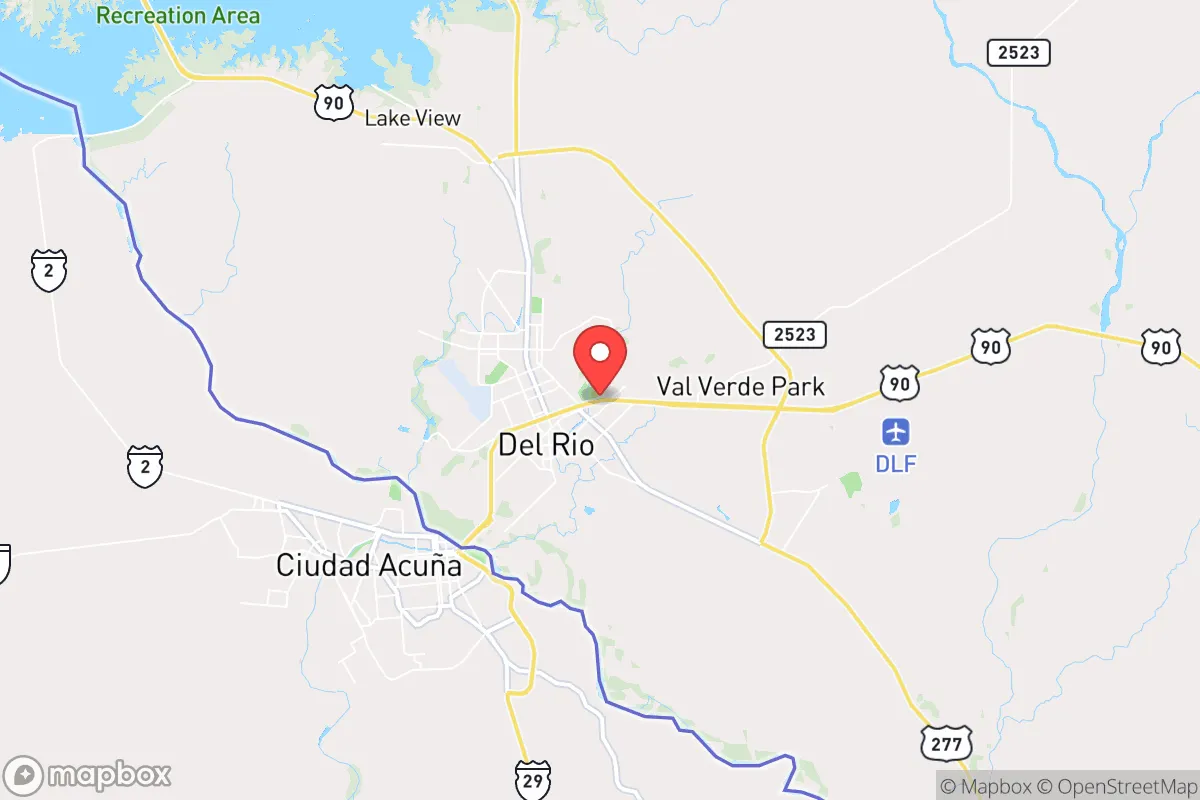
District shown is the primary district for this city’s centroid. Cities may span multiple districts.
Local Political AnalysisPolitical Analysis of Del Rio, TX
Del Rio leans solidly Republican, with a Cook Partisan Voting Index (PVI) of R+7, making it more conservative than the state of Texas as a whole, which sits at R+4. This isn't a new development; the area has been a reliable red stronghold for decades, driven by a mix of military families from Laughlin Air Force Base, ranching communities, and a strong sense of traditional values. While the national mood has shifted in recent cycles, Del Rio's political trajectory has remained remarkably stable, with local elections often decided in the Republican primary rather than the general election. You won't see the same kind of suburban swing toward the center that you might in places like San Antonio or Austin, and that's a defining feature of life here.
How it compares
Compared to the rest of Texas, Del Rio is noticeably more conservative than the state average. The R+7 PVI means a Republican candidate typically wins by about 7 points more than they do nationally, while the statewide R+4 reflects a closer margin. This gap is even more pronounced when you look at nearby cities: San Antonio, about 150 miles east, has a PVI of D+3, making it a liberal island in a red region. Even smaller towns like Uvalde (R+15) and Eagle Pass (R+12) are more conservative than Del Rio, but the difference is that Del Rio's politics are tempered by a significant Hispanic population—over 80%—which historically leans more Democratic in national races but votes reliably Republican in local and state contests here. The contrast is sharpest with the Rio Grande Valley to the south, where counties like Hidalgo (D+15) are Democratic strongholds, showing that border politics aren't monolithic.
What this means for residents
For conservative residents, Del Rio feels like home. Local government, law enforcement, and school board policies generally align with traditional Republican priorities: low taxes, Second Amendment rights, and a strong military presence. You'll find churches active in civic life, and the annual Fiesta de la Flor celebrates local heritage without much political friction. For liberal residents, the reality is more nuanced. While you won't face open hostility, you'll likely be in the minority in most social and professional circles. Progressive candidates rarely win local office, and issues like abortion access or environmental regulation are non-starters in public debate. That said, the community is generally polite and neighborly—political arguments are rare at the dinner table, and most folks just want to get along. The biggest practical difference is that if you're liberal, you'll need to seek out like-minded people in nearby cities like San Antonio or even Del Rio's small but active arts community.
Culturally, Del Rio stands apart from much of Texas due to its border location and deep Mexican-American roots. The annual Washington's Birthday Celebration is a huge, nonpartisan event that brings everyone together, and the local economy is heavily tied to the maquiladora industry in Ciudad Acuña just across the river. Policy-wise, the biggest distinction is the constant focus on border security, which dominates local news and political discourse far more than in inland Texas. This isn't a place where you'll hear much about urban issues like public transit or gentrification; instead, conversations center on water rights, trade, and immigration enforcement. For anyone moving here, the key takeaway is that Del Rio's politics are stable, predictable, and deeply rooted in its unique geography and history—don't expect the rapid shifts you'd see in a fast-growing suburb.

State Political ClimatePolitical Climate in Texas
State Political AnalysisPolitical Environment in the State
Texas has been a reliably Republican state for the past three decades, with a Cook Partisan Voting Index of R+4, but that label masks a far more volatile reality than it did in the 1990s or early 2000s. The dominant coalition remains a mix of rural and suburban conservatives, evangelical Christians, and business-oriented fiscal conservatives, but the state has shifted from a solid +12 or +13 Republican lean in presidential elections to a much narrower margin — Donald Trump won Texas by just 5.5 points in 2020 and by roughly 8 points in 2024, a dramatic tightening from the 16-point margins of the Bush and early Trump years. The long arc is clear: Texas is becoming more competitive, driven by explosive growth in the urban crescent from Dallas-Fort Worth down through Austin to San Antonio and Houston, while the rural and exurban counties that once delivered landslide margins are shrinking in relative population share.
Urban vs. rural divide
The political map of Texas is essentially a war between its booming blue metros and its vast red countryside. The five largest counties — Harris (Houston), Dallas, Tarrant (Fort Worth), Bexar (San Antonio), and Travis (Austin) — now cast roughly a third of all votes in the state, and all except Tarrant have trended sharply Democratic over the past decade. Travis County, home to Austin, is the bluest major urban county in the South, routinely delivering 70-75% of its vote to Democrats. Harris County, the third-most populous county in the nation, flipped from red to blue in 2018 and has stayed there. Meanwhile, the rural Panhandle, East Texas, and West Texas remain deeply Republican — counties like Ochiltree, Hemphill, and King routinely vote 85-90% Republican. The real battleground is the suburbs: Collin and Denton counties north of Dallas, once reliably red, have shifted from +20 Republican to single-digit margins, while Fort Bend County southwest of Houston flipped to blue in 2016 and has stayed there. Tarrant County, which includes Fort Worth, is the last of the big five to hold a Republican lean, but it's shrinking fast — Trump won it by just 2 points in 2024 after carrying it by 9 in 2020. The story of Texas politics is the story of these suburbs turning purple.
Policy environment
Texas operates under a conservative policy framework that has been remarkably stable for decades, though it has sharpened in recent years. The state has no personal income tax, which is the single biggest draw for relocating conservatives and a major factor in the state's population growth. Property taxes are high to compensate — the average effective rate is about 1.6%, among the highest in the nation — and there is no statewide cap on how fast appraisals can rise, though local jurisdictions can impose limits. The regulatory posture is famously business-friendly: Texas is a right-to-work state, has no state-level occupational licensing for many fields, and has a tort reform system that caps noneconomic damages in medical malpractice cases at $250,000. On education, the state funds schools primarily through local property taxes, leading to wide disparities between wealthy and poor districts, and has a robust school choice movement — the 2023 legislature passed a universal education savings account program after years of failed attempts. Healthcare policy is a notable outlier: Texas has the highest uninsured rate in the nation at roughly 17%, having refused to expand Medicaid under the Affordable Care Act. Election laws have been tightened: the 2021 Senate Bill 1 restricted mail-in voting, added ID requirements, and banned 24-hour and drive-through voting, changes that were challenged in court but largely upheld.
Recent policy direction
The last three legislative sessions have pushed Texas decisively to the right on a broad set of issues that relocators should weigh carefully. On gun and self-defense law, Texas became a permitless carry state in 2021, allowing anyone 21 or older who can legally possess a firearm to carry it openly or concealed without a license. On parental and education rights, the 2023 session passed a school voucher-style program and restricted how public schools can teach about race and gender, including a law requiring parental consent before a child can change their name or pronouns at school. On speech and privacy, the state passed a law in 2023 requiring age verification for adult websites and has been a leader in litigation against social media platforms for alleged censorship of conservative viewpoints. On medical and bodily autonomy, Texas has one of the nation's strictest abortion bans — Senate Bill 8, the "heartbeat bill" passed in 2021, effectively banned abortion after six weeks and created a novel private enforcement mechanism, and a 2023 trigger law banned abortion from conception with narrow exceptions for medical emergencies. Property rights remain strong: Texas has no state-level zoning in many cities (Houston is famously unzoned), and eminent domain protections were strengthened in 2023. On voting and ballot access, the trend has been toward restriction: the 2021 election law made it a crime for election officials to proactively mail absentee ballot applications, and the state has purged voter rolls aggressively, removing over a million names since 2020. For a relocator, the bottom line is that Texas is actively legislating on the cultural front lines — it's not a state that's standing still.
Civil unrest & political movements
Texas has been a flashpoint for political activism on both sides, and a new resident will see evidence of it regularly. The 2020 Black Lives Matter protests in Austin, Houston, and Dallas were among the largest in the country, with Austin alone seeing over 50 consecutive nights of demonstrations. The response was polarized: Democratic-led cities generally allowed protests to continue, while Governor Greg Abbott and the Republican legislature responded with a 2021 law that made it a felony to bail out protesters and increased penalties for rioting. Immigration politics are the most visible daily flashpoint: the state has bused over 100,000 migrants to Democratic-led cities like New York, Chicago, and Denver since 2022, and the 2023 legislature passed a law (SB 4) allowing state law enforcement to arrest people suspected of entering the U.S. illegally, though it has been tied up in court. The "secession" or "Texit" movement is real but marginal — the Texas Nationalist Movement has some grassroots support but has never gotten a serious legislative hearing, and polling consistently shows only about 15-20% of Texans support independence. Election integrity controversies have been a persistent feature since 2020: the state's Republican leadership has repeatedly claimed the 2020 election was "rigged" despite no evidence of widespread fraud, and the 2021 election law was passed explicitly to restore "confidence" in elections. A new resident in a blue city like Austin will see "Keep Austin Weird" bumper stickers next to "Don't Tread on Me" flags; in a red suburb like Keller or Southlake, the culture war over school board meetings and library books is a weekly reality.
Projection
Over the next five to ten years, Texas is likely to continue its slow drift toward competitiveness, but it's not going to flip blue anytime soon. The demographic forces are powerful: the state is growing by roughly 1,000 people per day, and the vast majority of new arrivals are moving to the urban and suburban counties that lean Democratic or are trending that way. The Hispanic population, which makes up about 40% of the state, is not the monolithic Democratic bloc that national pundits once assumed — Hispanic voters in the Rio Grande Valley, particularly in Starr and Zapata counties, shifted sharply toward Trump in 2020 and 2024, and the trend is accelerating. At the same time, the rural counties that anchor the Republican coalition are losing population, and the older, whiter voters who drive those margins are being slowly outnumbered. The most likely scenario is that Texas becomes a true swing state by the early 2030s, with presidential margins in the 2-4 point range, but that the Republican legislature and governor's office remain in GOP hands due to gerrymandering and the concentration of Democratic voters in a handful of urban counties. A relocator moving in now should expect the political temperature to stay hot — the state will be the center of national attention in every election cycle, and the culture war fights over education, immigration, and abortion will only intensify as the margins tighten.
For a new resident, the practical takeaway is that Texas offers a genuinely conservative policy environment — low taxes, light regulation, strong gun rights, and a government that is actively pushing back against federal authority — but it's a state in transition. If you're a conservative, you'll find a government that largely shares your values, but you'll also find that your vote matters less in a primary and more in a general election as the state becomes competitive. If you're a liberal, you'll find that your vote is increasingly meaningful in statewide races, but you'll also face a legislature that is actively hostile to many of your priorities, and you'll need to live in a blue city or county to feel at home. Either way, the political climate is not passive — it's something you'll encounter in your daily life, from the signs in your neighbors' yards to the debates at your child's school board meeting, and it's not going to calm down anytime soon.
* Values derived from national, state, county, city and local statistics and may differ in a specific area. Last updated: 2026-08-04T15:33:28.000Z
Narrative content on this page is AI-generated and may contain mistakes. Verify any details that matter before acting on them.
ReloMaps may earn a commission from affiliate links at no extra cost to you.

