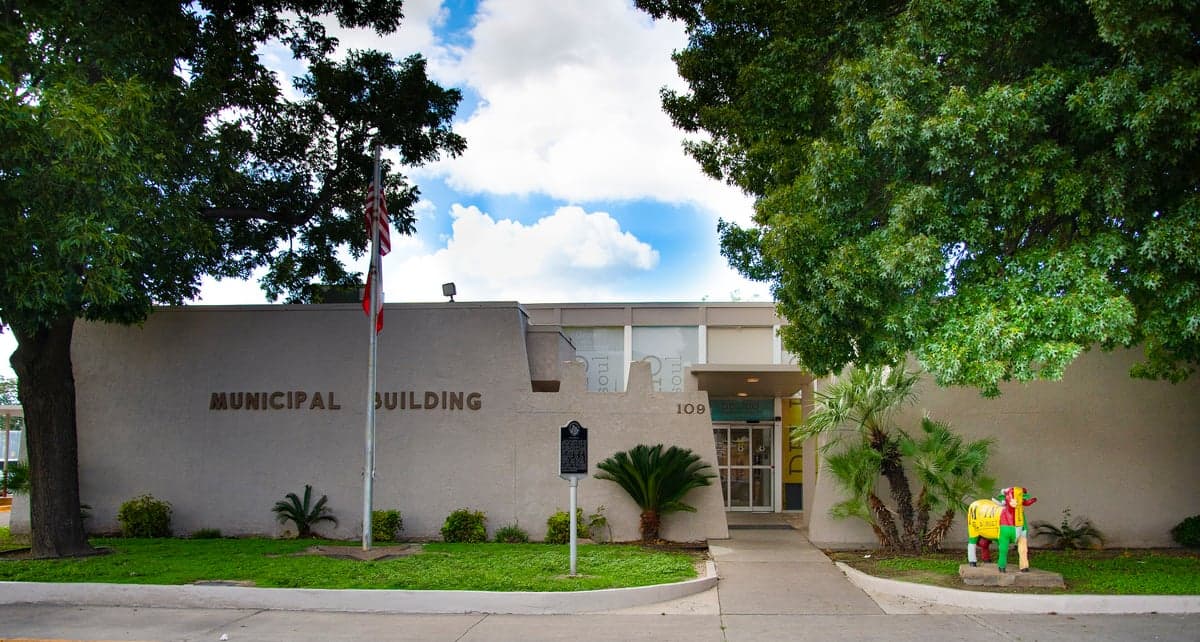
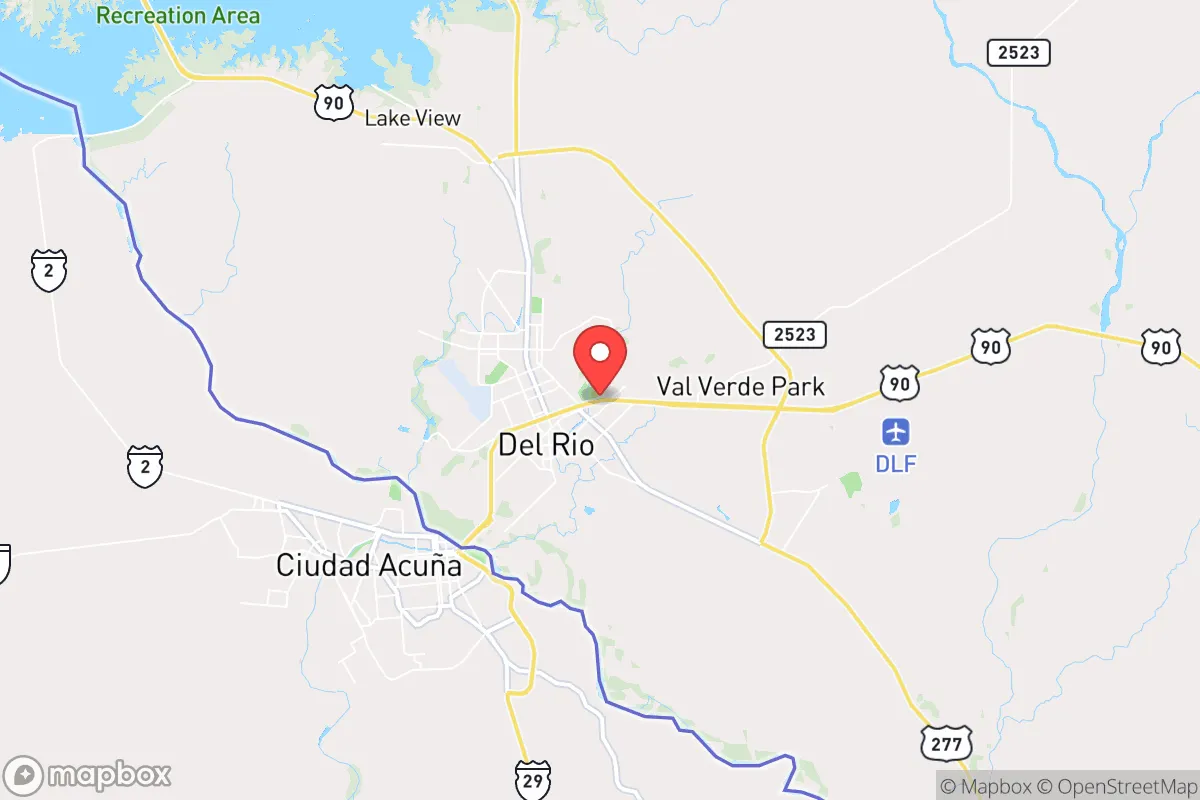
Photo: Wikipedia
Personal Sovereignty in Del Rio, TX
Strong independent fundamentals that actively favor personal liberty and low regulation.
What does Personal Sovereignty tell us?
Personal Sovereignty measures your capacity for self-reliance and independence with minimal government friction. Higher scores mean fewer barriers between you and the way you want to live... but it assumes you have the space you need and good neighbors.
What does this tell us?
Personal Sovereignty measures your capacity for self-reliance and independence with minimal government friction. Higher scores mean fewer barriers between you and the way you want to live... but it assumes you have the space you need and good neighbors.
State Policy
Energy independence: Net exporter (220% of energy produced in-state)
Personal Liberty
Homesteading

Personal Liberty Analysis
Del Rio, Texas, offers a personal sovereignty environment that is heavily shaped by its location on the U.S.-Mexico border and its status as a small, independent-minded city in a state that prioritizes individual autonomy. For a resident who values minimal government interference, the city provides a notably light-touch regulatory atmosphere, particularly when compared to major metropolitan areas in blue states. The combination of Texas’s strong property rights, lack of a state income tax, and permissive gun laws creates a baseline of personal freedom that is further amplified by Del Rio’s relatively low population density and distance from state capital influence. However, the border location introduces unique federal oversight and security considerations that residents must navigate, making the sovereignty picture here distinct from inland Texas communities.
Tax burden and regulatory posture in Val Verde County
Del Rio residents benefit from Texas’s most significant sovereignty advantage: the absence of a state personal income tax. This means every dollar earned stays with the individual, not the government. The primary local tax burden falls on property taxes, which in Val Verde County average around 2.1% to 2.3% of assessed home value, slightly above the Texas median but typical for rural counties with smaller tax bases. Sales tax in Del Rio is 8.25%, comprising the state’s 6.25% rate plus local additions. The regulatory posture in Del Rio is decidedly light-touch: there are no city-level rent control ordinances, no local minimum wage mandates above the federal floor, and business licensing requirements are minimal for most small operations. Zoning is present but not aggressively enforced in the county’s unincorporated areas, allowing for considerable flexibility in land use. The city’s border location does mean heightened federal presence—Customs and Border Protection checkpoints are a routine part of life—but this is a security reality rather than a regulatory burden on daily commerce or property use.
Self-defense and gun law specifics for Del Rio residents
Texas law provides a robust framework for self-defense that applies fully in Del Rio. The state’s “Stand Your Ground” statute, codified in Texas Penal Code §9.32, removes any duty to retreat before using deadly force in any location where a person has a legal right to be, provided they reasonably believe it is necessary to prevent imminent death or great bodily harm. Del Rio residents can carry a handgun without a license under the state’s permitless carry law (effective September 2021), which applies to anyone 21 or older who is not legally prohibited from possessing a firearm. For those who want reciprocity with other states, a Texas License to Carry (LTC) is available after a background check and training course. The city itself has no additional firearm ordinances beyond state law—no magazine capacity restrictions, no assault weapon bans, and no waiting periods. Open carry of handguns is legal with an LTC, and long guns may be carried openly without a license. The Val Verde County Sheriff’s Office and Del Rio Police Department are generally supportive of Second Amendment rights, and local gun culture is strong, with multiple firearms retailers and a public shooting range at the Val Verde County Gun Club. For homeowners, the “Castle Doctrine” provides a legal presumption that force used against an intruder inside one’s home or vehicle was reasonable, offering strong legal protection for defensive actions.
Self-reliance and homesteading viability: lot sizes, zoning, and off-grid feasibility
Del Rio’s arid climate and rural character make it a viable but challenging location for homesteading and self-reliance. The city itself has standard residential lot sizes of 6,000 to 10,000 square feet, but the surrounding Val Verde County offers acreage parcels from 1 to 100+ acres at prices significantly below the national average—raw land can be found for $2,000 to $5,000 per acre. County zoning is minimal in unincorporated areas, allowing for livestock, gardens, and accessory structures without extensive permitting. Off-grid living is legally feasible: Texas has no state-level prohibition on rainwater collection (in fact, it encourages it via tax exemptions for collection equipment), and solar panel installation is unrestricted. However, the region’s average annual rainfall of only 19 inches makes rainwater-dependent systems less reliable than in wetter parts of the state. Well drilling is permitted with a state water well report, and groundwater availability varies by location—prospective buyers should commission a well yield test before purchasing. Septic systems are standard and regulated by the county, but the permitting process is straightforward for standard designs. The city provides municipal water and electricity, but many rural properties rely on private wells and on-grid electric with solar backup. Burning restrictions during drought periods can limit wood heat as a primary source, but propane delivery is widely available. For those seeking maximum self-reliance, the county’s lax building codes in unincorporated areas allow for owner-built structures, though financing such projects can be difficult without conventional construction.
Personal liberties: parental rights, medical autonomy, speech, and property
Texas law provides strong protections for parental rights, and Del Rio families benefit from these state-level guarantees. The Texas Parental Rights statute (Texas Family Code §151.001) affirms that parents have the right to direct their children’s education, medical care, and moral upbringing. Homeschooling is legal with minimal regulation—no state notification, no curriculum approval, and no standardized testing requirements—making Del Rio attractive for families seeking educational autonomy. Medical autonomy is more complex: Texas has not expanded Medicaid under the ACA, and the state’s regulatory environment for alternative medicine is moderate. Direct primary care (DPC) memberships are available in the region, offering a workaround for those who want to avoid traditional insurance models. On medical freedom issues, Texas passed a law in 2021 prohibiting vaccine passports and mandating that employers allow religious or medical exemptions from employer vaccine mandates. Speech and assembly rights are robustly protected under the Texas Constitution, which contains its own free speech clause that has been interpreted broadly by state courts. Property rights are a cornerstone of Texas law, with strong protections against eminent domain abuse and no state-level property tax on business inventory or intangible assets. The border location does create some unique friction: federal checkpoints can search vehicles without warrants within 100 miles of the border, a reality that affects Fourth Amendment expectations in Del Rio more than in inland Texas cities.
Overall, Del Rio offers a personal sovereignty profile that ranks among the strongest in the United States for those who can tolerate the border security environment. The absence of state income tax, permissive gun laws, minimal zoning in the county, and strong parental and property rights create a foundation of autonomy that is difficult to find in coastal states. The trade-offs are real: the federal presence at the border, the arid climate limiting certain homesteading strategies, and the relatively high property tax rate for a rural area. For a conservative-leaning individual or family who prioritizes self-reliance and minimal government interference, Del Rio represents a viable option that balances freedom with the practical realities of living in a remote border community. It is not a libertarian utopia—no place is—but it offers a level of personal sovereignty that compares favorably to most of the country, particularly for those willing to live outside the city limits and embrace the challenges of rural self-sufficiency.

* Values derived from national, state, county, city and local statistics and may differ in a specific area. Last updated: 2026-08-04T15:33:28.000Z
Narrative content on this page is AI-generated and may contain mistakes. Verify any details that matter before acting on them.
ReloMaps may earn a commission from affiliate links at no extra cost to you.

