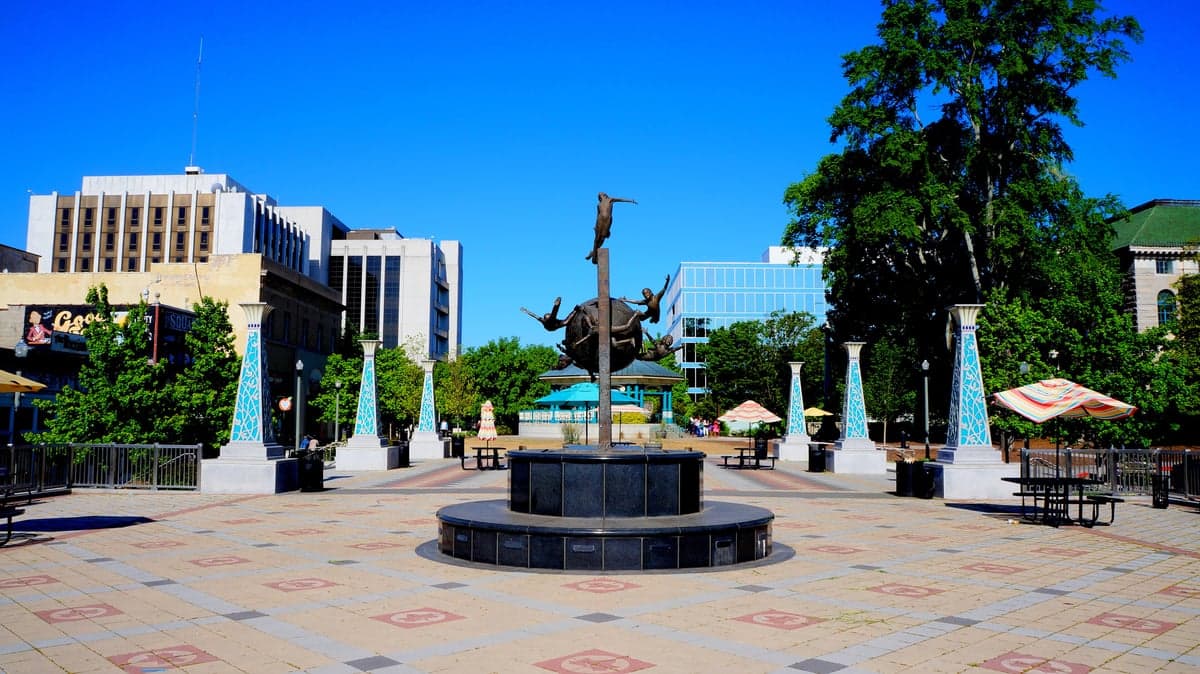
Photo: Wikipedia
Political ClimatePolitical Climate in Decatur, GA
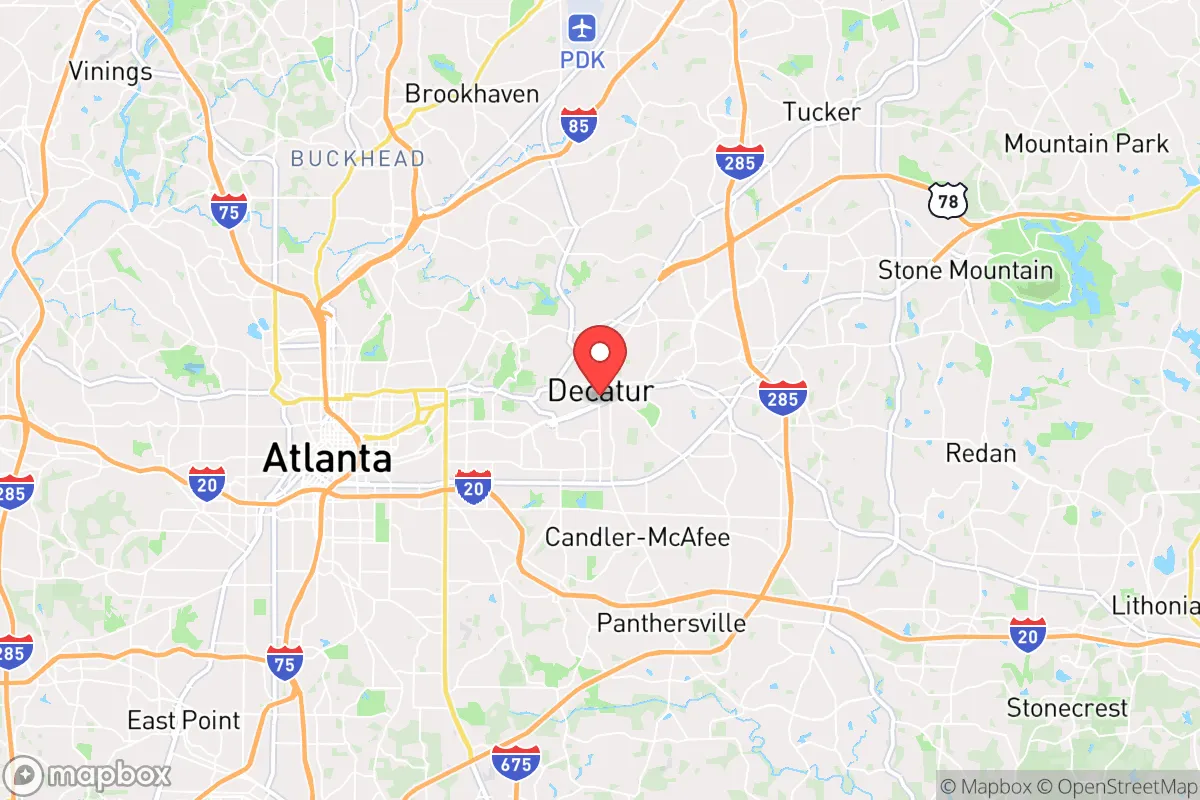
District shown is the primary district for this city’s centroid. Cities may span multiple districts.
Local Political AnalysisPolitical Analysis of Decatur, GA
Decatur, Georgia, is about as deep blue as it gets in the metro Atlanta area, with a Cook Partisan Voting Index of D+36. That means in a typical election, Democrats win by roughly 36 points more than the national average. It wasn’t always this way—I remember when this town was a lot more balanced, with a mix of old-school families and newcomers. But over the last 15 years, the shift has been dramatic. The city council and school board are now almost entirely progressive, and the local political conversation is dominated by issues like racial equity audits, defunding the police (though it was rebranded as “reimagining”), and aggressive zoning changes that prioritize density over single-family homes. If you’re a conservative, you’re definitely in the minority here, and it’s a minority that’s been shrinking fast.
How it compares
Drive 10 minutes in any direction and you’ll see a completely different political landscape. Just south, in Avondale Estates, you get a similar vibe—progressive, walkable, with a city council that’s all-in on green initiatives and social justice. But head north to Tucker or east to Stone Mountain, and the politics get noticeably more moderate. Tucker still has a strong Republican presence, and Stone Mountain’s older neighborhoods lean conservative. Even closer, the unincorporated parts of DeKalb County around Decatur are more purple, with a mix of libertarian-leaning homeowners and working-class families who don’t have time for the culture wars. The contrast is stark: Decatur’s city limits feel like a progressive island, while the surrounding areas are a lot more grounded in traditional values like property rights and fiscal restraint.
What this means for residents
If you value personal freedoms—especially the freedom to run your home, your business, or your family without government interference—Decatur is becoming a tough place to live. The city has been aggressive with new regulations: strict tree ordinances that limit what you can do on your own property, a push for “missing middle” housing that effectively eliminates single-family zoning in many areas, and a school system that’s increasingly focused on ideological training over academics. Property taxes are high, and they keep climbing to fund new social programs. The local government seems to think it knows better than you how to raise your kids, run your business, or even what kind of car you should drive (they’ve been flirting with congestion pricing and EV mandates). For a long-time resident like me, it feels like the city is micromanaging every aspect of daily life, and the trend is only accelerating.
On the cultural side, Decatur has become a hub for activism and protest. You’ll see signs in every yard, bumper stickers on every car, and a general expectation that you’re on board with the latest progressive cause. The city’s annual events, like the Decatur Book Festival and the Fourth of July parade, now have a heavy political undertone. If you’re not comfortable with that, you’ll feel out of place. Looking ahead, I don’t see this changing—if anything, the next wave of young, out-of-state transplants moving in will push things even further left. For conservatives, the best bet is to live just outside the city limits, where you can still enjoy Decatur’s restaurants and walkability without being subject to its ever-expanding list of rules and regulations.

State Political ClimatePolitical Climate in Georgia
State Political AnalysisPolitical Environment in the State
Georgia has shifted from a reliably conservative stronghold to a competitive battleground state over the past two decades, with its partisan lean narrowing from a double-digit Republican advantage in the 2000s to a razor-thin margin in 2024 where Donald Trump carried the state by just over 1 point. The state’s political landscape is now defined by a coalition of suburban moderates, growing minority populations in metro Atlanta, and deeply conservative rural and exurban voters who still hold significant sway in statewide elections. This trajectory means Georgia is no longer a safe bet for either party, but its underlying conservative infrastructure—from gun laws to tax policy—remains largely intact, though under increasing pressure from demographic change.
Urban vs. rural divide
The political map of Georgia is a classic story of urban islands surrounded by a red sea. Metro Atlanta, home to roughly 60% of the state’s population, is the Democratic engine, with Fulton County (Atlanta) and DeKalb County delivering margins of 70-80% for Democrats in recent presidential elections. The city of Atlanta itself is a deep blue stronghold, but the real story is the suburban ring: Cobb, Gwinnett, and Henry counties—once reliably Republican—have flipped blue or become competitive since 2016, driven by an influx of college-educated professionals and diverse populations. In contrast, the rest of the state is overwhelmingly Republican. Rural counties like Murray, Gilmer, and Union in the north Georgia mountains routinely vote 80%+ Republican, as do vast stretches of south Georgia, including Colquitt and Thomas counties. The exurban counties on Atlanta’s fringe—like Forsyth, Cherokee, and Paulding—remain deeply red and are growing fast, acting as a counterweight to the urban shift. The divide is stark: drive 30 minutes outside the I-285 perimeter and you’re in a different political universe.
Policy environment
Georgia’s state-level policy environment is broadly conservative, with a few notable exceptions that give pause. The state has a flat income tax rate of 5.49%, which is being phased down to 4.99% by 2029, and no estate tax—a clear win for property rights and family wealth preservation. The regulatory climate is business-friendly, with a right-to-work law and a tort reform package passed in 2005 that capped noneconomic damages in medical malpractice cases. On education, Georgia has a robust school choice landscape: the Georgia Promise Scholarship Act (2024) provides $6,500 per student for private school or homeschool expenses, and there are over 100 charter schools statewide. However, the state’s education bureaucracy remains centralized, and local control varies widely—Atlanta Public Schools are a progressive stronghold, while Forsyth County schools are more traditional. Healthcare policy is mixed: Georgia did not expand Medicaid under the ACA, but Governor Brian Kemp’s “Georgia Pathways” program (2023) added limited work-requirement-based coverage. Election laws tightened after 2020 with SB 202 (2021), which added voter ID requirements for absentee ballots, limited drop boxes, and restricted third-party ballot collection—a move conservatives saw as election integrity but critics called suppression. The state also has a permitless carry law (2022) and a heartbeat abortion ban (2019), both of which signal a conservative tilt on personal liberties.
Trajectory & freedom
Georgia’s trajectory on personal freedom is a mixed bag trending in the right direction on some fronts but with worrying signs of government overreach. On the positive side, the state enacted constitutional carry (SB 319) in 2022, allowing law-abiding citizens to carry a concealed firearm without a permit—a clear expansion of Second Amendment rights. The same year, the “Parents’ Bill of Rights” (HB 1178) was signed, giving parents more say over their children’s education, including the right to review curriculum and opt out of materials they find objectionable. Property rights were strengthened with the “Georgia Landowner Protection Act” (2023), which limits eminent domain abuse by private entities. On the concerning side, the state’s COVID-era emergency powers were used to shut down businesses and mandate masks in 2020, though the legislature later passed HB 345 (2021) to limit future emergency orders to 30 days without legislative approval. Medical freedom remains a flashpoint: the state’s telehealth and vaccine mandate restrictions are solid, but the medical board has shown hostility to alternative treatments. The biggest red flag for conservatives is the ongoing push by Atlanta city government to impose its own progressive agenda, including sanctuary city policies (despite a state law banning them) and local gun control ordinances that conflict with state preemption. The state’s trajectory is toward more freedom at the state level, but local governments—especially in metro Atlanta—are actively working to undermine that.
Civil unrest & political movements
Georgia has seen its share of political turbulence, particularly in the wake of the 2020 election. The most visible flashpoint was the “Stop the Steal” protests and the subsequent election integrity battles, which led to the aforementioned SB 202 and ongoing litigation over absentee ballot procedures. In 2020, Atlanta experienced significant civil unrest following the killing of George Floyd, with protests turning violent in parts of the city, including the burning of the Wendy’s on University Avenue and property damage along the Atlanta BeltLine. The “Cop City” controversy—a proposed police training facility in DeKalb County—has become a rallying point for left-wing activists, with protests and arson attacks continuing into 2024. On the right, the Georgia Republican Party has seen internal divisions between establishment figures like Governor Kemp and more populist, Trump-aligned factions, but the party remains unified on core issues like election integrity and gun rights. Immigration politics are heated: Atlanta’s sanctuary city policies have been a constant source of tension, with the state legislature passing HB 1105 (2024) to penalize local governments that refuse to cooperate with ICE. A new resident would notice the political energy at the grassroots level—both sides are highly organized, with active precinct-level groups and frequent rallies at the state capitol. The election integrity debate is not theoretical here; it’s a live issue that affects how people vote and trust the system.
Projection
Over the next 5-10 years, Georgia is likely to become more competitive at the statewide level, but the underlying conservative structure will hold in the legislature and local governments outside Atlanta. The key demographic driver is the continued growth of the Atlanta suburbs, which are becoming more diverse and more Democratic-leaning. Forsyth County, once the fastest-growing white-majority county in America, is now seeing significant Hispanic and Asian in-migration, which could shift its political lean over time. However, the exurban and rural areas are also growing, and the state’s Republican-drawn legislative maps (upheld by the courts in 2024) will keep the General Assembly red for the foreseeable future. The biggest wildcard is the 2026 gubernatorial race, which could see a more progressive Democrat challenge the Republican nominee. For a conservative moving in now, expect the state to remain a good bet for low taxes, gun rights, and school choice, but be prepared for increasing cultural battles in local school boards and city councils. The state’s freedom trajectory will depend on whether the legislature can continue to preempt local progressive ordinances—if Atlanta’s sanctuary policies or gun control efforts survive legal challenges, it could set a precedent for other cities. Realistically, Georgia will look more like North Carolina in a decade: a purple state with a red legislature and a mixed record on personal liberty.
For a new resident, the bottom line is that Georgia offers a solid conservative foundation—low taxes, strong gun rights, school choice, and election integrity laws—but you’ll need to choose your county carefully. If you want a deep-red environment with minimal progressive influence, look at exurban counties like Forsyth, Cherokee, or Paulding, or rural areas like Hall or Houston County. If you’re moving to metro Atlanta, expect to engage in local politics to protect your freedoms. The state is not Texas or Florida in terms of conservative dominance, but it’s far from California or New York. The key is to be aware of the growing urban-rural divide and to vote accordingly in local elections—that’s where the real battles over your rights will be fought.
* Values derived from national, state, county, city and local statistics and may differ in a specific area. Last updated: 2026-04-23T05:25:18.000Z
Narrative content on this page is AI-generated and may contain mistakes. Verify any details that matter before acting on them.
ReloMaps may earn a commission from affiliate links at no extra cost to you.

