
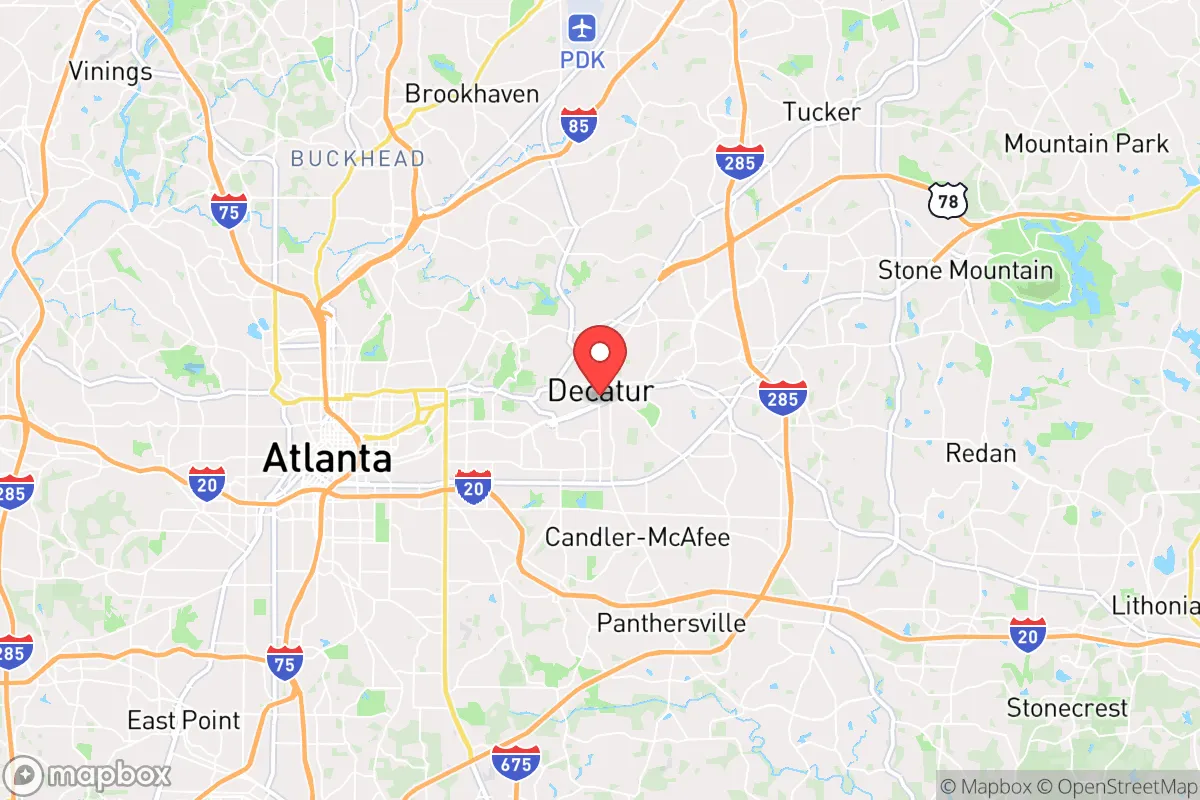
Photo: Wikipedia
Personal Sovereignty in Decatur, GA
Viable for self-reliance. Generally workable, though some barriers may limit total independence.
What does Personal Sovereignty tell us?
Personal Sovereignty measures your capacity for self-reliance and independence with minimal government friction. Higher scores mean fewer barriers between you and the way you want to live... but it assumes you have the space you need and good neighbors.
What does this tell us?
Personal Sovereignty measures your capacity for self-reliance and independence with minimal government friction. Higher scores mean fewer barriers between you and the way you want to live... but it assumes you have the space you need and good neighbors.
State Policy
Energy independence: Importer (12% of energy produced in-state)
Personal Liberty
Homesteading

Personal Liberty Analysis
For the liberty-minded individual or family evaluating Decatur, GA, the personal sovereignty picture is a study in contrasts: the city sits within a state that has made meaningful strides in gun rights and tax restraint, yet it is governed locally by a city council that consistently votes to expand regulation, raise taxes, and align with progressive state-level policies that erode individual autonomy. Decatur’s political culture—anchored by a city commission that has declared itself a "sanctuary city" for illegal immigrants and passed ordinances restricting landlord rights and mandating paid leave—signals a local government comfortable with top-down control. For a survivalist or prepper, the key question is whether Georgia’s state-level protections can insulate you from Decatur’s local overreach, or whether the city’s density and politics make it a net loss for personal freedom.
Tax burden and regulatory posture in Decatur compared to surrounding areas
Georgia’s state-level tax climate is relatively friendly: a flat 5.39% income tax (down from 5.75% in 2024) and no state-level estate or inheritance tax. But Decatur’s local tax burden is among the highest in metro Atlanta. The city’s property tax millage rate hovers around 13.5 mills for the city portion, plus DeKalb County’s 10.5 mills, for a combined effective rate near 1.8% of assessed value—roughly 40% higher than unincorporated DeKalb County and nearly double what you’d pay in neighboring Gwinnett County. Sales tax in Decatur is 8.9% (state 4%, county 4%, city 0.9% for MARTA), which is standard for the region but still a constant drain. More concerning for the prepper mindset: Decatur has aggressively pursued regulatory expansion, including a 2023 ordinance requiring employers to provide paid sick leave (preempted by state law but symbolic of local sentiment), strict tree canopy ordinances that limit property use, and zoning codes that effectively ban new single-family homes on lots under 6,000 square feet. The city’s stormwater utility fee and annual business license fees add recurring costs that are absent in less regulated suburbs. For a family trying to minimize government dependency, Decatur’s tax and regulatory posture is a net negative—you pay more for less autonomy over your own property.
Self-defense rights and gun law specifics in Decatur and DeKalb County
Georgia is a constitutional carry state as of 2022, meaning no permit is required to carry a concealed firearm for anyone 21 or older who can legally possess a gun. This is a strong baseline for self-defense sovereignty. However, Decatur and DeKalb County have local ordinances that create friction. The city of Decatur bans firearms in all city-owned buildings and parks—including the popular Decatur Square and Oakhurst Park—which effectively disarms law-abiding citizens in public gathering spaces. DeKalb County also prohibits firearms in county courthouses and administrative buildings. While state law preempts local governments from passing their own gun regulations (O.C.G.A. § 16-11-173), the park and building bans have survived legal challenges by citing "government property" exceptions. For a prepper, this means your ability to carry in Decatur’s public spaces is legally restricted in ways it wouldn’t be in unincorporated DeKalb or most other Georgia counties. Stand-your-ground laws apply statewide, and Georgia has no duty to retreat in any place you are lawfully present. But the practical reality is that Decatur’s local government has signaled hostility to armed self-defense, and the city’s police department (about 60 sworn officers) has a reputation for proactive enforcement of minor ordinances—meaning a routine encounter could escalate over a firearm in a park. If self-defense is a priority, Decatur’s local gun restrictions are a clear downgrade from the state’s otherwise strong protections.
Self-reliance and homesteading viability: lot sizes, zoning, and off-grid feasibility
Decatur is an older, dense inner-ring suburb with a median lot size of about 0.2 acres—roughly 8,700 square feet. Most residential lots range from 5,000 to 10,000 square feet, with very few exceeding half an acre. The city’s zoning code (R-60, R-75, R-100 districts) mandates minimum lot sizes of 6,000 to 10,000 square feet for single-family homes, but the actual built environment is far denser. Chickens are allowed (hens only, no roosters, up to six per property) with a permit, but goats, pigs, and other livestock are prohibited. The city’s tree ordinance requires a permit to remove any tree over 6 inches in diameter, and replacement trees must be planted—a direct obstacle to clearing land for a garden or solar array. Off-grid feasibility is essentially zero: the city requires connection to municipal water and sewer, and solar panels are allowed but must comply with historic district design guidelines in many neighborhoods. Rainwater collection is legal but limited to 500 gallons per property under state law, and the city’s stormwater regulations discourage large cisterns. For a family aiming for food self-sufficiency, the small lot sizes, restrictive zoning, and tree canopy rules make Decatur a poor choice. You’d be better off in unincorporated DeKalb County (where lot sizes can reach 1-2 acres) or in neighboring Gwinnett County, where agricultural zoning and larger parcels are more common.
Personal liberties: parental rights, medical autonomy, speech, and property
Georgia’s state-level protections for parental rights are moderate. The state has a Parents’ Bill of Rights (O.C.G.A. § 20-2-780) that affirms parents’ authority over their children’s education and healthcare, but it has been weakened by court challenges and does not explicitly override local school board policies. Decatur City Schools (DCSD) is a high-performing, progressive district that has adopted policies on gender identity and curriculum transparency that some conservative parents find intrusive. The district’s Gender Support Plan allows students to change names and pronouns without parental notification—a direct conflict with parental sovereignty. Medical autonomy is mixed: Georgia has a six-week abortion ban (HB 481), but Decatur’s city council passed a symbolic resolution opposing it, and the city is home to several reproductive health clinics that operate under legal challenge. Vaccine mandates are not enforced locally, but the city’s health department has pushed aggressive public health campaigns. Free speech is protected under the First Amendment, but Decatur’s noise ordinances and parade permit requirements have been used to limit protests and political gatherings. Property rights are the weakest link: the city’s rent control ordinance (preempted by state law but still on the books) and its strict historic preservation overlay (covering roughly 40% of residential properties) mean you cannot make significant changes to your home’s exterior without city approval. For a prepper, the ability to fortify your property, install security features, or modify your home for self-sufficiency is heavily constrained by local bureaucracy.
In the broader metro Atlanta landscape, Decatur ranks low for personal sovereignty. Its high taxes, restrictive zoning, local gun bans, and progressive school policies create an environment where the state’s otherwise strong protections for gun rights and tax restraint are undercut by aggressive local governance. For a survivalist or liberty-minded family, the city’s density and political culture make it a poor fit for self-reliance. Better options within commuting distance include unincorporated DeKalb County (lower taxes, fewer regulations), Gwinnett County (larger lots, constitutional carry without park bans), or even rural counties like Jackson or Barrow, where property rights and homesteading are far less contested. Decatur offers walkability and community, but for those prioritizing personal sovereignty, the trade-offs are steep.

* Values derived from national, state, county, city and local statistics and may differ in a specific area. Last updated: 2026-04-23T05:25:18.000Z
Narrative content on this page is AI-generated and may contain mistakes. Verify any details that matter before acting on them.
ReloMaps may earn a commission from affiliate links at no extra cost to you.

