
Photo: Wikipedia
Political ClimatePolitical Climate in Darien, IL
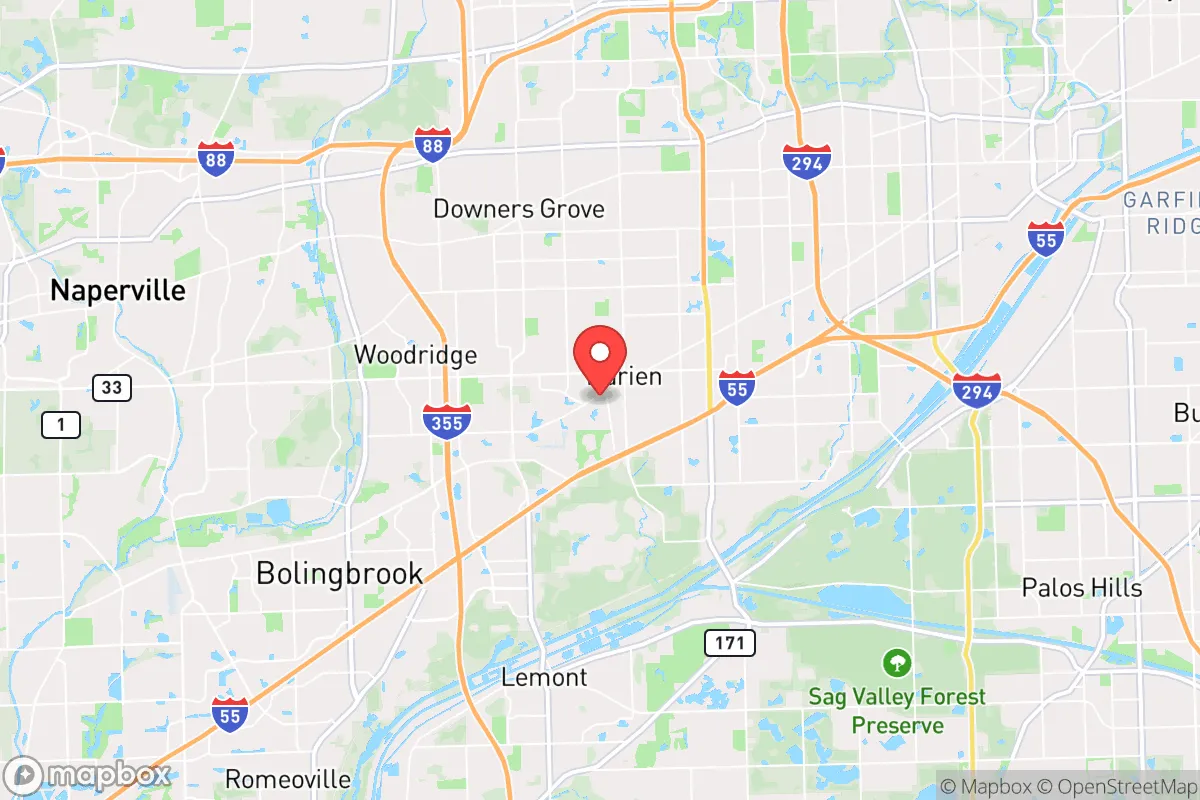
District shown is the primary district for this city’s centroid. Cities may span multiple districts.
Local Political AnalysisPolitical Analysis of Darien, IL
Darien sits in a bit of a political sweet spot, leaning Democratic but not overwhelmingly so. The area's Cook PVI of D+3 means it's about four points more conservative than Illinois as a whole, which sits at D+7. That gap has been pretty stable over the last decade, though you can feel the national trends tugging at the edges. The town itself has a long history as a solidly middle-class, family-oriented suburb, and that shows in its voting patterns: it's reliably blue in presidential years, but not by the kind of margins you see in, say, Oak Park or Evanston. In local races, Republicans can and do win here, especially when they focus on fiscal issues or school board seats.
How it compares
To understand Darien's politics, you have to look at its neighbors. Head west a few miles to Downers Grove or Naperville, and you're in D+2 or even R-leaning territory—places where the 2020 presidential race was a genuine toss-up. Go east to Hinsdale or Burr Ridge, and you're in solidly Republican country, with Cook PVIs around R+5 to R+8. Darien sits right in the middle, a kind of political buffer zone. It's not as liberal as the near-west suburbs like Berwyn or Cicero, but it's also not as conservative as the far-west exurbs. The D+3 rating reflects a community that's comfortable with moderate Democrats and pragmatic Republicans—the kind of place where a candidate's stance on property taxes or school funding matters more than their national party label. That's a real contrast with the state as a whole, where the D+7 rating is driven by Chicago's massive Democratic machine and the deep-blue collar counties.
What this means for residents
For a conservative resident, Darien isn't hostile territory. You'll find plenty of neighbors who share your views on taxes and local control, and the town's Republican organization is active enough to field candidates for village board and park district. You won't feel isolated, but you'll also notice that national Republican messaging doesn't always land here—the town's moderate streak means Trump-style populism is a tougher sell. For a liberal resident, you're in a comfortable majority, but not an overwhelming one. You'll have to engage with conservative neighbors on school issues and zoning, and you won't see the kind of progressive policy experiments you'd find in Evanston or Oak Park. What this means in practice is that Darien's politics are pragmatic and local. The big fights are about school referendums, road repairs, and the library budget—not about national culture wars. Both sides can find common ground on keeping the town safe and well-run, even if they disagree on who should be president.
One cultural distinction worth noting: Darien has a strong Catholic and Polish-American heritage, which gives its politics a slightly more socially conservative flavor than the state average. You'll see that in things like the town's stance on development and its support for parochial schools. But that's balanced by a growing population of younger families moving in from Chicago, who tend to be more liberal on social issues. The trajectory is slowly leftward, but it's a crawl, not a sprint. In the near term, expect Darien to stay D+3 to D+4, with local races remaining competitive. Long-term, if the state's Democratic trend continues, Darien might drift toward D+5, but it's unlikely to ever become a deep-blue stronghold. For now, it's one of the few places in DuPage County where you can have a genuine political conversation without shouting.

State Political ClimatePolitical Climate in Illinois
State Political AnalysisPolitical Environment in the State
Illinois is a solidly Democratic state at the statewide level, with a Cook PVI of D+7, meaning it votes about seven points more Democratic than the national average in presidential elections. The state’s political trajectory over the past 20 years has been a slow but steady march leftward, driven by the massive population and political weight of Chicago and its inner suburbs, while the rest of the state—downstate and the collar counties—has grown increasingly Republican. For a conservative relocator, the reality is a state where Democrats control every lever of government, but where the political landscape is far from monolithic, offering distinct pockets of red and purple that can feel like a different world from the state capital in Springfield.
Urban vs. rural divide
The political map of Illinois is a textbook case of the urban-rural split. The city of Chicago and its immediate suburbs—places like Evanston, Oak Park, and Naperville—are the engine of the state’s Democratic majority, delivering massive vote margins that swamp the rest of the state. Cook County alone accounts for roughly 40% of the state’s population and votes about D+30. The collar counties (DuPage, Lake, Kane, McHenry, Will) have been trending blue for a decade, especially in the inner-ring suburbs, though places like McHenry County remain reliably red. Drive two hours southwest of Chicago, and you hit downstate Illinois, where counties like Effingham, Shelby, and Jasper routinely vote 70-80% Republican. The divide is stark: in 2024, Donald Trump won 92 of Illinois’s 102 counties, but lost the state by 11 points because Cook County alone gave Joe Biden a margin of over 1.2 million votes. The state’s second-largest city, Aurora, is a purple swing town, while Peoria and Rockford lean blue but are surrounded by deep-red rural areas. For a conservative, the best bet is to look at the western and southern exurbs—places like Yorkville, Oswego, or the Quad Cities area—where you can live in a red community while still being within commuting distance of Chicago’s job market.
Policy environment
Illinois’s policy environment is defined by a progressive tax and regulatory structure that has been in place for decades. The state has a flat income tax rate of 4.95%, but a 2020 constitutional amendment to allow a graduated income tax was rejected by voters, so the flat rate remains. Property taxes are among the highest in the nation, averaging about 2.1% of home value, which is a major pain point for homeowners. The state’s regulatory posture is business-friendly in some sectors (agriculture, manufacturing) but heavily regulated in others (energy, healthcare, labor). Illinois has a $15 minimum wage, a strong union presence (especially in construction and public sector), and a state-level paid leave law. On education, Illinois spends heavily per pupil—among the top 10 states—but the funding formula is notoriously inequitable, with wealthy suburban districts like New Trier Township spending over $25,000 per student while downstate districts like Cairo struggle at under $10,000. Election laws are among the most accessible in the country: no-excuse mail voting, automatic voter registration, and same-day registration are all in place. For conservatives, the policy environment is a mixed bag: low income tax but crushing property taxes, strong labor protections, and a regulatory climate that can feel hostile to small business in certain sectors.
Recent policy direction
The last five years have seen Illinois move decisively left on a range of issues that matter to relocators. On gun and self-defense law, Illinois passed the Protect Illinois Communities Act in 2023, which bans the sale of assault weapons and high-capacity magazines, and requires a state-issued Firearm Owner’s Identification (FOID) card for all gun purchases. The law is currently being challenged in court, but it remains in effect. On parental and education rights, the state passed a law in 2021 requiring public schools to teach LGBTQ+ inclusive history, and in 2023, it banned book bans in public libraries, effectively preventing local school boards from removing books based on content. On speech and privacy, Illinois has one of the strongest biometric privacy laws in the country (BIPA), which has led to a flood of class-action lawsuits against employers. On medical and bodily autonomy, Illinois is a safe haven for abortion access, with a 2019 law codifying Roe v. Wade protections and a 2023 law expanding Medicaid coverage for abortion. Property rights are relatively strong, with no statewide rent control and a homestead exemption that shields up to $15,000 of home value from creditors. On voting and ballot access, the state has expanded early voting and mail voting, and in 2023, it passed a law requiring counties to offer ballot drop boxes. For a conservative, the recent direction is clearly toward a more regulated, more progressive state, but the pace of change is slower than in California or New York.
Civil unrest & political movements
Illinois has a history of political activism that ranges from the labor movement to the current culture wars. The 2020 George Floyd protests in Chicago were among the largest in the country, with widespread property damage and looting in the Loop and on the Magnificent Mile. Since then, organized activist movements have focused on police reform, with the state passing a sweeping police reform bill in 2021 that ended qualified immunity for officers. On the right, the Illinois Republican Party has been in disarray, with a series of weak statewide candidates and internal factional fights between moderates and Trump-aligned conservatives. Immigration politics are a flashpoint: Illinois is a sanctuary state, with a 2017 law prohibiting local law enforcement from cooperating with federal immigration authorities, and Chicago has seen a surge of migrant arrivals from the southern border since 2022, straining city resources. Election integrity controversies have been relatively muted compared to other states, though some downstate counties have passed resolutions calling for election audits. The most visible flashpoint for a new resident would be the ongoing debate over crime in Chicago, which dominates local news and political ads, though violent crime has actually declined in the city since 2021.
Projection
Over the next 5-10 years, Illinois is likely to continue its slow leftward drift, but with significant caveats. The state’s population has been declining for a decade, losing about 250,000 residents since 2020, with most leaving for Florida, Texas, and Indiana. This out-migration is disproportionately from downstate and the collar counties, which are the redder parts of the state, meaning the remaining population is becoming more Democratic. At the same time, Chicago’s economy is diversifying beyond finance and manufacturing into tech and biotech, which tends to attract younger, more liberal workers. The state’s fiscal situation is precarious—Illinois has the worst-funded pension system in the country, with a $140 billion unfunded liability—which will likely force future tax increases or service cuts. For a conservative moving in now, the expectation should be that the state will remain solidly Democratic, with progressive policies on guns, abortion, and education, but that the cost of living (especially property taxes) will continue to rise. The best-case scenario is that the state’s fiscal crisis forces a bipartisan compromise on pension reform and tax relief, but that is far from guaranteed.
For a new resident, the bottom line is that Illinois offers a high level of public services—good roads, strong schools in the suburbs, and robust healthcare—but at a high cost. Conservatives can find welcoming communities in the exurbs and downstate, but they will be living in a state where their votes are largely irrelevant in statewide elections. The practical takeaway: if you value low taxes and a light regulatory touch, Illinois is not for you. But if you want a state with a strong economy, good schools, and a vibrant cultural scene, and you’re willing to pay for it, Illinois can work—just be prepared to live in a red enclave within a blue state.
* Values derived from national, state, county, city and local statistics and may differ in a specific area. Last updated: 2026-09-10T05:18:05.000Z
Narrative content on this page is AI-generated and may contain mistakes. Verify any details that matter before acting on them.
ReloMaps may earn a commission from affiliate links at no extra cost to you.

