
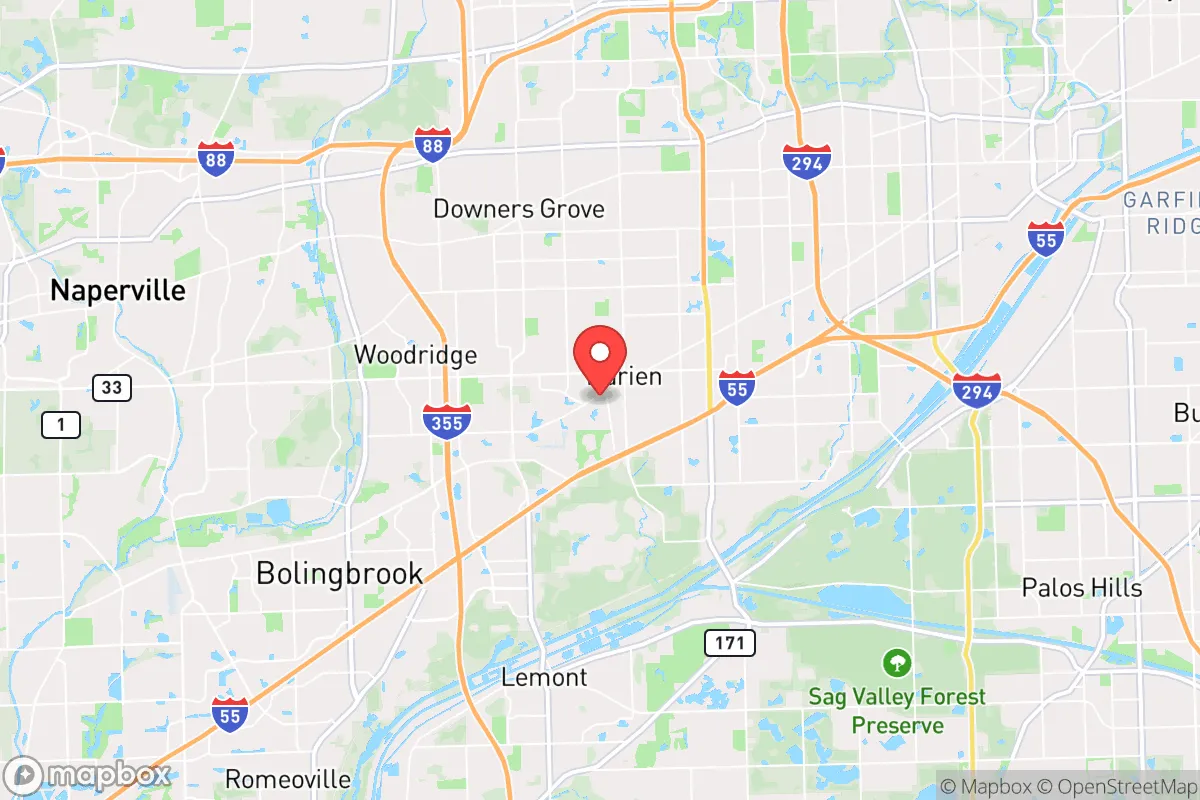
Photo: Wikipedia
Personal Sovereignty in Darien, IL
Viable for self-reliance. Generally workable, though some barriers may limit total independence.
What does Personal Sovereignty tell us?
Personal Sovereignty measures your capacity for self-reliance and independence with minimal government friction. Higher scores mean fewer barriers between you and the way you want to live... but it assumes you have the space you need and good neighbors.
What does this tell us?
Personal Sovereignty measures your capacity for self-reliance and independence with minimal government friction. Higher scores mean fewer barriers between you and the way you want to live... but it assumes you have the space you need and good neighbors.
State Policy
Energy independence: Importer (45% of energy produced in-state)
Personal Liberty
Homesteading

Personal Liberty Analysis
Darien, Illinois, offers a personal sovereignty environment that is best described as a trade-off: residents enjoy strong property rights and a well-ordered community, but operate within one of the nation's highest-tax and most regulatory-heavy state frameworks. For the freedom-minded individual or family, the key question is whether the local autonomy in daily life—solid schools, low crime, and a permissive self-defense environment—outweighs the structural constraints imposed by Springfield. The answer depends heavily on how much weight you place on tax burden versus day-to-day personal liberties.
Tax burden and regulatory posture in Darien compared to surrounding areas
Illinois imposes a heavy tax and regulatory load that directly impacts personal sovereignty. The state's flat income tax rate of 4.95% is moderate, but property taxes are among the highest in the nation. In Darien, effective property tax rates typically range from 2.0% to 2.5% of assessed home value, meaning a $400,000 home carries an annual tax bill of $8,000 to $10,000. This is roughly double the national average and significantly higher than neighboring Indiana or Wisconsin. The state also levies a 6.25% sales tax (plus local add-ons, bringing Darien's total to around 8.0%), and a gas tax of $0.39 per gallon. Regulatory posture is similarly heavy: Illinois has a statewide building code, environmental regulations that can delay construction, and a complex business licensing structure. For a homeowner, this means any major renovation—adding a deck, finishing a basement, or installing solar panels—requires permits and inspections that can take weeks. The upside is that these regulations contribute to Darien's stable property values and well-maintained neighborhoods. For the self-reliant individual, the tax burden is the single largest constraint on financial sovereignty, but the regulatory environment is predictable and consistently enforced, not arbitrary.
Self-defense and gun law specifics for Darien residents
Illinois is a "shall-issue" state for concealed carry, but with notable restrictions that affect personal sovereignty. To carry a firearm, residents must obtain a Firearm Owner's Identification (FOID) card and a separate Concealed Carry License (CCL). The FOID requires a background check and can take 30-90 days to process; the CCL requires 16 hours of in-person training and a live-fire qualification. Open carry is illegal in Illinois, and firearms are prohibited in many "sensitive places" including public parks, public transportation, and any establishment that derives more than 50% of its revenue from alcohol sales. Darien itself is a relatively safe suburb—the city's violent crime rate is less than half the national average—so the practical need for defensive firearms is lower than in urban centers. However, for the sovereignty-minded individual, the licensing requirements represent a bureaucratic hurdle. Illinois does not have a "stand your ground" law; instead, it follows a "duty to retreat" standard in public spaces, though the Castle Doctrine applies inside one's home. This means that if confronted outside the home, a Darien resident must attempt to retreat before using deadly force. For those prioritizing self-defense autonomy, this legal framework is more restrictive than in states like Texas or Florida, but it is clear and consistently applied. The local police department is responsive and professional, and there is no local ordinance that further restricts state gun laws—Darien does not have its own assault weapons ban or magazine capacity limit beyond state law.
Self-reliance and homesteading viability: lot sizes, zoning, and off-grid feasibility
Darien is a fully developed suburban community, and the scope for homesteading or off-grid living is limited. Typical residential lot sizes range from 0.25 to 0.5 acres, with some larger parcels in the older sections near the Waterfall Glen Forest Preserve. Zoning is strictly residential, and the city enforces a minimum lot size of 10,000 square feet for single-family homes. Raising backyard chickens is permitted with a permit and specific coop requirements, but larger livestock (goats, pigs, cows) is not allowed on standard residential lots. Gardening is unrestricted, and many homes have space for substantial vegetable plots. Off-grid feasibility is low: Illinois requires connection to the municipal water and sewer system in Darien, and the local building code mandates grid-tied electrical service. Solar panels are allowed but must be installed by licensed contractors and connected to the grid; net metering is available, but the state's regulatory environment makes full off-grid independence impractical. For the self-reliant individual, the best approach is to view Darien as a base for suburban self-sufficiency—growing food, preserving harvests, and reducing consumption—rather than a place for true off-grid living. The nearby forest preserves and the Des Plaines River Trail offer opportunities for foraging, hiking, and hunting (with appropriate licenses), but these are recreational, not subsistence, activities.
Personal liberties: parental rights, medical autonomy, speech, and property
Illinois has a mixed record on personal liberties that directly affects Darien residents. Parental rights are generally strong: Illinois law gives parents broad authority over their children's education, medical decisions, and upbringing. The state does not have a universal school mask or vaccine mandate for children (as of 2026), and parents can opt out of sex education or specific health curricula. However, Illinois has a comprehensive vaccination requirement for school attendance, with only medical exemptions recognized (no religious or philosophical exemptions). Medical autonomy for adults is more constrained: Illinois has a state-level vaccine mandate for healthcare workers and long-term care facility employees, and the state's emergency powers allow the governor to impose public health orders. For the sovereignty-minded, this is a significant concern. Free speech is protected under the First Amendment, and Darien has no local ordinances restricting political expression, signage, or assembly. Property rights are well-defined: Illinois has a strong tradition of protecting private property, and eminent domain is used sparingly. Darien's zoning is stable, and there are no rent control or landlord-tenant laws that significantly restrict property owners. The city does have a stormwater management fee and a vehicle sticker requirement (around $30 per year), which are minor but illustrative of the local regulatory touch. Overall, personal liberties in Darien are strongest in the areas of property and speech, moderate in parental rights, and weakest in medical autonomy and tax burden.
Compared to other suburbs in the Chicago region, Darien offers a relatively high degree of personal sovereignty in daily life—low crime, good schools, and a predictable regulatory environment—but the structural constraints of Illinois state law (high taxes, gun licensing, limited off-grid feasibility) are unavoidable. For a family that values community stability and property rights and is willing to accept a higher tax burden in exchange for excellent public services, Darien is a strong choice. For an individual seeking maximum autonomy with minimal government interference, a state like Indiana or Missouri would offer a lighter touch. Darien's sovereignty is real but conditional: it works best for those who prioritize local safety and order over low taxes and minimal regulation.

* Values derived from national, state, county, city and local statistics and may differ in a specific area. Last updated: 2026-09-10T05:18:05.000Z
Narrative content on this page is AI-generated and may contain mistakes. Verify any details that matter before acting on them.
ReloMaps may earn a commission from affiliate links at no extra cost to you.

