
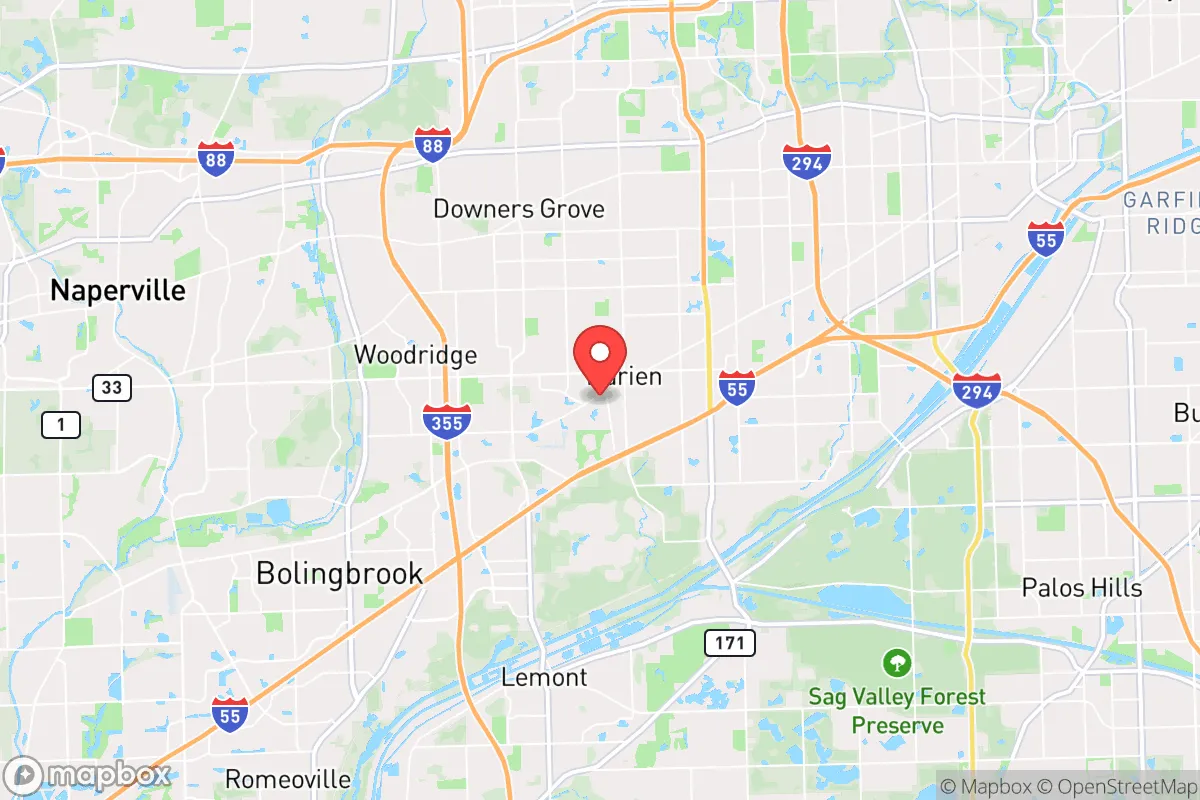
Photo: Wikipedia
Demographics of Darien, IL
Affluence Level in Darien, IL
A middle-class area roughly in line with national averages across income, home values, education, and employment.
People of Darien, IL
The people of Darien, Illinois, today number 21,855, forming a predominantly white-collar, family-oriented suburb with a notably high college attainment rate of 51.7%. The city is characterized by a stable, largely owner-occupied housing stock and a population that is 73.6% white, with growing East/Southeast Asian (7.7%) and Indian-subcontinent (3.4%) communities, alongside a Hispanic population of 8.6% and a Black population of 2.7%. Darien’s identity is that of a quiet, well-educated enclave where long-term residents mix with newer immigrant families drawn by the area’s top-rated schools and safe neighborhoods.
How the city was settled and grew
Darien’s human history begins not with a grand founding, but as a quiet crossroads in the mid-19th century. The area was originally part of the vast prairie land opened to settlement by the 1830s land grants and the construction of the Illinois & Michigan Canal. Early settlers were primarily of German and Irish stock, drawn by fertile farmland and the promise of the Chicago & Alton Railroad, which arrived in the 1860s. The original village core, now known as Downtown Darien, grew around the railroad depot and a handful of general stores. A second early node, Lacey Creek, developed as a farming hamlet to the south. These communities remained small and agricultural through the early 1900s, with the population barely topping 1,000 by 1950. The real transformation came after World War II, when the post-war housing boom and the expansion of the Stevenson Expressway (I-55) turned Darien into a classic bedroom suburb. The Brookbank and Hinsbrook subdivisions, built in the 1950s and 1960s, absorbed the first wave of white, middle-class families fleeing Chicago for new ranch homes and split-levels.
Modern era (post-1965)
The 1965 Immigration and Nationality Act reshaped Darien’s population, though the change was gradual. Through the 1970s and 1980s, the city remained overwhelmingly white, with new subdivisions like Carriage Way and Farmingdale Village attracting second-generation suburbanites and a small number of professional families from Chicago’s ethnic enclaves. The most significant demographic shift began in the 1990s and accelerated after 2000, as East/Southeast Asian families—particularly of Chinese, Korean, and Filipino heritage—began moving into the Westlake and Lakeview neighborhoods, drawn by the reputation of Hinsdale Central High School and the area’s low crime rates. Simultaneously, a smaller but notable wave of Indian-subcontinent professionals (engineers, doctors, IT managers) settled in the newer Hidden Lake Estates area. The Hispanic population, which now stands at 8.6%, grew more slowly, largely through families moving from nearby Downers Grove and Westmont into older, more affordable housing stock in the Lacey Creek area. The Black population remains modest at 2.7%, concentrated in no single neighborhood but present across the city’s newer subdivisions. Today, Darien’s foreign-born population is 5.8%, a figure that understates the cultural influence of its Asian and Indian communities, who are heavily represented in local school leadership and small business ownership.
The future
Darien’s population is projected to remain stable in size but continue its gradual diversification. The white share, while still dominant, is slowly declining as older residents age in place and younger, more diverse families move in. The East/Southeast Asian and Indian-subcontinent populations are expected to grow further, driven by the area’s reputation for academic excellence and proximity to corporate employers in the I-88 and I-55 corridors. New construction is limited—Darien is largely built out—so future growth will come from infill development and the resale of existing homes, particularly in the Brookbank and Carriage Way neighborhoods, where turnover is highest. The Hispanic population is likely to increase modestly, while the Black population may grow slowly as housing affordability pressures push families from more expensive suburbs like Naperville and Hinsdale into Darien. The city’s cultural identity is evolving from a quiet, homogenous suburb into a more cosmopolitan, education-focused community, though it retains a distinctly Midwestern, family-first character.
For someone moving in now, Darien offers a stable, low-crime environment with excellent schools and a population that is becoming more diverse in a measured, organic way. It is not a place of rapid change or high energy, but rather a well-maintained, middle-to-upper-middle-class suburb where new residents—particularly those with school-age children—will find a welcoming, if reserved, community. The bottom line: Darien is a safe bet for families who value education and stability, and who are comfortable with a gradual, rather than dramatic, demographic evolution.

* Values derived from national, state, county, city and local statistics and may differ in a specific area. Last updated: 2026-09-10T05:18:05.000Z
Narrative content on this page is AI-generated and may contain mistakes. Verify any details that matter before acting on them.
ReloMaps may earn a commission from affiliate links at no extra cost to you.

