Photo: Wikipedia
Demographics of Custer, SD
Affluence Level in Custer, SD
A middle-class area roughly in line with national averages across income, home values, education, and employment.
People of Custer, SD
The people of Custer, South Dakota, today number 2,148, forming a predominantly white (89.0%) and native-born (98.4% U.S.-born) community with a distinctive Western character. The city’s identity is shaped by its role as a gateway to Mount Rushmore and the Black Hills, a retirement and tourism hub, and a place where generational ranching families live alongside newer arrivals seeking a quieter, conservative lifestyle. With 30.1% holding a college degree and a foreign-born population of just 1.6%, Custer remains ethnically homogenous, with small East/Southeast Asian (1.0%) and Hispanic (1.9%) communities, and no Black or Indian subcontinent residents recorded.
How the city was settled and grew
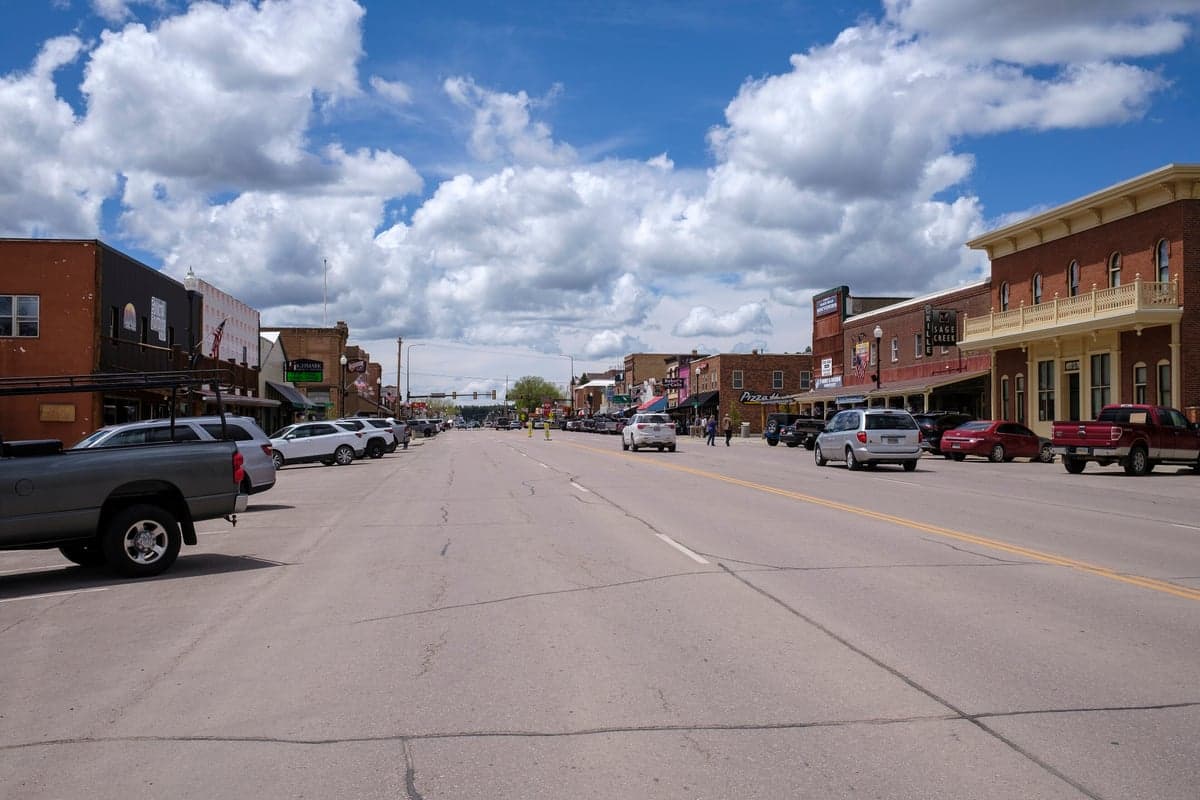
Custer’s human history begins with the 1874 Custer Expedition, which discovered gold in French Creek, triggering a rush of white prospectors and miners. The city was founded in 1875 as a mining camp, named after General George Armstrong Custer, and quickly became a supply and government center for the Black Hills gold boom. The original population was overwhelmingly of Northern European descent—Cornish, Irish, German, and Scandinavian—who built the first homes and businesses in what is now Historic Downtown Custer, along Mount Rushmore Road. The city’s early growth was tied to gold, timber, and later, tourism after Mount Rushmore’s construction began in 1927. By the mid-20th century, Custer’s population had stabilized around 1,500, with families settling in West Custer (near the Custer State Park boundary) and East Custer (along Highway 16), where ranching and service-industry jobs anchored the community. No significant immigrant waves arrived during this period; the city remained a closed, white-majority enclave shaped by federal land policies and the Homestead Act’s legacy.
Modern era (post-1965)
After the 1965 Immigration and Nationality Act, Custer saw virtually no change in its ethnic composition. The foreign-born share (1.6%) is among the lowest in South Dakota, and the city’s growth has come almost entirely from domestic in-migration—retirees from the Midwest, remote workers, and families seeking low crime and outdoor recreation. The small East/Southeast Asian community (1.0%) is concentrated in Pine Crest, a newer subdivision near the Custer Regional Airport, where a handful of Korean- and Vietnamese-owned motels and restaurants serve tourists. The Hispanic population (1.9%) is scattered, with no distinct barrio; most work in seasonal hospitality or construction and live in rental units along Mount Rushmore Road. The Black and Indian subcontinent populations remain at zero, reflecting the city’s lack of economic pull for diverse labor markets. Suburbanization has been minimal; newer developments like Rocky Knoll Estates (built in the 2000s) attract affluent retirees and second-home owners, while French Creek Estates draws younger families priced out of nearby Rapid City. The city’s white share (89.0%) has held steady, with no significant racial or ethnic diversification since 1965.
The future
Custer’s population is projected to grow slowly, driven by tourism expansion and remote-work migration, but its demographic profile will likely remain static. The foreign-born share is unlikely to rise above 3% in the next decade, as the city lacks the industrial or agricultural jobs that attract immigrant labor in other parts of South Dakota. The East/Southeast Asian and Hispanic communities are plateauing, with no signs of enclave formation or rapid growth; most second-generation members assimilate into the white-majority culture. The city is not tribalizing into distinct ethnic neighborhoods—rather, it is homogenizing further, with new subdivisions like Sunrise Ridge attracting only white, middle-class families. The biggest demographic shift may be aging: the median age (mid-40s) is rising as retirees outnumber young families, a trend that could slow school enrollment and increase demand for healthcare services. No significant Black or Indian subcontinent in-migration is expected, given the city’s distance from urban job centers and its overwhelmingly white social fabric.
For someone moving in now, Custer is becoming a stable, culturally uniform retirement and tourism community—safe, politically conservative, and resistant to demographic change. The city offers a predictable, low-diversity environment where newcomers will find a population that is older, whiter, and more native-born than the national average. If you value ethnic homogeneity, low crime, and a Western small-town atmosphere, Custer delivers; if you seek racial or cultural diversity, you will need to look elsewhere.

* Values derived from national, state, county, city and local statistics and may differ in a specific area. Last updated: 2026-05-01T05:57:08.000Z
Narrative content on this page is AI-generated and may contain mistakes. Verify any details that matter before acting on them.
ReloMaps may earn a commission from affiliate links at no extra cost to you.

