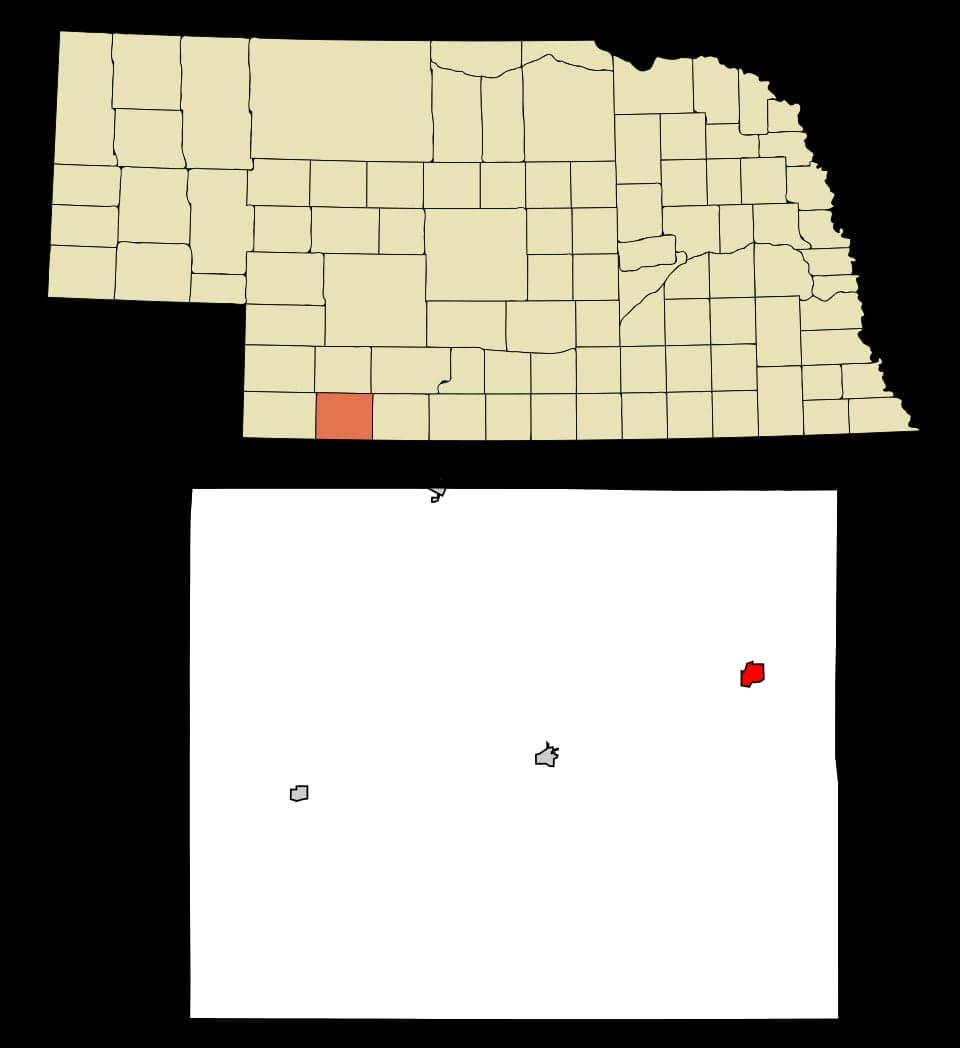
Photo: Wikipedia
Strategic Assessment of Culbertson, NE
Strong survivability profile. Good buffer from population centers, with manageable environmental and tactical risks.
What does the Strategic Assessment tell us?
Our Strategic Assessment grades tactical survivability of an area. Major population centers, military targets, fallout zones, natural disasters, and border exposure all drive risk — lower exposure means a more defensible position in a crisis.
This is heavily inspired by Joel Skousen's Strategic Relocation book. Highly recommended you checkout the book ($)What does this tell us?
Our Strategic Assessment grades tactical survivability of an area. Major population centers, military targets, fallout zones, natural disasters, and border exposure all drive risk — lower exposure means a more defensible position in a crisis.
This is heavily inspired by Joel Skousen's Strategic Relocation book. Highly recommended you checkout the book ($)Strategic Pillars

Key Distances
Regional Safe Places
Below is our recommended "safe zones" in Nebraska and the surrounding area based on our strategic heuristics. For most people, it's unrealistic to live in a “safe zone” full-time due to work, family or other personal reasons. They tend to be more rural. However, many of these areas are perfect for second homes and retreat properties that double as a vacation home or even a short-term rental.
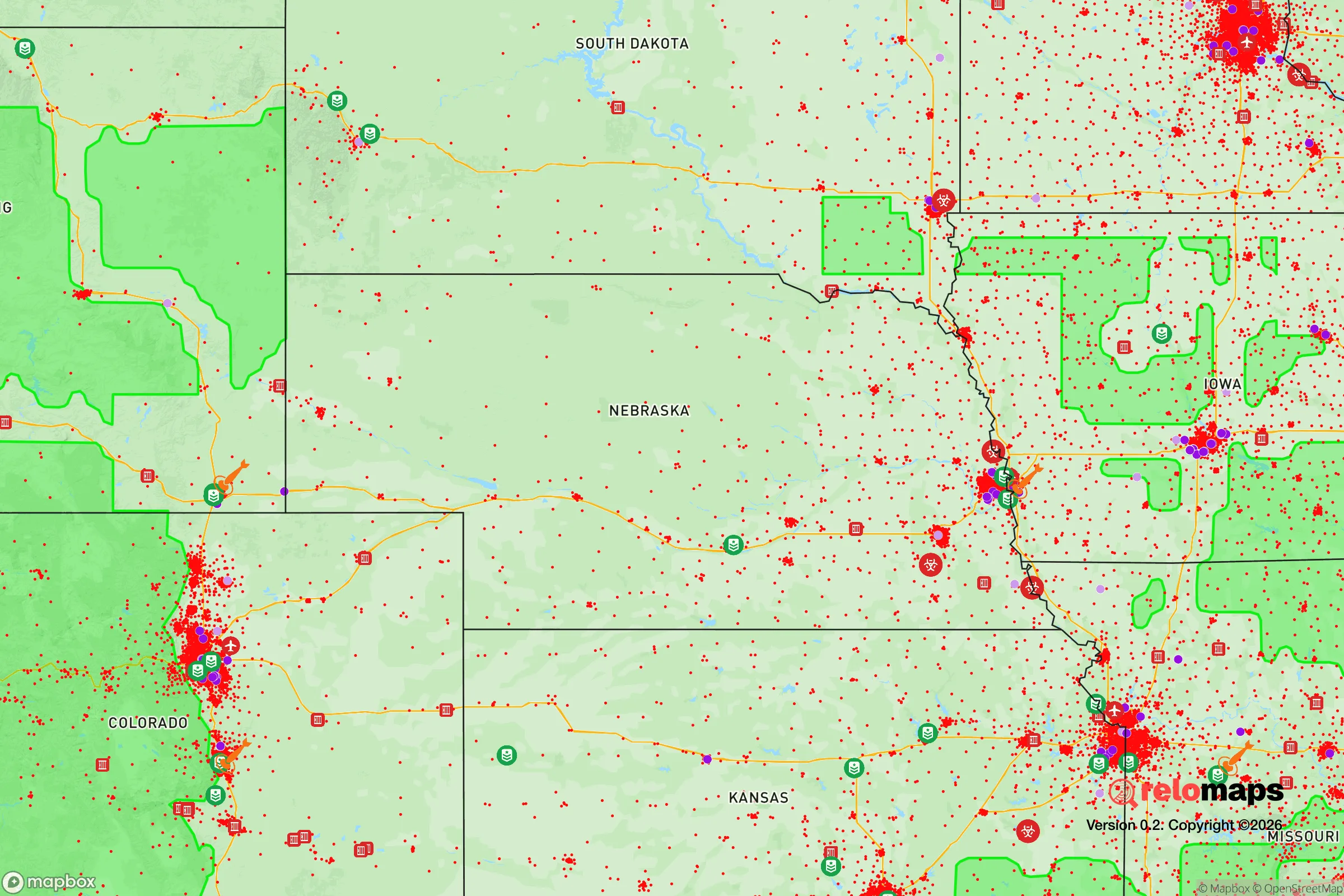
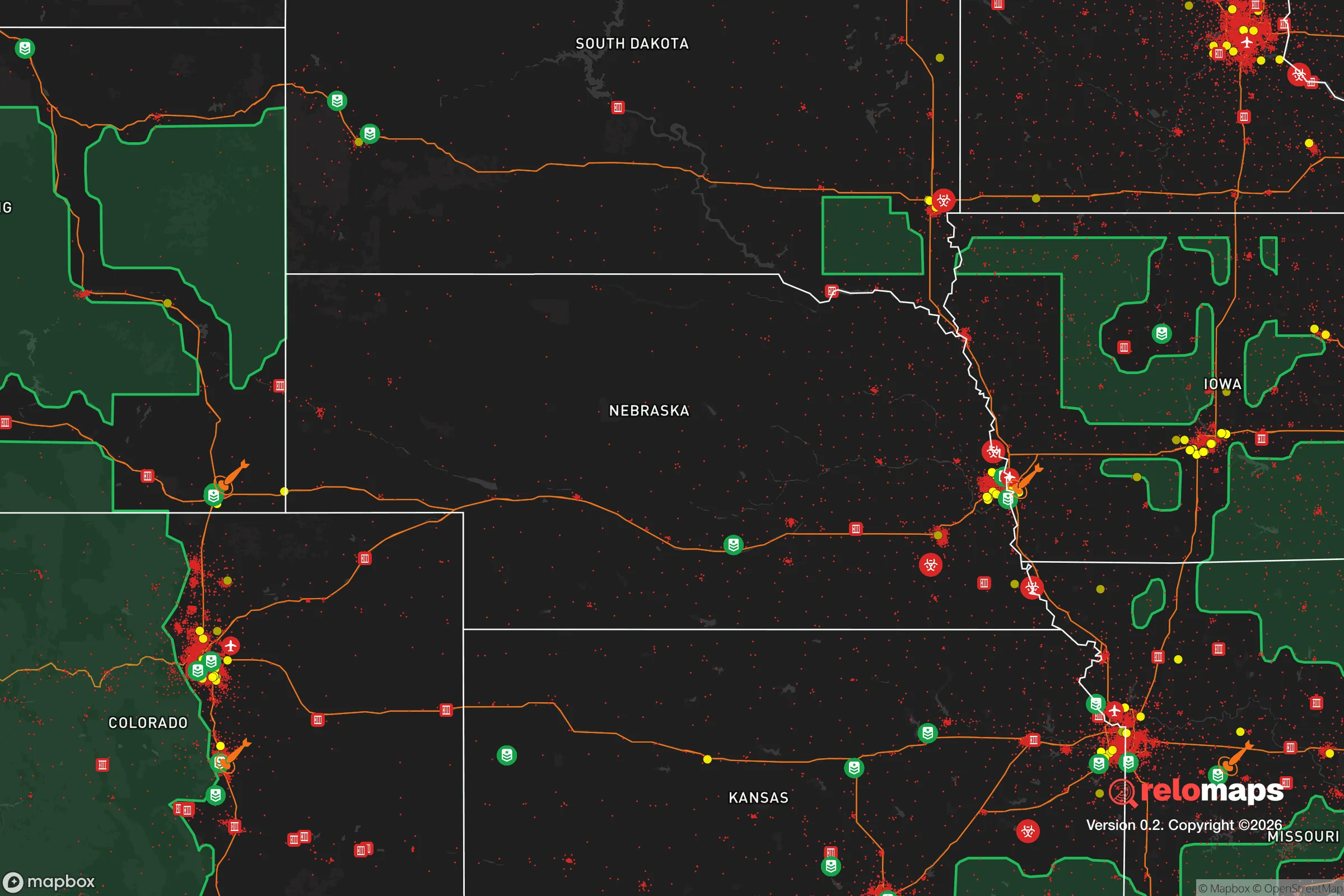


Important Note: For informational purposes only. This does not mean nothing bad ever happens in the green zones. Please use common sense. This is based on public data and modeled with AI. We tried to take a conservative approach but mistakes happen. We update this regularly as new information becomes available.
Solar Generator Recommendations
Backup power matters more here than in safer locations. We've picked three solar generators across budgets and capacity tiers — start with the budget unit if you only need a few essentials, or step up if you want to run a fridge and HVAC for days at a time.

Jackery Portable Power Station Explorer 300
Budget OptionPower on the Go: Weighing only 11 lbs, it's convenient to set up and store with book-sized foldable solar panels

BLUETTI Portable Power Station AC180
Designed for both indoor and outdoor scenarios, AC180 is highly capable as it has a robost capacity and continuous output power.

EF ECOFLOW DELTA Pro Ultra Power Station
Upgraded PickEcoFlow DELTA Pro Ultra is a whole-home energy system designed to grow with your family. Integrated with the Smart Home Panel 2, it scales to meet your evolving energy needs — keeping your home powered, intelligent, and secure through every stage of life.
We earn a commission, at no additional cost to you.
Strategic Assessment Analysis
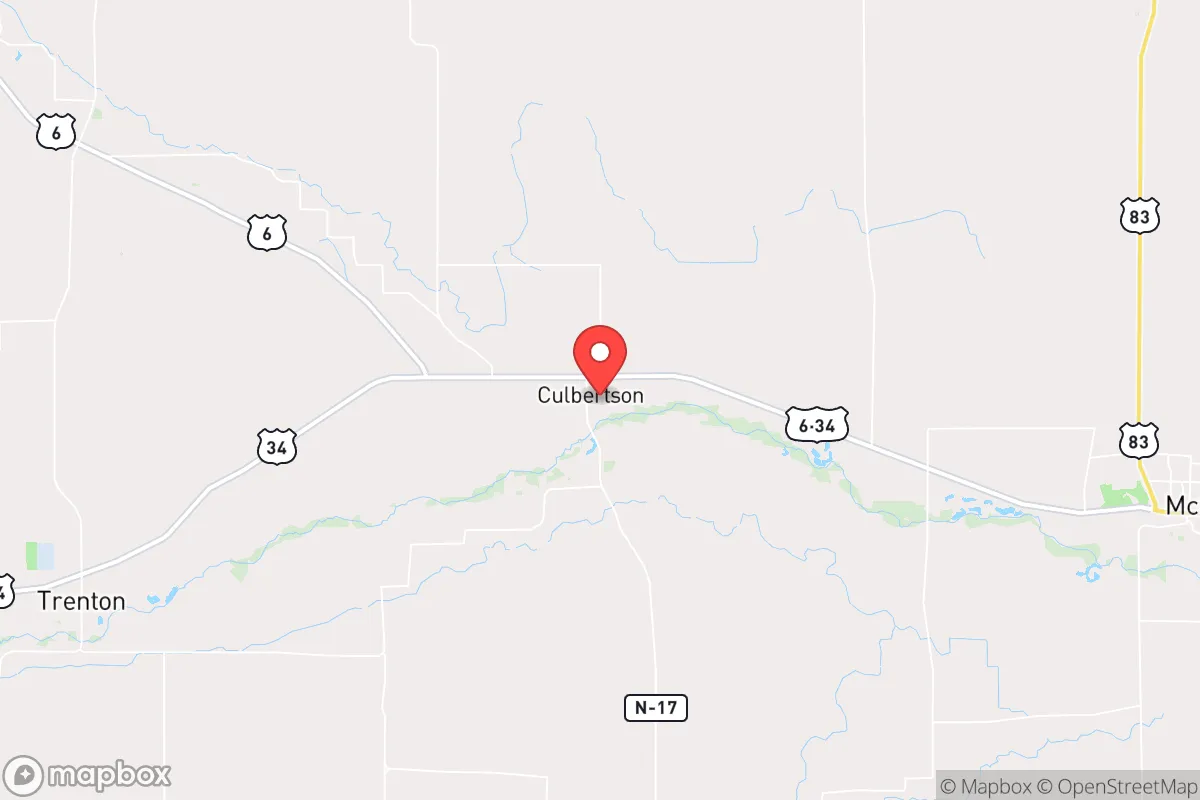
Culbertson, Nebraska, sits in the far southwestern corner of the state, a position that offers a distinct blend of isolation and strategic access for those prioritizing resilience and self-sufficiency. With a population hovering around 600, this small town is anchored by the Republican River and the Burlington Northern Santa Fe rail line, providing both a water source and a logistical backbone. Its location near the intersection of U.S. Highway 6 and U.S. Highway 34 places it roughly 15 miles from the Colorado border and 20 miles from Kansas, making it a quiet crossroads rather than a bustling hub. For a relocator focused on disaster readiness, Culbertson’s primary advantage is its distance from major population centers—Denver is about 200 miles west, and Omaha is over 300 miles east—while still being within a day’s drive of essential supplies and medical care in McCook (20 miles east) or North Platte (90 miles east). This balance of remoteness and accessibility is rare on the Great Plains.
Geographic position and natural advantages for long-term stability
Culbertson sits in the Republican River Valley, a region defined by flat to gently rolling terrain that is part of the High Plains aquifer system. The Republican River itself is a perennial stream, fed by irrigation runoff and groundwater, which provides a reliable surface water source—a critical asset for any long-term self-sufficiency plan. The area’s elevation, around 2,600 feet, places it above the flood-prone zones of the lower Missouri basin, though localized flash flooding from heavy rains is a periodic concern. The climate is semi-arid, with average annual precipitation of about 20 inches, mostly falling during the growing season from April to September. This supports dryland farming and ranching, but also means that drought is a recurring risk—the 2012 drought, for example, severely impacted local corn and soybean yields. For a relocator, the key natural advantage is the aquifer: the Ogallala formation underlies much of the region, and while it is being depleted at a rate of about 1-2 feet per year in some areas, it still offers a deep groundwater reserve that surface water alone cannot match. The flat terrain also simplifies construction of earth-sheltered homes or root cellars, and the wide-open views provide excellent situational awareness—no one is sneaking up on you here.
Risk exposure and proximity to fallout-relevant landmarks
Culbertson’s greatest resilience strength is also its greatest vulnerability: its location near the Nebraska-Kansas-Colorado tri-state area. While this keeps it far from the direct blast zones of major cities, it sits within a broader region that includes several potential man-made risks. The most significant is the proximity to the Burlington Northern Santa Fe rail line, which runs directly through town. This line carries freight including hazardous materials—such as anhydrous ammonia, chlorine, and petroleum products—between Denver and the Midwest. A derailment or spill could contaminate local water supplies or require evacuation, though the low population density reduces the scale of such an event. More concerning for a preparedness-minded reader is the presence of the U.S. Strategic Command (STRATCOM) at Offutt Air Force Base near Omaha, about 300 miles east. While not a direct target, Culbertson lies within the broader fallout shadow of a potential nuclear exchange targeting STRATCOM or the Minuteman III missile silos scattered across western Nebraska and eastern Colorado. The nearest silo is roughly 80 miles north, near Ogallala. Prevailing winds in the region are from the west and northwest, meaning fallout from a strike on Denver or Cheyenne would likely be carried eastward, away from Culbertson. However, a strike on the missile fields to the north could push contamination southward. The area also experiences occasional severe weather—tornadoes are a risk, though the town has never suffered a direct hit from an EF3 or stronger storm in recorded history. Hail and straight-line winds are more common, with the 2019 Memorial Day storm causing widespread crop damage. For a relocator, the key takeaway is that Culbertson is not a primary target, but it is within the secondary risk zone of both rail transport hazards and strategic military infrastructure.
Practical resilience for a relocator: food, water, energy, and defensibility
For someone serious about self-sufficiency, Culbertson offers a strong foundation but requires deliberate preparation. Water is the most reliable asset: the Republican River flows year-round, and shallow wells (typically 30-60 feet deep) can tap into the alluvial aquifer for household use. The town’s municipal water system draws from the river and is treated, but a private well with a hand pump or solar-powered pump is a straightforward backup. The river’s flow is regulated by upstream dams like Swanson Lake and Enders Reservoir, which buffer against extreme drought but also mean that a prolonged grid-down scenario could reduce flow if dam operations cease. Food production is viable but not effortless: the growing season averages 150 frost-free days, enough for corn, beans, squash, and hardy vegetables. Local soil is loamy with good drainage, but irrigation is essential in dry years—rainwater catchment from a 1,000-square-foot roof can yield about 12,000 gallons annually, supplementing well water. The area supports cattle ranching, and small-scale poultry or hog operations are feasible. For long-term storage, the dry climate (average humidity around 60%) reduces spoilage risks for grains and dried goods. Energy independence is achievable: the region averages 5.5 peak sun hours per day, making solar photovoltaic systems viable year-round. Wind is also a resource—average speeds of 12-15 mph at 50 meters height—but small wind turbines require more maintenance and are less common. Natural gas is available in town, but for off-grid living, propane or wood are the primary heating alternatives. Defensibility is a mixed picture: Culbertson’s layout is a classic Plains grid, with wide streets and open fields on all sides. This provides clear lines of sight but limited natural cover. The town has no police department—law enforcement is provided by the Hitchcock County Sheriff’s Office, based in Trenton, 10 miles east—so response times for emergencies are 15-30 minutes. For a relocator, this means self-reliance in security is non-negotiable. The nearest hospital is in McCook, 20 miles east, which is a Level IV trauma center—adequate for routine injuries but not for major trauma. For serious medical events, transport to North Platte (90 miles) or Denver (200 miles) is required. The local economy is based on agriculture, with the largest employers being the school district and a few grain elevators, so supply chains for non-food goods are thin—stockpiling tools, ammunition, and medical supplies before moving is strongly advised.
Overall, Culbertson presents a solid strategic option for a relocator who values isolation, water access, and a low-risk profile over convenience and amenities. It is not a fortress—no place on the Plains is—but its distance from major targets, reliable water source, and agricultural base make it a defensible location for a prepared individual or family. The trade-offs are real: limited medical care, thin local supply chains, and exposure to rail hazards and severe weather. But for someone willing to invest in solar, a well, and a deep pantry, Culbertson offers a quiet corner of the Great Plains where resilience is built, not bought. The key is to arrive with a plan, not just a dream—this is a place where preparation determines outcome, not luck.

* Values derived from national, state, county, city and local statistics and may differ in a specific area. Last updated: 2026-09-27T15:28:38.000Z
Narrative content on this page is AI-generated and may contain mistakes. Verify any details that matter before acting on them.
ReloMaps may earn a commission from affiliate links at no extra cost to you.

