 Popular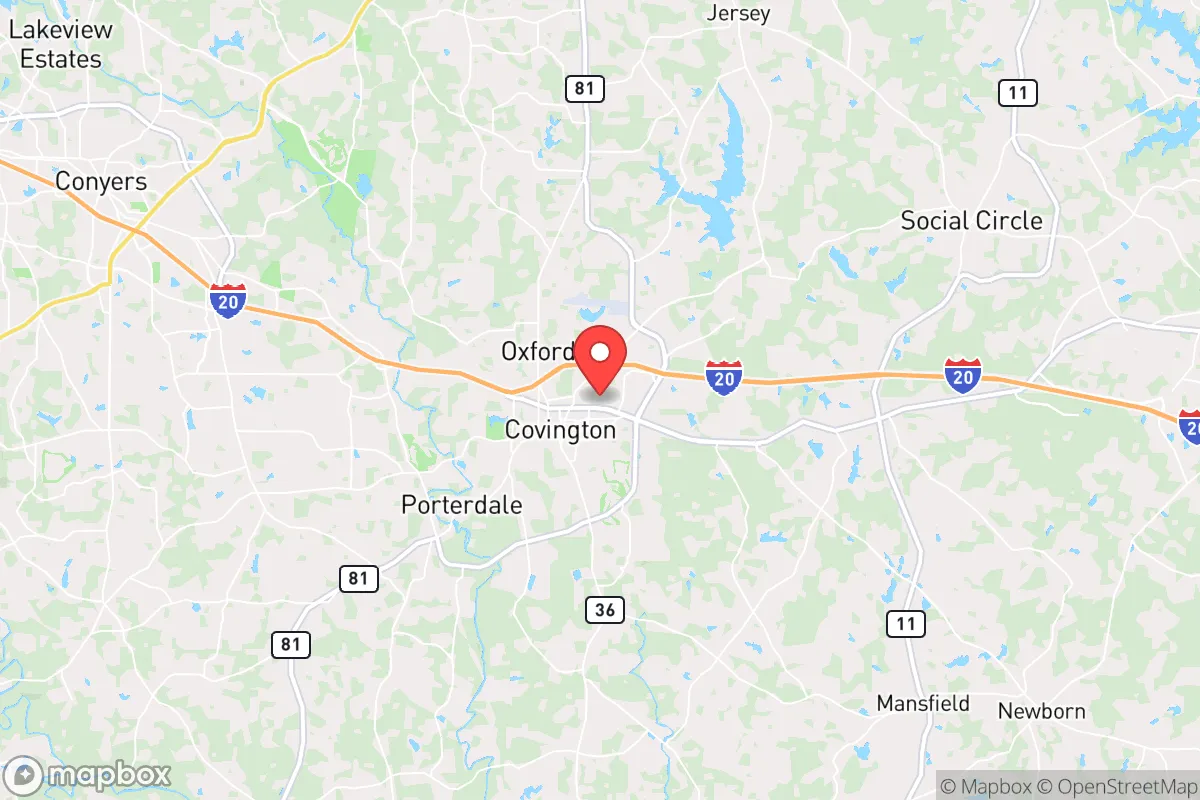
Photo: Wikipedia
Political ClimatePolitical Climate in Covington, GA
District shown is the primary district for this city’s centroid. Cities may span multiple districts.
Local Political AnalysisPolitical Analysis of Covington, GA
Covington, Georgia, has a political climate that leans decisively Democratic, with a Cook Partisan Voting Index (PVI) of D+21, making it one of the more reliably blue areas in the state. This isn't a recent flip, but a long-standing trend that has only deepened over the last decade as the Atlanta metro area's liberal influence has pushed further east along I-20. While the surrounding county, Newton, has been trending blue, Covington itself is the anchor of that shift, and you can feel it in local elections and everyday conversations. The trajectory here is toward a more solidly Democratic identity, though it's not without its conservative pockets, especially as you get closer to the more rural edges of the county.
How it compares
Compared to the rest of Georgia, Covington is a clear outlier. The state as a whole is a classic purple battleground, with a Cook PVI that's essentially even (D+3 as of 2024, but often cited as a toss-up). That means Covington's D+21 is about 18 points more Democratic than the state average. To put it in perspective, drive 15 minutes west on I-20 and you hit Conyers (Rockdale County), which is even more Democratic (D+27). But head 20 minutes east to Social Circle or 30 minutes south to Jackson (Butts County), and you'll find communities that vote reliably Republican, often by double digits. Even within Newton County, the northern parts near the Alcovy River and the more rural stretches around Mansfield lean red, while Covington's city limits and the newer subdivisions near the Covington Square are solidly blue. This creates a real patchwork: you can go from a yard full of Harris-Walz signs to a Trump flag in under a mile.
What this means for residents
For liberal residents, Covington feels like a comfortable bubble within a swing state. You can expect your local elected officials—from the mayor to the county commission—to generally align with progressive priorities on issues like affordable housing, public transit expansion (the proposed I-20 bus rapid transit line is a hot topic), and environmental protections for the Alcovy River. Conservative residents, however, aren't marginalized. They hold significant sway in countywide races where turnout from the rural precincts can balance the city vote, and they're well-organized around property rights, Second Amendment issues, and keeping taxes low. The practical reality is that most local debates are about growth management, not culture wars. The biggest fights in Covington right now are over zoning for new apartment complexes and how to fund the school system's aging infrastructure—issues that don't split neatly along party lines.
Culturally, Covington wears its politics lightly in day-to-day life. The famous town square, used as a filming location for The Vampire Diaries, is a gathering spot where you'll see MAGA hats and "In This House We Believe" signs coexisting at the Saturday farmers market. The biggest policy distinction you'll notice is in how the city approaches development: Covington has been more aggressive than its neighbors in requiring affordable housing set-asides in new subdivisions, a policy that conservative-leaning towns like Social Circle have resisted. For the long-time resident, the change has been gradual but unmistakable—the old "everyone knows everyone" dynamic has given way to a more diverse, politically engaged community that's still figuring out how to balance its small-town charm with its role as a bedroom suburb of Atlanta. If you're moving here, expect to have neighbors with very different bumper stickers, but also expect to find common ground on the things that actually matter day-to-day, like keeping the parks clean and the traffic moving.

State Political ClimatePolitical Climate in Georgia
State Political AnalysisPolitical Environment in the State
Georgia has transformed from a reliably Republican stronghold into the nation’s premier swing state over the past two decades, with a partisan lean that now sits at roughly R+3 to D+1 depending on the election cycle. The state’s 16 electoral votes flipped for Joe Biden in 2020 by fewer than 12,000 votes, then backed Donald Trump in 2024 by about 117,000 votes, illustrating a razor-thin margin that makes every precinct count. The driving force behind this shift is the explosive growth of metro Atlanta’s diverse suburbs, which have pulled the state leftward even as deep-red rural counties and exurbs push back, creating a political environment where control of the state legislature and governor’s mansion remains Republican but presidential outcomes are genuinely competitive.
Urban vs. rural divide
The political map of Georgia is a study in stark contrasts. Metro Atlanta’s core counties—Fulton, DeKalb, Cobb, Gwinnett, and Clayton—cast roughly 60% of the state’s votes and lean heavily Democratic, with Fulton and DeKalb routinely delivering 75-85% of their ballots to Democratic candidates. The suburbs north of Atlanta, like Alpharetta and Roswell, have shifted dramatically: Cobb County, which voted for Mitt Romney by 12 points in 2012, backed Joe Biden by 14 points in 2020. Meanwhile, the rural “Black Belt” counties in southwest Georgia, such as Albany and Macon, are reliably Democratic but have shrinking populations. The real Republican strongholds are the exurban and rural counties surrounding Atlanta—places like Forsyth County (north of the city) and Paulding County (west), which vote 70-80% Republican. South Georgia’s agricultural counties, including Valdosta and Thomasville, also lean conservative but with less intensity than the Atlanta exurbs. The coastal city of Savannah (Chatham County) is a Democratic-leaning urban center, while the surrounding coastal counties remain Republican. This geographic split means that a candidate can win the state by running up margins in metro Atlanta while losing the rest of the state by 20-30 points.
Policy environment
Georgia’s policy environment reflects its Republican-controlled legislature and governor’s office, but with notable moderation on economic issues. The state has a flat income tax rate of 5.49% (scheduled to drop to 4.99% by 2029), a corporate tax rate of 5.75%, and a state sales tax of 4% (local options push it to 7-8% in most areas). Property taxes are relatively low, with a median effective rate of 0.87% of home value. The state is a “right-to-work” state with no state-level minimum wage (federal $7.25 applies), and it has some of the nation’s weakest labor union protections. On education, Georgia has a robust charter school system and a school voucher program (the Georgia Promise Scholarship Act, passed in 2024) that provides $6,500 per student for private school tuition in low-performing districts. The state’s public schools are locally funded through property taxes, creating wide disparities between wealthy suburbs like Johns Creek and rural districts. Healthcare policy is mixed: Georgia expanded Medicaid under the Affordable Care Act only partially (the “Georgia Pathways” work requirement program, which has low enrollment), and the state has some of the highest uninsured rates in the country. Election laws have been a flashpoint: the 2021 Election Integrity Act (SB 202) added voter ID requirements for absentee ballots, limited drop boxes, and restricted third-party ballot collection, while also expanding early voting hours in rural counties. The state also has a “stand your ground” self-defense law and permitless carry (HB 218, passed in 2022).
Recent policy direction
Georgia’s recent legislative trajectory has been consistently conservative, with a focus on cultural and economic issues that appeal to the GOP base. On gun rights, the 2022 permitless carry law (HB 218) allows any legal gun owner to carry a concealed firearm without a license, while the 2024 “Safe Carry Protection Act” further restricted local governments from regulating firearms in public spaces. On education and parental rights, the 2022 “Parents’ Bill of Rights” (SB 449) requires schools to notify parents of any curriculum changes involving sexuality or gender identity, and the 2024 “Protect Students First Act” bans classroom instruction on gender identity and sexual orientation in grades K-8. On abortion, Georgia’s 2019 “Heartbeat Bill” (HB 481) bans abortion after a fetal heartbeat is detected (around six weeks), with exceptions for rape, incest, and medical emergencies; the law was blocked by courts until 2022 and remains in effect. On voting, SB 202 (2021) remains the most consequential law, though its impact has been debated—turnout in 2022 and 2024 remained high, suggesting the law didn’t suppress turnout as critics feared. On property rights, Georgia has no statewide rent control and limited zoning reform, though Atlanta has pursued upzoning in some neighborhoods. The state also passed a 2023 law (HB 133) restricting foreign ownership of agricultural land, particularly near military bases. On privacy and surveillance, Georgia has no comprehensive data privacy law, though a 2024 bill (SB 394) created a limited consumer data protection framework for large companies.
Civil unrest & political movements
Georgia has been a focal point for political activism on both sides. The 2020 election aftermath saw massive protests in Atlanta over racial justice (following George Floyd’s death) and election integrity (the “Stop the Steal” movement). The 2021 Senate runoff elections drew national attention, with record turnout and intense campaigning. Immigration politics are less visible than in border states, but the 2024 “Georgia Criminal Alien Act” (HB 1105) requires local law enforcement to cooperate with ICE detainers and penalizes “sanctuary” policies. No Georgia county has declared itself a sanctuary jurisdiction, though Atlanta’s city council passed a symbolic resolution in 2017. Election integrity remains a live issue: the 2020 audit and recount (three times, including a hand recount) affirmed Biden’s win, but many Republican voters remain skeptical, and the state GOP has pushed for further restrictions on mail-in voting. Organized activist groups include the Georgia Democratic Party’s “Stacey Abrams” network (Fair Fight Action) and conservative groups like the Georgia Republican Assembly and the Georgia Right to Life. Visible flashpoints include the “Cop City” protests in Atlanta (2023-2024) over a proposed police training facility, which led to arrests and a controversial state law (SB 44) expanding penalties for protest-related offenses. A new resident would notice political yard signs and bumper stickers are common in suburbs, but less so in rural areas where politics is more private.
Projection
Over the next 5-10 years, Georgia is likely to remain a competitive swing state, but with a slight rightward tilt driven by in-migration patterns. The Atlanta suburbs are still diversifying and trending Democratic, but the pace of that shift is slowing as the suburbs fill up. Meanwhile, the exurban counties (Forsyth, Paulding, Cherokee) are growing rapidly with conservative-leaning families moving from higher-tax states like California and New York. The state’s population is projected to grow by 1.5-2 million by 2035, with most of that growth in the Atlanta metro and the “Golden Corridor” along I-85 toward Greenville, SC. Rural counties will continue to lose population, reducing their electoral weight. The state legislature is likely to remain Republican-controlled through at least 2030 due to gerrymandering, but the governor’s race and presidential contests will be toss-ups. A new resident moving to Atlanta or Savannah should expect a blue-leaning urban environment with progressive local policies, while someone settling in Gainesville or Warner Robins will find a deeply conservative community. The biggest wildcard is whether the state’s growing Hispanic population (now 11% of the state) will lean Democratic or Republican—early trends suggest a split, with Cuban and Venezuelan immigrants in the suburbs trending right.
For a new resident, the bottom line is that Georgia offers a genuinely mixed political environment where your experience depends heavily on where you live. If you’re conservative, you’ll find a state government that reflects your values on taxes, guns, and education, but you’ll need to accept that your neighbors in the city may disagree strongly. If you’re liberal, you’ll find a vibrant urban culture and a Democratic stronghold in Atlanta, but you’ll be living under a Republican state government that restricts abortion, limits voting access, and promotes school choice. The practical takeaway: choose your county carefully, because local politics in Georgia matter more than state-level lean. The state’s trajectory is toward continued polarization, with the Atlanta metro becoming more Democratic and the rest of the state more Republican, making Georgia a bellwether for the nation’s political future.
* Values derived from national, state, county, city and local statistics and may differ in a specific area. Last updated: 2026-08-26T02:47:53.000Z
Narrative content on this page is AI-generated and may contain mistakes. Verify any details that matter before acting on them.
ReloMaps may earn a commission from affiliate links at no extra cost to you.

