 Popular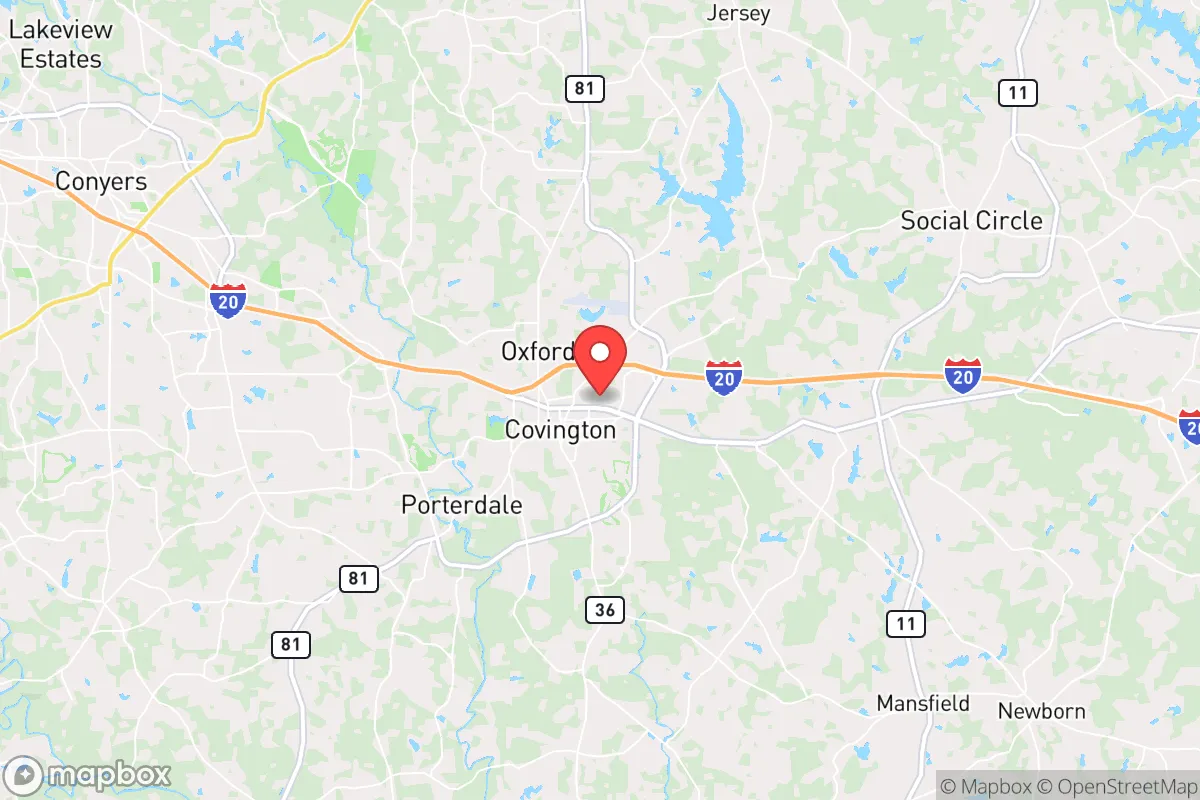
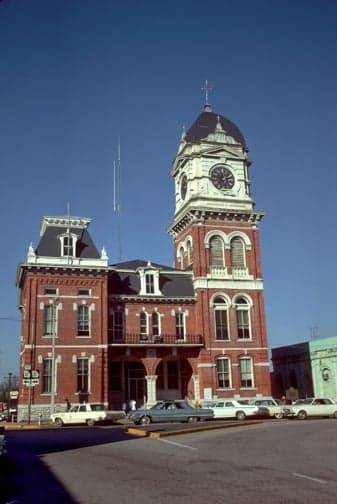
Photo: Wikipedia
Strategic Assessment of Covington, GA
Workable tactical position. Some exposure to population density or targets, but generally defensible in a crisis.
What does the Strategic Assessment tell us?
Our Strategic Assessment grades tactical survivability of an area. Major population centers, military targets, fallout zones, natural disasters, and border exposure all drive risk — lower exposure means a more defensible position in a crisis.
This is heavily inspired by Joel Skousen's Strategic Relocation book. Highly recommended you checkout the book ($)What does this tell us?
Our Strategic Assessment grades tactical survivability of an area. Major population centers, military targets, fallout zones, natural disasters, and border exposure all drive risk — lower exposure means a more defensible position in a crisis.
This is heavily inspired by Joel Skousen's Strategic Relocation book. Highly recommended you checkout the book ($)Strategic Pillars

Key Distances
Regional Safe Places
Below is our recommended "safe zones" in Georgia and the surrounding area based on our strategic heuristics. For most people, it's unrealistic to live in a “safe zone” full-time due to work, family or other personal reasons. They tend to be more rural. However, many of these areas are perfect for second homes and retreat properties that double as a vacation home or even a short-term rental.
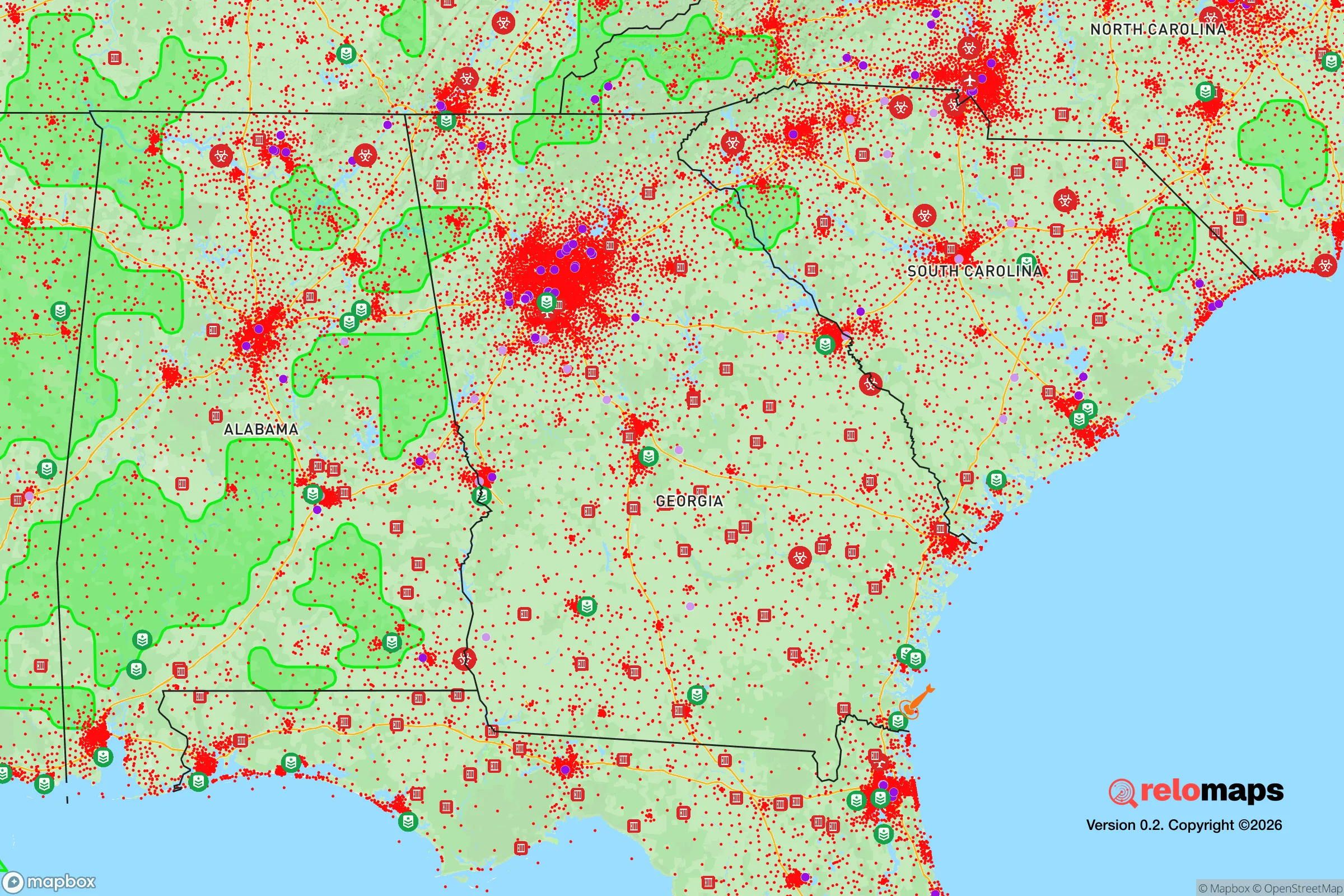
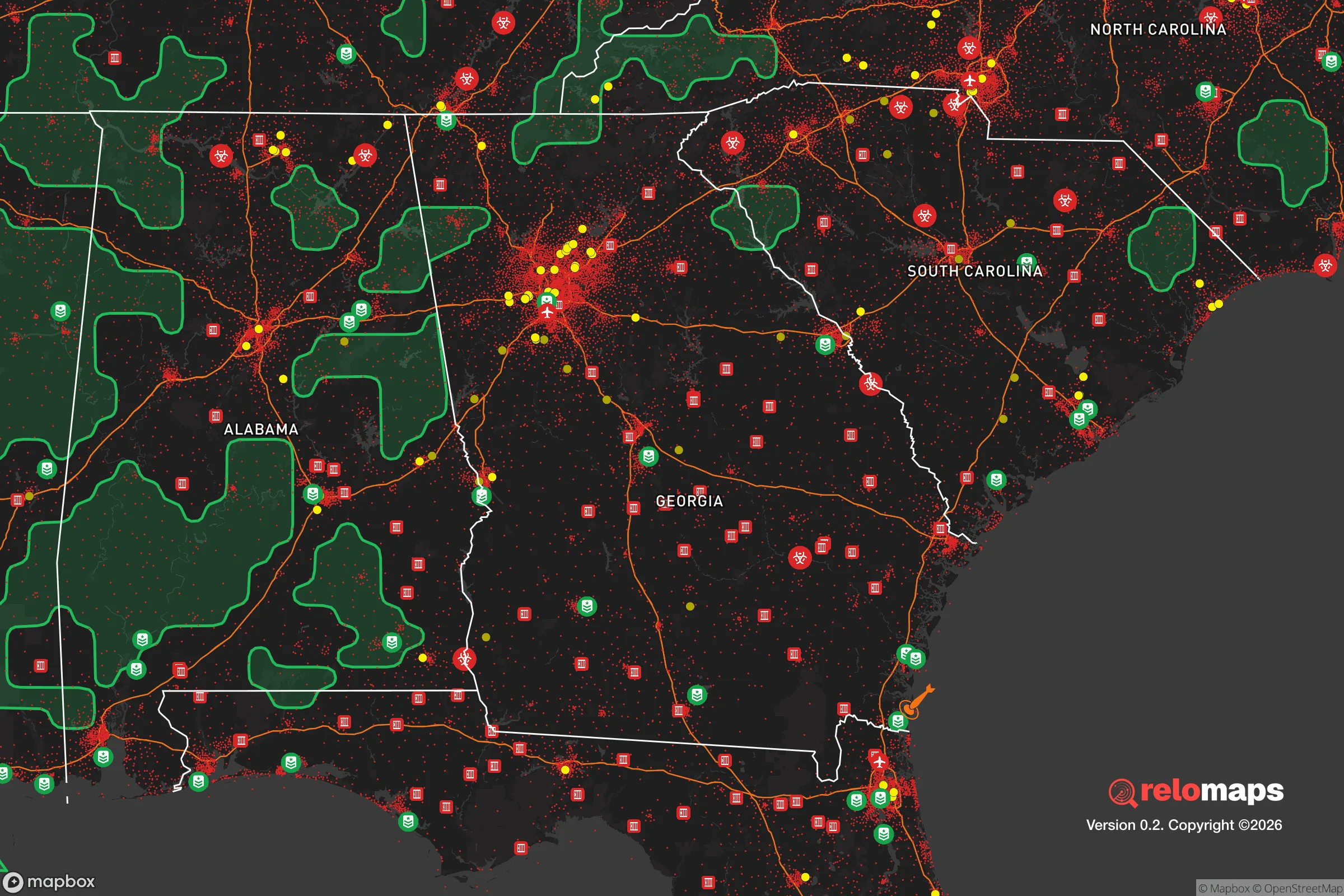


Important Note: For informational purposes only. This does not mean nothing bad ever happens in the green zones. Please use common sense. This is based on public data and modeled with AI. We tried to take a conservative approach but mistakes happen. We update this regularly as new information becomes available.
Solar Generator Recommendations
Backup power matters more here than in safer locations. We've picked three solar generators across budgets and capacity tiers — start with the budget unit if you only need a few essentials, or step up if you want to run a fridge and HVAC for days at a time.

Jackery Portable Power Station Explorer 300
Budget OptionPower on the Go: Weighing only 11 lbs, it's convenient to set up and store with book-sized foldable solar panels

BLUETTI Portable Power Station AC180
Designed for both indoor and outdoor scenarios, AC180 is highly capable as it has a robost capacity and continuous output power.

EF ECOFLOW DELTA Pro Ultra Power Station
Upgraded PickEcoFlow DELTA Pro Ultra is a whole-home energy system designed to grow with your family. Integrated with the Smart Home Panel 2, it scales to meet your evolving energy needs — keeping your home powered, intelligent, and secure through every stage of life.
We earn a commission, at no additional cost to you.
Strategic Assessment Analysis
Covington, Georgia, occupies a strategic middle ground that appeals to relocation-minded readers who value both access to metro Atlanta and a degree of separation from its densest vulnerabilities. Located roughly 35 miles east of downtown Atlanta in Newton County, Covington sits at the intersection of I-20 and several state highways, giving it solid logistical connectivity while remaining outside the immediate blast or fallout zones of major urban targets. For a conservative-leaning audience thinking seriously about disaster readiness and self-sufficiency, Covington offers a mix of geographic advantages and real exposures that demand a clear-eyed assessment.
Geographic position and natural advantages for long-term stability
Covington’s location on the eastern edge of the Piedmont region provides several natural benefits. The area sits on relatively stable bedrock, with low seismic risk compared to the western U.S. or even parts of the New Madrid zone. Elevation averages around 800 feet above sea level, which reduces flood risk compared to low-lying coastal or river-bottom communities — though the Yellow River and its tributaries do run through the county, and low-lying areas near these waterways can flood during heavy rain events. The climate is humid subtropical, with hot summers and mild winters, which supports year-round gardening and livestock operations for those pursuing self-sufficiency. Growing season runs roughly from mid-April to mid-October, long enough for two crop cycles in many years.
The surrounding landscape is a mix of forested hills, farmland, and developing subdivisions. Newton County retains significant agricultural land — about 40% of the county’s acreage is still in farms or timber — which means local food production capacity is not yet fully suburbanized. Water resources are adequate for a moderate population: the county draws from the Upper Ocmulgee River basin and several groundwater aquifers, and the Yellow River provides surface water that could be tapped with proper infrastructure. For a relocator, this means the raw natural resources for long-term stability exist, but they require active management and investment to be usable in a crisis.
Risks, exposures, and proximity to fallout-relevant landmarks
The most significant risk for Covington is its proximity to Atlanta, which is a Tier 1 target for any nuclear exchange scenario. Covington lies about 35 miles from downtown Atlanta — well outside the immediate blast radius of a single warhead, but within the moderate-to-heavy fallout zone depending on wind direction. A ground burst on Atlanta would send radioactive debris northeast or east-southeast depending on prevailing winds; Covington sits roughly east-northeast of the city, meaning it could be in the path of significant fallout under certain weather conditions. The same logic applies to other high-value targets within 50-75 miles: Hartsfield-Jackson Atlanta International Airport, the Centers for Disease Control and Prevention (CDC) in DeKalb County, and the large military logistics hub at Fort Moore (formerly Fort Benning) about 100 miles south.
Beyond nuclear risk, Covington faces natural hazards typical of the Southeast. Tornado risk is moderate — Newton County averages about 1-2 tornado touchdowns per decade, usually EF0-EF2. Severe thunderstorms with damaging winds and hail are more common, occurring several times per year. The area is far enough inland to avoid direct hurricane storm surge, but remnants of Gulf storms can bring flooding and wind damage. Wildfire risk is low compared to the Western U.S., but dry-season brush fires can occur in rural areas. Industrial hazards include the nearby Georgia Power coal ash ponds and chemical facilities along I-20, though these are not catastrophic-scale risks. On balance, Covington’s risk profile is moderate — not a high-risk zone like coastal Florida or California, but not a low-risk zone like the Upper Midwest either.
Practical resilience for a relocator: food, water, energy, and defensibility
For a relocator focused on self-sufficiency, Covington offers a mixed picture. Food production is feasible: the growing season is long, soil quality varies but is generally workable with amendments, and local farmers’ markets and feed stores provide access to seeds, livestock, and equipment. Newton County has no zoning restrictions that prevent backyard chickens, goats, or small-scale agriculture in most residential areas, though homeowners’ associations in newer subdivisions may impose limits. For those serious about food independence, rural properties in the eastern part of the county or in adjacent Morgan County offer more acreage and fewer restrictions.
Water is the more concerning variable. Covington’s municipal water comes from the Yellow River and treated through the city’s water plant, which is vulnerable to power loss and contamination. Well water is available in rural areas, but well depths vary — some areas require drilling 200-300 feet to reach reliable aquifers, and water quality can be affected by iron, manganese, and agricultural runoff. A relocator should budget for a well test and possibly a filtration system. Rainwater catchment is legal and practical, with average annual rainfall of about 48 inches, but storage capacity and treatment are necessary for potable use.
Energy resilience is achievable but requires upfront investment. The local grid is served by Georgia Power, which has a mixed reliability record — outages during storms are common, and the grid is not hardened against EMP or cyberattack. Solar potential is moderate: the area receives about 4.5 peak sun hours per day, enough for a grid-tied system with battery backup, but not ideal for full off-grid solar without significant panel area. Natural gas is available in Covington proper and some suburban areas, but rural properties rely on propane or heating oil. Wood heating is viable given the forested landscape, but requires a woodlot and labor to process fuel.
Defensibility is a relative strength. Covington is not a remote mountain redoubt, but its location on I-20 means it is accessible for resupply and evacuation while still offering rural pockets that are harder to reach. The county’s population density is about 250 people per square mile — moderate, but with significant variation. Rural areas east of the city offer better defensibility due to limited road access, tree cover, and distance from major highways. However, the presence of I-20 also means that in a crisis, Covington could see significant refugee flow from Atlanta, potentially straining local resources and security. A relocator should consider a property with good sight lines, multiple egress routes, and distance from major roads.
Community resilience is a wild card. Newton County is politically mixed — it voted for Trump in 2020 by about 12 points, but the city of Covington itself is more moderate. The local culture is generally self-reliant and rural-minded, with a strong church network and active volunteer fire departments. However, the area has seen rapid growth since 2020, with new subdivisions and commercial development that bring a more transient population. Long-term residents tend to be more prepared and community-oriented; newcomers may not share that mindset. For a relocator, building relationships with established locals is a practical step toward resilience.
Overall, Covington offers a viable but not ideal strategic position for the disaster-conscious relocator. Its advantages — moderate climate, agricultural land, water availability, and distance from Atlanta — are real but require active investment to realize. Its disadvantages — proximity to a major target, moderate grid reliability, and potential refugee flow — are manageable with planning but not negligible. For a family or individual willing to invest in well water, solar backup, food production, and community ties, Covington can serve as a solid base for long-term resilience. It is not a bug-out location, but a live-and-prepare location that balances access with security. The key is to treat it as a starting point, not a final answer, and to build redundancy into every critical system.

* Values derived from national, state, county, city and local statistics and may differ in a specific area. Last updated: 2026-08-26T02:47:53.000Z
Narrative content on this page is AI-generated and may contain mistakes. Verify any details that matter before acting on them.
ReloMaps may earn a commission from affiliate links at no extra cost to you.

