
Photo: Wikipedia
Demographics of Jefferson County
Affluence Level in Jefferson County
An upper-middle-class area. Household wealth, education levels, and homeownership run ahead of national benchmarks.
People of Jefferson County
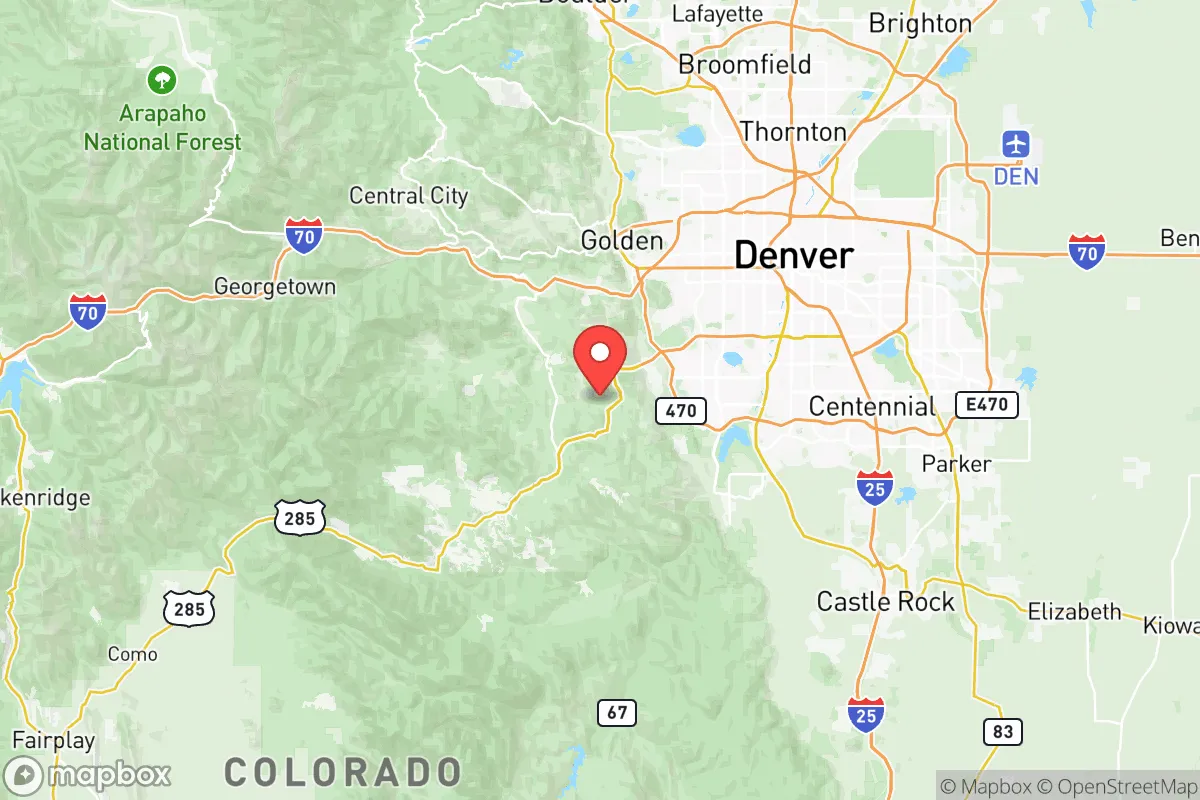
Jefferson County, Colorado, is home to roughly 580,000 residents who occupy a distinctive middle ground between Denver’s urban energy and the Rocky Mountain frontier. The county is predominantly white (75.9%) with a significant Hispanic minority (15.9%), a small but growing East/Southeast Asian population (2.3%), and a very low foreign-born share (2.6%) that reflects its character as a long-established, domestically settled region. With over half of adults holding a college degree, Jefferson County’s population is well-educated, politically moderate-to-conservative, and defined by a culture that values outdoor recreation, suburban stability, and a strong sense of local history rooted in mining, ranching, and Cold War-era federal investment.
Settlement & growth (pre-1960)
Long before European settlement, the area now known as Jefferson County was seasonal hunting and gathering territory for the Ute, Cheyenne, and Arapaho nations. The Ute people used the mountain valleys west of present-day Golden and Evergreen as summer camps, while the plains east of the Front Range were frequented by Cheyenne and Arapaho bands following bison herds. Spanish exploration touched the region in the 1700s, but no permanent colonial settlements were established; the area remained Native-controlled until the 1858 Pike’s Peak Gold Rush.
The first major wave of American settlers arrived in 1858–1859, drawn by gold discoveries in Clear Creek and the South Platte River. Prospectors and merchants flooded into what became Golden, which served as the territorial capital of Colorado from 1862 to 1867. These early settlers were overwhelmingly Anglo-American, hailing from the Midwest, Appalachia, and the Upper South—farmers, miners, and small-town tradesmen seeking fortune on the frontier. The 1870s and 1880s saw a second wave of European immigrants, particularly Irish and German Catholics, who found work in the gold mines around Black Hawk and Central City (just west of the county line) and in the coal mines near Leyden and Ralston Creek. The railroad arrived in the 1870s, linking Jefferson County to Denver and spurring the growth of agricultural towns like Arvada and Wheat Ridge, where German and Swedish immigrant families established truck farms and orchards.
The Dust Bowl and Great Depression of the 1930s brought a third wave: displaced farmers from the Southern Plains—Oklahoma, Texas, Kansas—often called “Okies.” They settled in unincorporated areas and small communities like Lakewood (then a scattering of subdivisions) and Edgewater, working in Denver’s factories or on local ranches. World War II transformed the county’s economy and population. The Denver Ordnance Plant (later the Federal Center) opened in Lakewood, drawing thousands of workers from across the country. After the war, the Cold War brought the Rocky Flats nuclear weapons plant near Broomfield (on the county’s northern edge) and the Coors Brewery expansion in Golden, which together attracted a wave of skilled workers, engineers, and managers—many from the Midwest and East Coast—who settled in new suburban developments. By 1960, Jefferson County’s population had grown to roughly 127,000, up from 55,000 in 1950, and the county was firmly established as a bedroom community for Denver’s growing white-collar workforce.
Modern era (post-1965)
The 1965 Hart-Cellar Act had a muted effect on Jefferson County compared to coastal urban centers. The county’s foreign-born population remains low at 2.6%, reflecting its character as a destination for domestic, not international, migration. The most significant demographic shift since 1965 has been the growth of the Hispanic population, which rose from a small minority to 15.9% today. This growth came primarily through domestic migration from the Southwestern states (New Mexico, Texas, and southern Colorado) and natural increase, rather than direct immigration. Hispanic communities concentrated in older suburban areas like Wheat Ridge, Edgewater, and parts of Lakewood, where affordable housing and proximity to service-sector and construction jobs provided a foothold.
The East/Southeast Asian population (2.3%) and Indian-subcontinent population (0.4%) are small but have grown since the 1990s, driven by tech and engineering professionals employed at the Denver Federal Center, Lockheed Martin in Littleton, and the National Renewable Energy Laboratory in Golden. These communities are dispersed rather than concentrated in ethnic enclaves, with families settling in higher-income suburbs like Ken Caryl and Columbine. The Black population remains very small (1.1%), a legacy of the county’s historically low African American presence; most Black residents live in Lakewood or Arvada.
Domestic migration has been the dominant force shaping modern Jefferson County. The 1970s through 1990s saw a massive suburban build-out as families left Denver for larger lots, better schools, and lower crime rates. Master-planned communities like Ken Caryl Ranch (southwest of Littleton) and Green Mountain (Lakewood) attracted upper-middle-class professionals. The 2000s and 2010s brought a wave of retirees and remote workers from California and the Pacific Northwest, drawn by Colorado’s lower cost of living (relative to the West Coast) and outdoor lifestyle. This influx has pushed the county’s population from 363,000 in 1980 to 579,715 today, with most growth occurring in unincorporated areas and the southern suburbs around Littleton and Columbine.
The future
Jefferson County’s population is projected to continue growing, though at a slower pace than the Denver metro average, as developable land becomes scarce. The county is becoming slightly more diverse: the Hispanic share is expected to rise toward 20% by 2040, driven by natural increase and continued domestic migration from the Southwest. The East/Southeast Asian and Indian populations will likely grow modestly as tech and energy sectors expand, but the county will remain predominantly white and U.S.-born. New residential construction is concentrating in the southern part of the county—areas like Chatfield Reservoir and Roxborough Park—and in infill developments within Golden and Arvada. The county’s cultural identity is evolving from a purely suburban bedroom community toward a more self-contained region with its own employment base, but the core values of outdoor recreation, family-oriented neighborhoods, and political moderation are likely to persist.
For someone moving in now, Jefferson County offers a stable, well-educated, and increasingly diverse community that balances suburban comfort with easy access to Denver and the mountains. The population is growing slowly, aging gradually, and becoming more Hispanic, but it remains overwhelmingly white and native-born—a place where newcomers will find established neighborhoods, strong schools, and a culture that prizes both personal freedom and community involvement.

* Values derived from national, state, county, city and local statistics and may differ in a specific area. Last updated: 2026-07-07T10:41:54.000Z
Narrative content on this page is AI-generated and may contain mistakes. Verify any details that matter before acting on them.
ReloMaps may earn a commission from affiliate links at no extra cost to you.

