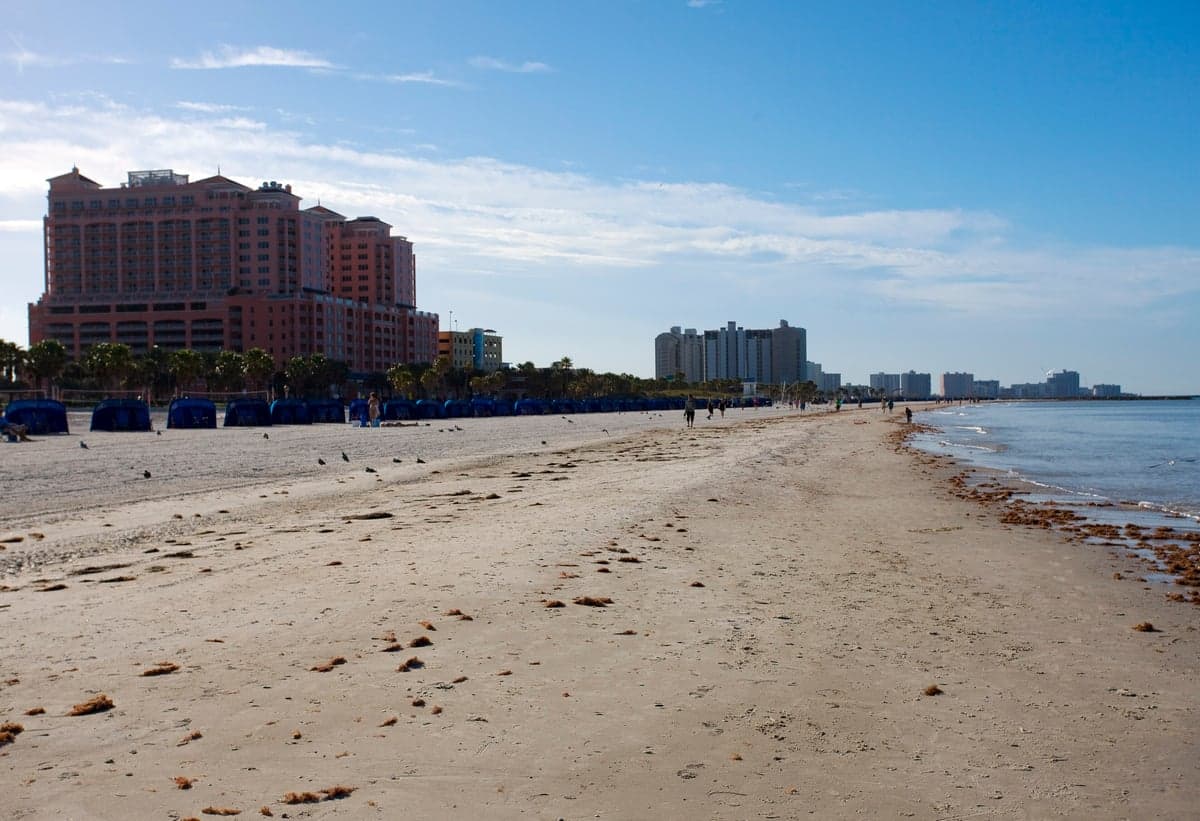
Photo: Wikipedia
Personal Sovereignty in Clearwater, FL
Viable for self-reliance. Generally workable, though some barriers may limit total independence.
What does Personal Sovereignty tell us?
Personal Sovereignty measures your capacity for self-reliance and independence with minimal government friction. Higher scores mean fewer barriers between you and the way you want to live... but it assumes you have the space you need and good neighbors.
What does this tell us?
Personal Sovereignty measures your capacity for self-reliance and independence with minimal government friction. Higher scores mean fewer barriers between you and the way you want to live... but it assumes you have the space you need and good neighbors.
State Policy
Energy independence: Importer (10% of energy produced in-state)
Personal Liberty
Homesteading

Personal Liberty Analysis
For the liberty-minded individual or family evaluating Clearwater, Florida, as a relocation destination, the concept of personal sovereignty is a mixed bag of strong state-level protections and increasingly assertive local governance. While Florida has positioned itself as a national bastion against federal overreach, particularly under Governor Ron DeSantis, the reality on the ground in Pinellas County is that you are trading some rural autonomy for coastal amenities and a dense population. The key to maintaining your personal sovereignty here lies in understanding the precise legal and regulatory boundaries that define your rights to self-defense, property use, and family autonomy, and knowing where the local government’s appetite for control begins and ends.
Tax burden and regulatory posture: How Florida’s framework protects your wallet and choices
Florida’s lack of a state income tax is the single most powerful tool for preserving personal sovereignty in Clearwater. This means every dollar you earn is yours to keep, save, or invest without the state taking a cut for programs you may not support. The state’s constitutional cap on property tax increases (the Save Our Homes amendment) provides long-term stability for homeowners, though new buyers in Clearwater will face current market-rate assessments. The regulatory posture is generally pro-business and anti-red tape at the state level, but Pinellas County is a different animal. Clearwater operates under a strict comprehensive plan that heavily regulates land use, building codes, and environmental buffers. For a prepper or survivalist, this means you cannot simply buy a residential lot and build a fortified compound without navigating a thicket of permits, setbacks, and homeowners' association (HOA) covenants. The trade-off is clear: you keep more of your income, but you surrender significant control over your property’s appearance and use to local boards and HOAs. If you value low taxes above all else, this is a win; if you value absolute control over your land, it is a significant compromise.
Self-defense and gun law specifics: Stand Your Ground and the reality of a blue county
Florida’s firearm laws are among the most robust in the nation for preserving the individual’s right to self-defense. The state is a "Stand Your Ground" jurisdiction, meaning you have no duty to retreat before using deadly force if you are in a place you have a legal right to be and reasonably believe it is necessary to prevent death or great bodily harm. Clearwater residents benefit from this state preemption, which also prohibits local governments from enacting their own gun control ordinances—a critical protection against the city council’s potential overreach. However, the practical reality is that Pinellas County is a politically mixed area with a strong progressive presence in the city of St. Petersburg and parts of Clearwater. While you can legally carry a concealed firearm with a permit (Florida is a shall-issue state), and open carry is restricted, the social climate in many public spaces is not uniformly supportive of visible firearms. For the survivalist, the legal framework is solid, but you must be aware that local law enforcement in a dense urban county may not share the same interpretation of "reasonable fear" as a sheriff in a rural county. The state preemption law is your shield, but the local culture is a factor in how that shield is perceived.
Self-reliance and homesteading viability: Lot sizes, zoning, and off-grid feasibility
For those seeking true self-reliance through homesteading, off-grid living, or significant food production, Clearwater presents serious challenges. The typical residential lot in the city is a quarter-acre or less, with many properties in planned subdivisions that have strict HOA covenants prohibiting livestock, large gardens, or non-standard structures. Zoning is predominantly R-1 (single-family residential) with minimum square footage requirements that discourage tiny homes or alternative dwellings. Off-grid feasibility is extremely low: the city requires connection to municipal water and sewer, and solar panel installations must comply with building codes and often HOA aesthetic guidelines. Rainwater collection for potable use is heavily regulated by the Florida Department of Environmental Protection. The survivalist looking for a bug-out location or a property where they can be self-sufficient for weeks or months will find Clearwater inhospitable. Your best bet is to look at the unincorporated areas of northern Pinellas County, such as Tarpon Springs or East Lake, where lot sizes increase to one to five acres and zoning is slightly more permissive. Even there, you will face county-level regulations on wells, septic systems, and outbuildings. Clearwater is a place to live in comfort, not to survive in isolation.
Personal liberties: Parental rights, medical autonomy, speech, and property
Florida has become a national leader in protecting parental rights, particularly through the Parental Rights in Education Act and the expansion of school choice via vouchers and charter schools. In Clearwater, this means you have significant legal leverage to direct your child’s education and medical decisions without state interference. Medical autonomy is a more complex picture: while Florida banned vaccine passports and protected medical conscience rights during the pandemic, the state still maintains a powerful medical licensing board and mandates certain public health reporting. For the liberty-minded individual, the key is that you are not forced into any medical procedure, but you may face social or employment pressure to comply with prevailing norms. Free speech is strongly protected under the Florida Constitution, and the state has preempted local governments from restricting speech on public property in most cases. Property rights are the weakest link: as noted, local zoning and HOA covenants can severely limit what you do with your land. The state’s "Private Property Rights Protection Act" provides some recourse if a regulation "inordinately burdens" your property, but it is a difficult legal battle. Overall, your personal liberties in Clearwater are strongest in the family and medical spheres, moderate in speech, and weakest in property control.
In the final analysis, Clearwater offers a high degree of personal sovereignty relative to deep-blue states like New York or California, particularly in taxation, self-defense, and parental rights. However, compared to rural Florida counties like DeSoto or Highlands, it falls short on property autonomy and off-grid feasibility. For the strategic relocator who values a strong legal framework for family and self-defense but is willing to accept local regulatory oversight in exchange for coastal living and economic opportunity, Clearwater is a viable option. For the hardcore survivalist seeking total independence from government and neighbors, it is a place to visit, not to homestead. Your sovereignty here is real but bounded—know the lines, and you can live freely within them.

* Values derived from national, state, county, city and local statistics and may differ in a specific area. Last updated: 2026-05-01T11:27:35.000Z
Narrative content on this page is AI-generated and may contain mistakes. Verify any details that matter before acting on them.
ReloMaps may earn a commission from affiliate links at no extra cost to you.

