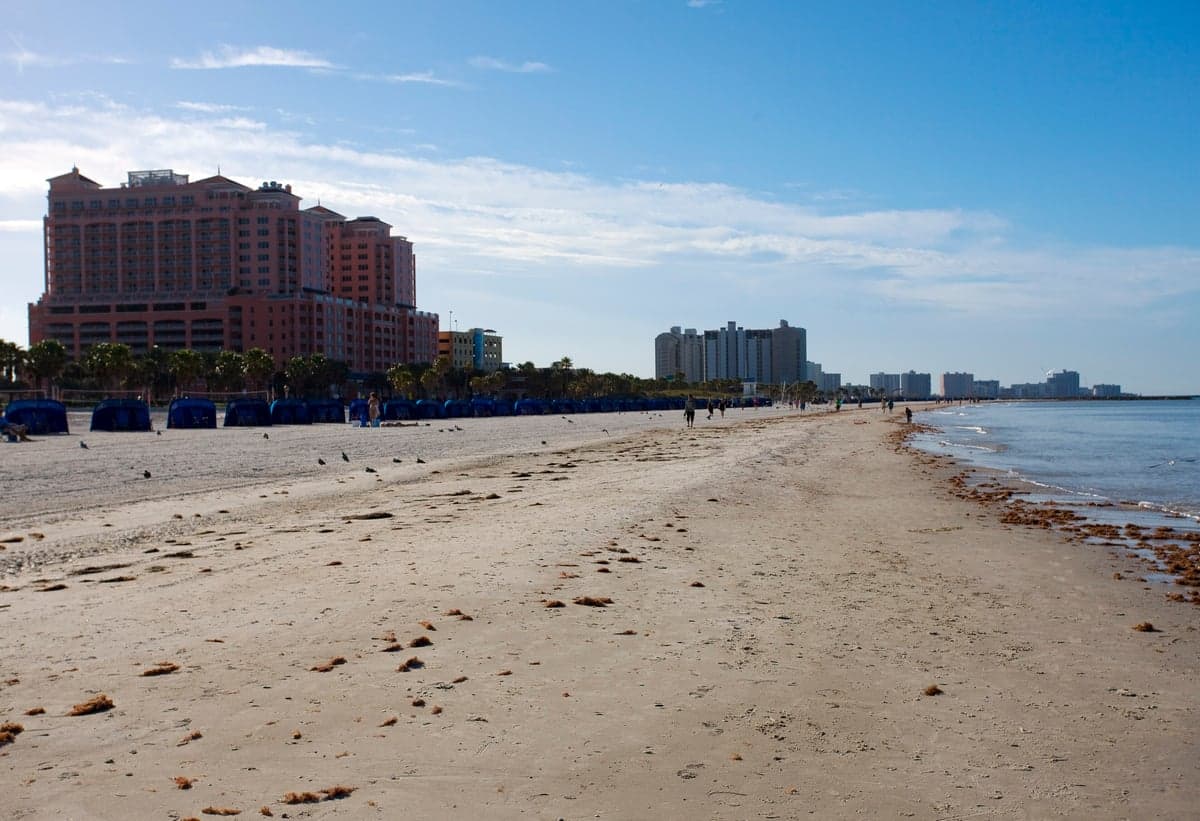
Photo: Wikipedia
Demographics of Clearwater, FL
Affluence Level in Clearwater, FL
A middle-class area roughly in line with national averages across income, home values, education, and employment.
People of Clearwater, FL
Clearwater, Florida, is a city of 117,075 residents defined by a predominantly white (65.3%) and older population, with a growing Hispanic (17.1%) and Black (10.1%) presence that is reshaping its historic character. The city’s identity is split between established beachside and downtown enclaves and newer suburban-style subdivisions, with a foreign-born share of just 7.3% — lower than the national average. College-educated residents make up 32.5% of the population, reflecting a workforce tilted toward healthcare, professional services, and tourism rather than heavy industry. The people of Clearwater are best understood as a series of distinct settlement waves, each leaving a visible imprint on specific neighborhoods.
How the city was settled and grew
Clearwater was not a colonial-era settlement; it was a product of the late 19th-century railroad boom. The city’s modern population history begins in the 1890s, when the Orange Belt Railway reached the area, drawing white Protestant farmers and fishermen from the U.S. Southeast and Midwest. These early settlers clustered around what is now Cleveland Street and the waterfront, building a small commercial core. The 1910s and 1920s brought a second wave: middle-class Northerners seeking winter homes, who developed Mandarin Estates and the Harbor Oaks neighborhood with Mediterranean Revival homes. By 1930, Clearwater was a segregated resort town of roughly 7,000, with Black residents concentrated in the North Greenwood area, a historically African American neighborhood that served as the city’s service-worker hub. The post-World War II boom — fueled by air conditioning, the GI Bill, and the construction of U.S. 19 — drew a massive influx of white retirees and veterans from the Rust Belt and Northeast, who filled new subdivisions like Countryside and Belleair Bluffs. By 1970, the population had exploded to 52,000, and Clearwater had become a quintessential Sun Belt retirement destination.
Modern era (post-1965)
The 1965 Hart-Cellar Act had a modest direct effect on Clearwater — the city’s foreign-born share remains low at 7.3% — but the domestic migration patterns that followed reshaped its demographics. The 1970s through 1990s saw a steady influx of white retirees from the Midwest and Northeast, who filled the Countryside and East Lake areas with gated communities and golf-course subdivisions. Meanwhile, Hispanic migration — primarily Puerto Rican and Mexican — began accelerating in the 1990s, with families settling in North Greenwood and the Druid Road corridor, drawn by service-sector jobs in hospitality and healthcare. The Black population, which had been concentrated in North Greenwood since the Jim Crow era, began a slow suburban spread into Clearwater Highlands and unincorporated areas south of Gulf-to-Bay Boulevard. The Asian population (East/Southeast Asian, 2.6%) is small but visible in the Bayside area, with a cluster of Vietnamese-owned nail salons and restaurants. The Indian subcontinent population (1.0%) is even smaller, with no single dominant neighborhood. The city’s white share has declined from roughly 80% in 1990 to 65.3% today, driven by Hispanic growth and an aging white population that is not fully replacing itself.
The future
Clearwater’s population is heading toward greater diversity, but at a slower pace than Tampa or St. Petersburg. The Hispanic share (17.1%) is the fastest-growing segment, projected to reach 22-25% by 2035, driven by both domestic migration from Puerto Rico and immigration from Mexico and Central America. The Black population (10.1%) is stable, with growth concentrated in the Clearwater Highlands and Morningside areas. The white population is aging and slowly declining in absolute numbers, though Countryside and Belleair remain overwhelmingly white and older. The city is not tribalizing into stark enclaves — most neighborhoods are moderately mixed — but North Greenwood remains predominantly Black and Hispanic, while Mandarin Estates and Harbor Oaks are still heavily white and affluent. The foreign-born share is unlikely to rise dramatically given the city’s high housing costs and limited entry-level jobs. The next decade will likely see continued Hispanic growth, a stable Black population, and a slow decline in the white share, making Clearwater a more diverse but still majority-white city.
For a conservative-leaning mover, Clearwater is becoming a more diverse but still predominantly white and older city, with distinct neighborhoods that retain their historic character. The city’s low foreign-born share and slow demographic change mean that the cultural and political landscape will shift gradually, not abruptly. New arrivals will find a place where the beachside and suburban enclaves remain largely unchanged, while the central and northern neighborhoods are absorbing the city’s modest diversification. The bottom line: Clearwater is a stable, slow-changing Sun Belt city where the population is diversifying at a manageable pace, and where neighborhood choice remains the primary determinant of daily experience.

* Values derived from national, state, county, city and local statistics and may differ in a specific area. Last updated: 2026-05-01T11:27:35.000Z
Narrative content on this page is AI-generated and may contain mistakes. Verify any details that matter before acting on them.
ReloMaps may earn a commission from affiliate links at no extra cost to you.

