Photo: Wikipedia
Demographics of Chester, NJ
Affluence Level in Chester, NJ
An upper-middle-class area. Household wealth, education levels, and homeownership run ahead of national benchmarks.
People of Chester, NJ
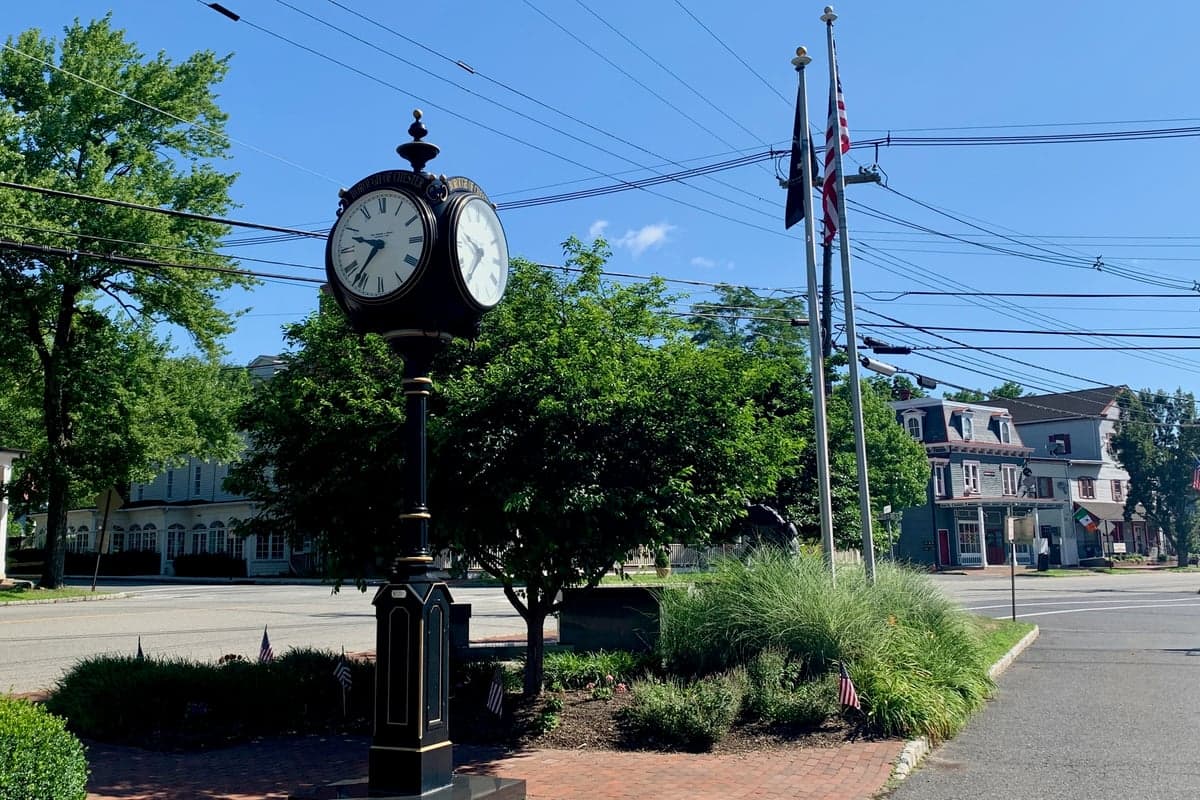
Today, Chester, New Jersey, is a small, affluent borough with a population of 1,359, characterized by a predominantly white (81.2%) and highly educated (61.1% college-educated) populace. The community projects a quiet, family-oriented character, with a notable but modest Hispanic presence (9.4%) and small but distinct Indian (2.0%) and East/Southeast Asian (0.7%) communities. Its identity is shaped by a historic downtown, a strong sense of local tradition, and a demographic profile that is slowly diversifying from its historically homogeneous roots.
How the city was settled and grew
Chester Borough’s human history begins with the Lenni Lenape people, who inhabited the region before European settlement. The area was originally part of a larger land grant, and the first European settlers—primarily of English and Scots-Irish descent—arrived in the early 18th century, drawn by fertile farmland and the promise of self-sufficiency. These early families established farms and small mills along the Black River and its tributaries, forming the nucleus of what would become the village of Chester. The construction of the Morris Canal in the 1830s, and later the railroad in the 1860s, connected Chester to larger markets, spurring modest growth. The historic Chester Village district, with its 19th-century homes and storefronts, was built by these early agricultural and mercantile families. The borough was officially incorporated in 1930, separating from Chester Township to maintain its distinct village character. Through the mid-20th century, the population remained small, stable, and overwhelmingly white, with growth limited by the lack of major industry and the preservation of open space.
Modern era (post-1965)
The post-1965 era, following the Hart-Cellar Act, saw Chester’s population remain largely stable in size but begin a slow demographic shift. The borough did not experience the rapid suburbanization seen in many New Jersey towns, partly due to its distance from major highways and its strong zoning laws that preserved large-lot, single-family homes. The most significant change was the arrival of a small but growing Hispanic population, now at 9.4%, and the emergence of an Indian community (2.0%) and an East/Southeast Asian community (0.7%). These newer residents have largely integrated into existing neighborhoods rather than forming distinct ethnic enclaves. The Furnace Road area and the North Chester district, which feature newer single-family homes, have seen some of this diversification. The foreign-born population remains low at 3.8%, indicating that most of the diversity comes from domestic migration—families moving from more diverse urban centers or other parts of New Jersey for Chester’s schools and quality of life. The borough’s character has remained stable, with the historic downtown and community events like the Chester Fall Festival continuing to anchor local identity.
The future
Chester’s population is slowly becoming more diverse, but the pace of change is gradual. The Hispanic share (9.4%) and the combined Indian and East/Southeast Asian share (2.7%) are likely to increase modestly over the next 10-20 years, driven by families seeking the borough’s highly-rated school district and low crime rates. However, the high cost of housing and limited new construction will constrain rapid demographic turnover. The white population, while still the overwhelming majority, will likely continue its slow decline as a share of the total. New residents are expected to continue dispersing across the borough, with the Lamington Road corridor and the Old Chester Village area seeing some infill and renovation. The cultural identity of Chester will likely remain rooted in its historic, family-centric character, but with a gradually more inclusive and diverse community fabric. The borough is not trending toward becoming a diverse, urban suburb, but rather a stable, affluent small town that is slowly becoming less homogeneous.
For someone moving in now, Chester offers a stable, safe, and highly educated community with a strong sense of place. The population is slowly diversifying, but the borough’s core identity remains that of a historic, family-oriented village. The key trade-off is between the high cost of entry and the assurance of a well-maintained, low-crime environment with excellent schools, where demographic change is gradual and largely integrated into the existing social fabric.

* Values derived from national, state, county, city and local statistics and may differ in a specific area. Last updated: 2026-09-29T21:23:46.000Z
Narrative content on this page is AI-generated and may contain mistakes. Verify any details that matter before acting on them.
ReloMaps may earn a commission from affiliate links at no extra cost to you.

