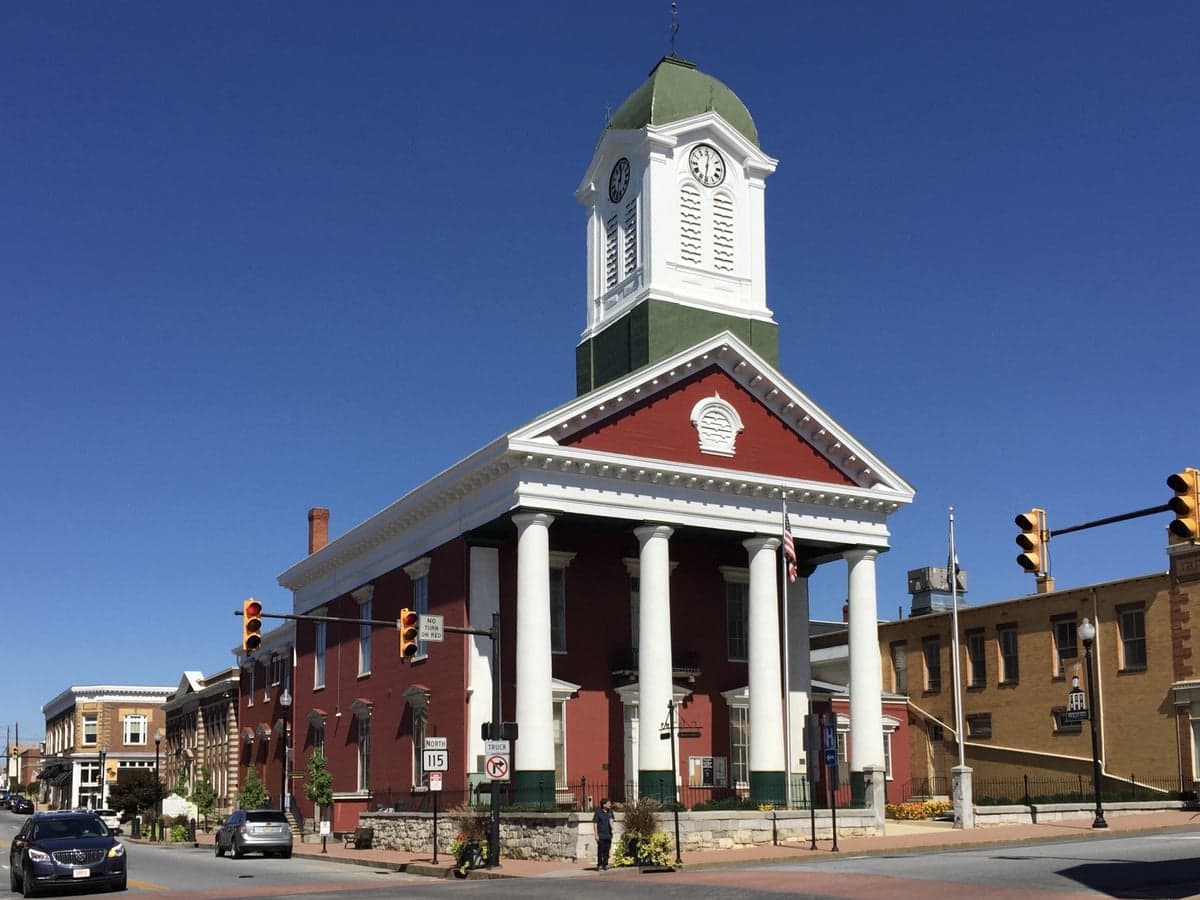
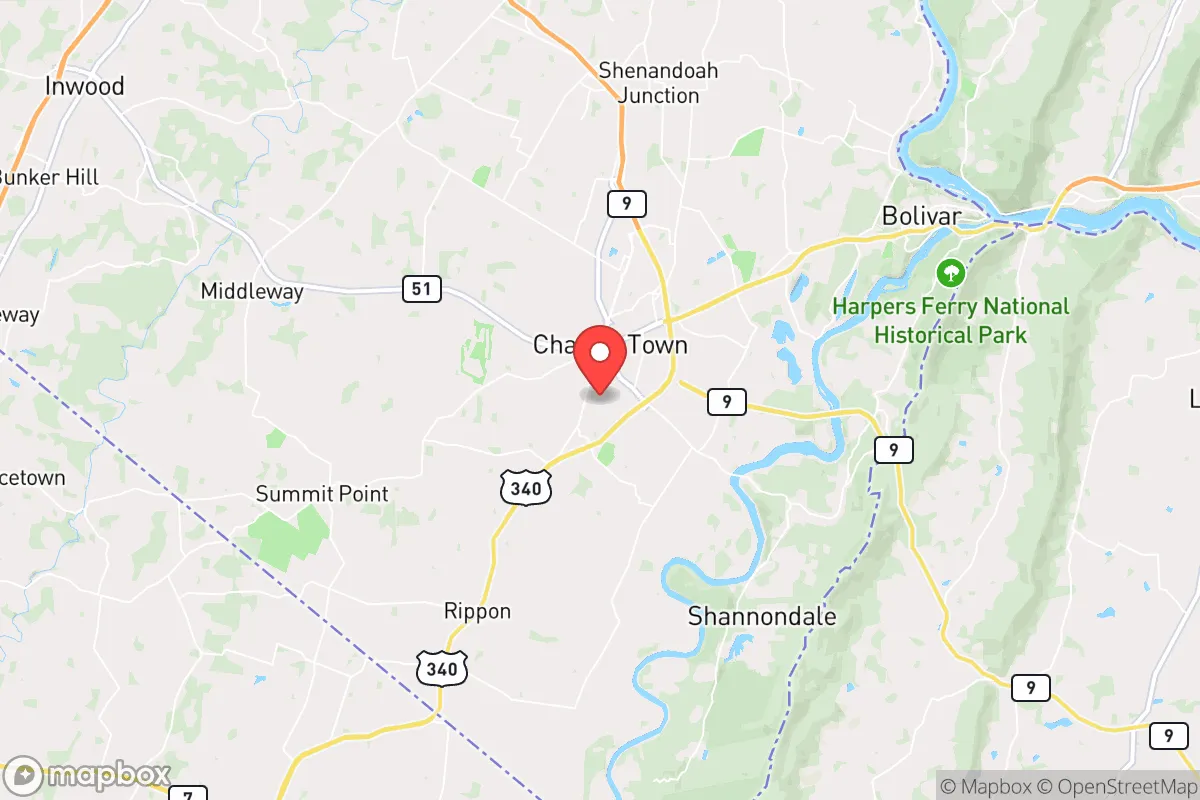
Photo: Wikipedia
Political ClimatePolitical Climate in Charles Town, WV
District shown is the primary district for this city’s centroid. Cities may span multiple districts.
Local Political AnalysisPolitical Analysis of Charles Town, WV
Charles Town, West Virginia, has long been a reliably conservative community, and that hasn't changed much despite some new folks moving in from the D.C. suburbs. The Cook PVI rating of R+20 tells you the real story—this area votes Republican by a solid 20-point margin over the national average, and that's held steady through the last few cycles. You'll see Trump signs in yards year-round, not just during election season, and the local chatter at the coffee shop on Washington Street still leans heavily toward limited government and personal responsibility. But there's a quiet tension brewing as more people from Loudoun County and points east discover the cheaper land and lower taxes here, bringing with them a different set of expectations about what government should do.
How it compares
Drive 15 minutes east to Leesburg, Virginia, and you're in a different world politically—Loudoun County has swung hard blue in recent years, with school board battles and zoning fights that would never fly in Jefferson County. Head west to Martinsburg or south to Winchester, and you'll find similar conservative values, though Charles Town has a slightly more established small-town feel that resists the sprawl creeping in from the D.C. orbit. The contrast is starkest when you look at ballot measures: Jefferson County consistently votes against tax hikes and bond issues that would expand government programs, while nearby Virginia localities often approve them. It's not that folks here are anti-progress—it's that they want progress on their own terms, without the heavy hand of bureaucracy telling them how to live.
What this means for residents
For someone living here, the political climate means you can generally expect local government to stay out of your business. The county commission and city council are dominated by Republicans who prioritize low taxes, minimal regulation, and Second Amendment rights without apology. You won't see mask mandates or vaccine passports being pushed at the county level, and the school board has resisted the kind of curriculum battles that have torn apart districts in Northern Virginia. Property taxes remain among the lowest in the region, and there's no city income tax—a big reason why people from Maryland and Virginia are willing to make the commute. The downside is that services can feel thin: road maintenance is slow, and the county's approach to growth is more laissez-faire than some newcomers would like, but that's the trade-off for keeping government small.
Culturally, Charles Town still feels like a place where your neighbor knows your name and the local hardware store owner remembers what you bought last time. The annual Jefferson County Fair and the historic downtown with its old brick buildings reinforce a sense of continuity that's rare in the hyper-paced D.C. orbit. But there's a real concern among long-time residents that the influx of out-of-state transplants could shift the political balance over the next decade. Some of these newcomers bring progressive ideas about zoning, public transit, and "equity" initiatives that clash with the local ethos of self-reliance. If the county starts adopting policies that mirror what's happening in Loudoun or Montgomery County—like higher impact fees, stricter building codes, or diversity mandates—you'll see a backlash. For now, the conservative foundation holds, but it's something to keep an eye on if you're thinking about putting down roots here.

State Political ClimatePolitical Climate in West Virginia
State Political AnalysisPolitical Environment in the State
West Virginia has long been one of the most reliably Republican states in the nation, but that wasn’t always the case. As recently as the 1990s, it was a Democratic stronghold at the state and local level, voting for Bill Clinton twice. The shift has been dramatic: from a blue-leaning swing state to a deep red one, with Donald Trump carrying it by nearly 39 points in 2020 and by a similar margin in 2024. The dominant coalition today is a mix of rural conservatives, working-class voters who abandoned the national Democratic Party over energy and cultural issues, and a growing number of out-of-state transplants seeking lower taxes and fewer regulations. The trajectory over the last 20 years has been a steady march rightward, with the state legislature now holding a supermajority of Republicans and the governorship firmly in GOP hands.
Urban vs. rural divide
The political map of West Virginia is starkly divided between a few small urban centers and the vast rural expanse. The state’s largest city, Charleston, and its surrounding Kanawha County lean Democratic, but even there the margins have tightened. In 2024, Kanawha County voted for Trump by about 12 points, a far cry from the 20+ point Democratic wins of the 1990s. Huntington and Morgantown are the other notable blue-ish pockets, driven by university populations and some union influence. Morgantown, home to West Virginia University, is the most liberal city in the state, but even it voted for Trump in 2020 by a narrow margin. The real action is in the rural counties. Mingo, Logan, and McDowell counties in the southern coalfields have flipped from solidly Democratic to overwhelmingly Republican, often by 50+ point margins. Berkeley County in the Eastern Panhandle, part of the DC exurbs, is a fast-growing Republican stronghold, while Jefferson County nearby is more competitive due to commuters from Maryland and Virginia. The divide isn’t just urban vs. rural—it’s also about energy: coal country is now the most conservative region in the state.
Policy environment
West Virginia’s policy environment is among the most conservative in the country, and it’s been getting more so. The state has no personal income tax on Social Security benefits, and in 2023, the legislature passed a phased elimination of the state income tax on wages, with rates dropping from 6.5% to 3.99% by 2026. Property taxes are low, with no state-level property tax and local rates averaging around 0.5% of assessed value. The regulatory posture is business-friendly, with right-to-work laws in place since 2016 and a tort reform system that caps noneconomic damages. Education policy has been a flashpoint: the state passed a school choice law in 2021 allowing charter schools and education savings accounts, though implementation has been slow. On healthcare, West Virginia expanded Medicaid under the Affordable Care Act in 2014, but the state has not pursued a state-based exchange and has resisted further expansion. Election laws are among the most secure in the nation: voter ID is required, early voting is limited to 10 days, and no-excuse absentee voting was ended in 2021. The state has also passed a constitutional amendment banning any recognition of same-sex marriage, though it’s moot after Obergefell. Overall, the policy environment leans heavily toward limited government, low taxes, and traditional values.
Trajectory & freedom
West Virginia is becoming more free in several key areas, but not without some concerning backsliding. On gun rights, the state passed constitutional carry in 2016, allowing permitless carry of concealed firearms, and in 2021 it became a Second Amendment Sanctuary state, prohibiting state enforcement of federal gun laws that violate the Second Amendment. Parental rights were strengthened in 2023 with the passage of the "Parental Bill of Rights," which requires schools to notify parents of any medical or mental health services provided to their children and prohibits instruction on sexual orientation or gender identity in K-3. Medical autonomy took a hit, however: the state passed a near-total abortion ban in 2022 with no exceptions for rape or incest, which some conservatives see as a necessary protection of life but others view as government overreach. Property rights are strong, with no statewide zoning and a low property tax burden. On taxation, the income tax cuts are a clear win for personal freedom. The biggest red flag for liberty-minded newcomers is the state’s heavy reliance on federal funding—about 40% of the state budget comes from Washington—which creates a dependency that could be leveraged for federal control. Still, the trajectory is toward more individual freedom, especially compared to neighboring states like Maryland and Virginia.
Civil unrest & political movements
West Virginia has a history of labor unrest, but modern political movements are more focused on cultural and constitutional issues. The 2018 teachers’ strike was the most visible recent protest, shutting down schools across the state for nine days over pay and benefits—a rare show of union power in a right-to-work state. On the right, the "Second Amendment Sanctuary" movement swept through county commissions in 2020, with over 40 counties passing resolutions. Immigration politics are less heated here than in border states, but the legislature passed a bill in 2023 requiring local law enforcement to cooperate with ICE and banning sanctuary policies. There’s been no serious secession or nullification rhetoric, though some rural counties have floated the idea of joining neighboring states like Virginia or Kentucky over cultural differences. Election integrity controversies flared after 2020, with the GOP-led legislature passing stricter voter ID laws and purging inactive voters. The most visible flashpoint for a new resident would be the ongoing debate over energy: coal country sees any federal climate policy as an existential threat, and protests against the Green New Deal or EPA regulations are common in places like Beckley and Morgantown. Overall, the state is politically stable, with most activism coming from the right.
Projection
Over the next 5-10 years, West Virginia is likely to become even more conservative, but with some demographic wrinkles. The state is losing population—down about 3% since 2020—with young people leaving for jobs in larger metros. However, in-migration from retirees and remote workers, especially in the Eastern Panhandle (Berkeley and Jefferson counties), is bringing in new residents who are often more moderate or even liberal. This could make the Panhandle more competitive over time, but the rest of the state is aging and becoming more Republican. The income tax cuts will likely accelerate, with the full elimination of the state income tax possible by 2030, which would make West Virginia one of the few no-income-tax states east of the Mississippi. That could attract more conservative transplants from high-tax states like New York and California. The biggest wildcard is the energy transition: if coal continues to decline, the southern coalfields could become even more economically depressed, potentially radicalizing the politics there. A new resident moving in now should expect a state that is deeply red, low-tax, and culturally traditional, but with a growing divide between the rural south and the exurban Panhandle.
For someone choosing West Virginia, the bottom line is clear: you’re getting one of the most conservative state governments in the country, with low taxes, strong gun rights, and a culture that values self-reliance. The trade-offs are a struggling economy in many areas, limited healthcare access in rural regions, and a heavy reliance on federal dollars that could create future vulnerabilities. If you’re looking for a place where the government stays out of your life and your wallet, West Virginia delivers. Just be prepared for the isolation and the slow pace of life—that’s the price of freedom here.
* Values derived from national, state, county, city and local statistics and may differ in a specific area. Last updated: 2026-04-23T05:31:28.000Z
Narrative content on this page is AI-generated and may contain mistakes. Verify any details that matter before acting on them.
ReloMaps may earn a commission from affiliate links at no extra cost to you.

