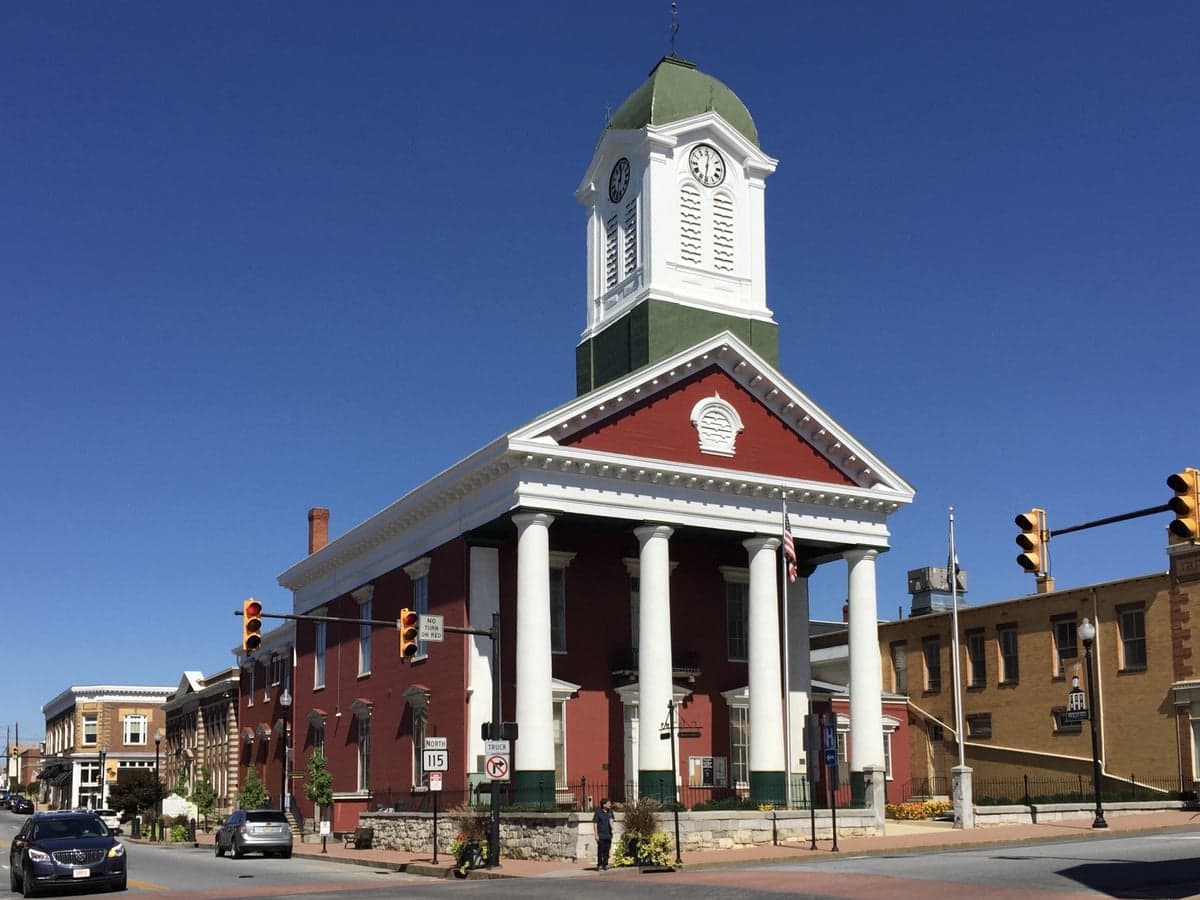
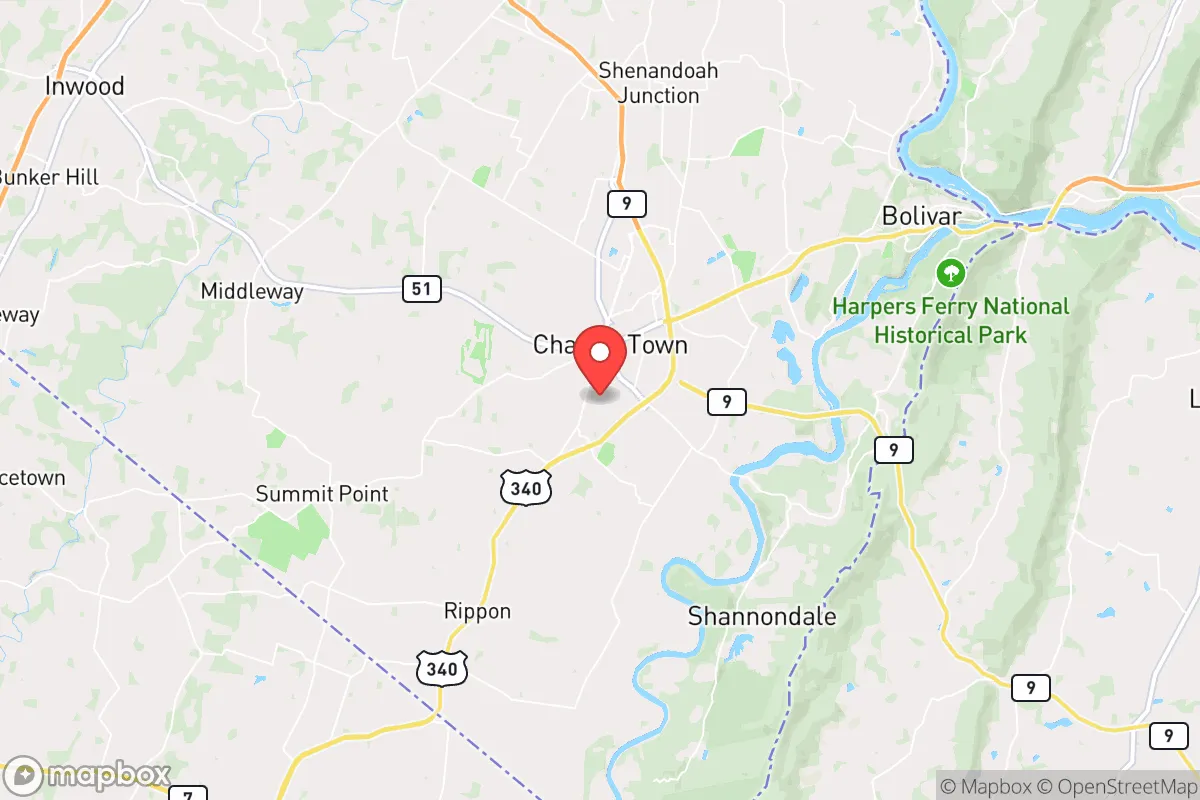
Photo: Wikipedia
Demographics of Charles Town, WV
Affluence Level in Charles Town, WV
A middle-class area roughly in line with national averages across income, home values, education, and employment.
People of Charles Town, WV
The people of Charles Town, West Virginia, today number 6,854, forming a small but diversifying city that blends historic small-town character with a growing commuter and retiree base drawn by proximity to the Washington, D.C. metro area. The population is notably more diverse than much of the surrounding Jefferson County, with a white share of 69.8%, a Hispanic share of 11.5%, a Black share of 12.1%, and a college-educated rate of 38.1% that reflects an influx of professionals and remote workers. Distinctive identity markers include a strong sense of local history tied to the Washington family, a growing number of families seeking lower taxes and housing costs compared to Northern Virginia, and a visible Hispanic community concentrated in specific neighborhoods.
How the city was settled and grew
Charles Town was founded in 1786 by Charles Washington, brother of George Washington, on land granted from the Washington family's vast holdings in the Shenandoah Valley. The original population was overwhelmingly English and Scots-Irish, drawn by fertile farmland and the promise of land grants for Revolutionary War veterans. The town's early growth centered around the Washington Street Historic District, where merchants, craftsmen, and farmers built brick and stone homes that still stand today. The arrival of the Baltimore and Ohio Railroad in the 1830s spurred a second wave of German and Irish laborers, who settled in the Rion Hall area and along the railroad corridor, working in the quarries and on the line. By the early 20th century, the population remained nearly entirely white and native-born, with small numbers of Black families living in the South Charles Town area, many descended from enslaved people freed after the Civil War who found work as farm laborers and domestic workers.
Modern era (post-1965)
The post-1965 period brought gradual but significant demographic change. The Hart-Cellar Act did not directly drive large-scale immigration to Charles Town, but the broader shift in U.S. immigration patterns eventually reached the area through secondary migration from larger East Coast cities. The most transformative force, however, was domestic: the suburbanization of the Washington, D.C. metro area pushed families seeking affordable housing and lower taxes into Jefferson County. From the 1990s onward, Charles Town absorbed a steady stream of white and Black professionals from Northern Virginia and Maryland, many settling in newer subdivisions like Huntfield and Fairway Estates. The Hispanic population grew from near zero in 1990 to 11.5% today, driven largely by Mexican and Central American immigrants who arrived for construction, landscaping, and service jobs. These families concentrated in the Rion Hall and South Charles Town neighborhoods, where older, more affordable housing stock and rental properties are common. The Black population, now 12.1%, includes both long-standing local families and newer arrivals from the D.C. area, with a visible presence in Huntfield and the Charles Town Village apartment complexes. The East/Southeast Asian share (0.9%) and Indian subcontinent share (1.2%) are small but growing, primarily among professionals working in tech and healthcare in the broader D.C. region.
The future
The population of Charles Town is heading toward continued diversification, driven by two main forces: ongoing in-migration from the D.C. metro area and natural increase among the Hispanic community. The white share, while still a majority at 69.8%, is declining slowly as younger white families move to newer exurban developments farther west, while older white residents age in place. The Hispanic share is likely to grow to 15-18% over the next decade, with the Rion Hall and South Charles Town neighborhoods becoming increasingly Hispanic-majority. The Black share is expected to remain stable or rise modestly, as the area remains more affordable than Prince George's County or D.C. for Black professionals. The East/Southeast Asian and Indian communities, while small, will likely grow as remote work and the expansion of the MARC train service make Charles Town more accessible to knowledge workers. The city is not homogenizing; rather, it is tribalizing into distinct enclaves: older white families in the historic district, Hispanic families in Rion Hall and South Charles Town, and a mixed-race professional class in Huntfield and newer subdivisions.
For someone moving in now, Charles Town is becoming a small city where diversity is real but geographically segmented, and where the dominant cultural tone remains that of a historic Appalachian town adapting to exurban pressures. The schools, housing market, and local politics reflect this tension, making it a place where newcomers can find community among like-minded neighbors but should expect distinct neighborhood identities rather than a fully integrated social fabric.

* Values derived from national, state, county, city and local statistics and may differ in a specific area. Last updated: 2026-04-23T05:31:28.000Z
Narrative content on this page is AI-generated and may contain mistakes. Verify any details that matter before acting on them.
ReloMaps may earn a commission from affiliate links at no extra cost to you.

