
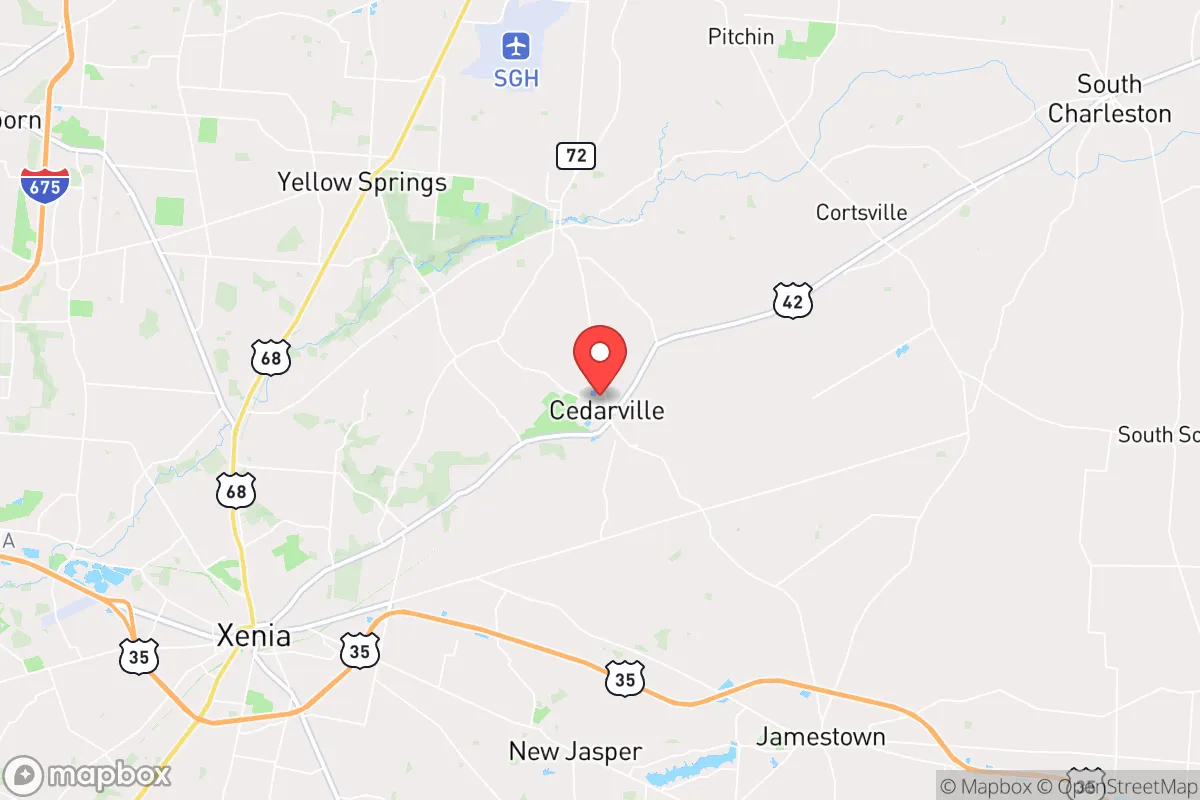
Photo: Wikipedia
Personal Sovereignty in Cedarville, OH
Viable for self-reliance. Generally workable, though some barriers may limit total independence.
What does Personal Sovereignty tell us?
Personal Sovereignty measures your capacity for self-reliance and independence with minimal government friction. Higher scores mean fewer barriers between you and the way you want to live... but it assumes you have the space you need and good neighbors.
What does this tell us?
Personal Sovereignty measures your capacity for self-reliance and independence with minimal government friction. Higher scores mean fewer barriers between you and the way you want to live... but it assumes you have the space you need and good neighbors.
State Policy
Energy independence: Importer (40% of energy produced in-state)
Personal Liberty
Homesteading

Personal Liberty Analysis
Cedarville, Ohio, offers a personal sovereignty environment shaped by its location in Greene County and the broader legal framework of a state that consistently ranks among the most freedom-oriented in the Midwest. For individuals and families who prioritize autonomy, the village provides a tangible sense of self-determination, grounded in low municipal taxation, permissive state-level gun laws, and a regulatory posture that generally favors individual choice over government intervention. While not a libertarian enclave, Cedarville’s character as a small college town (home to Cedarville University) blends conservative community norms with a practical, hands-off approach to daily life, making it a compelling option for those seeking to maximize personal independence without the isolation of more rural areas.
Tax burden and regulatory posture: How light is the local government footprint?
Cedarville’s tax and regulatory environment is notably light, especially when compared to Ohio’s major metropolitan areas. The village itself imposes a 1.5% income tax on residents and those who work within its limits, which is moderate for Ohio but lower than nearby cities like Xenia (2.25%) or Dayton (2.5%). There is no additional municipal sales tax beyond the state’s 5.75% and Greene County’s 1.5%, keeping the combined rate at a manageable 7.25%. Property taxes are also relatively restrained: the effective property tax rate in Greene County hovers around 1.5% of assessed value, which is below the national average and significantly lower than in neighboring Warren or Montgomery counties. The regulatory posture is best described as “practical minimalism.” Zoning exists but is not aggressively enforced for minor residential modifications; residents report that building permits for sheds, fences, and home additions are straightforward to obtain. There are no onerous business licensing requirements for home-based enterprises, and the village does not impose rental registration fees or occupancy limits that would restrict how a family uses its property. This light-touch approach extends to environmental regulations—Ohio does not require state-level environmental impact reviews for most residential construction, and Greene County’s health department handles septic and well permits with reasonable turnaround times. For a relocation prospect, the key takeaway is that Cedarville’s government does not create friction in daily life; it operates as a service provider rather than a gatekeeper.
Self-defense and gun law specifics: What are the legal protections for armed citizens?
Ohio is a “constitutional carry” state, and Cedarville residents enjoy the full spectrum of self-defense rights without local infringement. Since June 2022, no permit is required to carry a concealed handgun for any law-abiding adult 21 or older (or 18 for active military). The village itself has no additional firearm ordinances—no bans on magazine capacity, no restrictions on firearm types, and no “safe storage” mandates that would impose liability on gun owners. Open carry is legal without a permit, and the state’s “stand your ground” law, codified in Ohio Revised Code §2901.09, eliminates any duty to retreat before using deadly force in self-defense, provided the individual is in a place where they have a lawful right to be. For those who choose to obtain a concealed handgun license (CHL) for reciprocity purposes, Greene County’s sheriff’s office processes applications efficiently, typically within 45 days. Importantly, Ohio law preempts all local firearm regulations, meaning Cedarville cannot pass its own gun control measures—a critical protection for residents who view self-defense as a fundamental right. The practical effect is that a family moving to Cedarville can store firearms in their home or vehicle without worrying about local ordinances, and they can carry for protection in most public spaces, including parks and parking lots. The only notable restrictions are federal: schools (including Cedarville University) are gun-free zones under the Gun-Free School Zones Act, though Ohio law allows licensed carriers to store firearms in locked vehicles on school property.
Self-reliance and homesteading viability: Lot sizes, zoning, and off-grid feasibility
For those interested in self-reliance—gardening, small-scale livestock, or even off-grid living—Cedarville offers a mixed but generally permissive environment. Within the village limits, residential lots average 0.25 to 0.5 acres, which is sufficient for substantial vegetable gardens, fruit trees, and small animal husbandry. Zoning regulations allow for chickens (hens only, no roosters) without a special permit, and beekeeping is permitted with registration. However, larger livestock like goats, pigs, or horses are restricted to properties zoned agricultural, which are primarily found in the surrounding township areas. For off-grid feasibility, the regulatory picture is more nuanced. Ohio law does not prohibit solar panels, and net metering is available through Dayton Power & Light (DP&L), the local utility. However, completely disconnecting from the grid is not practical due to building code requirements for electrical safety and the difficulty of obtaining financing for a fully off-grid home. Rainwater collection is legal for non-potable uses (irrigation, livestock) but is not permitted as a primary drinking water source without extensive treatment systems. Composting toilets are allowed under Ohio’s alternative sewage system regulations, but they require a permit and periodic inspection from the Greene County Health Department. The most viable path to self-reliance in Cedarville is a hybrid approach: grid-tied solar, a large garden, and small livestock, all of which are achievable within the existing zoning framework. For those seeking true homesteading with acreage, the unincorporated areas of Greene County just outside Cedarville offer 2- to 10-acre parcels with far fewer restrictions, including the ability to keep horses, install wind turbines, and drill private wells without village oversight.
Personal liberties: Parental rights, medical autonomy, speech, and property
Cedarville’s personal liberties environment is strongly influenced by Ohio’s state-level protections and the village’s conservative social fabric. Parental rights are robust: Ohio law grants parents explicit authority over their children’s education, healthcare, and religious upbringing, and the state does not mandate COVID-19 vaccines for school attendance. The village is home to Cedarville University, a private Christian institution, which reinforces a culture where parental involvement in education is the norm rather than the exception. Medical autonomy is similarly protected—Ohio has not enacted any vaccine mandates for adults, and the state’s “Right to Try” law allows terminally ill patients to access experimental treatments without FDA approval. However, Ohio does require childhood immunizations for school entry (with medical and religious exemptions available), and the state’s abortion laws are among the most restrictive in the nation, which aligns with the values of many conservative families. Free speech is protected under both the U.S. and Ohio constitutions, and Cedarville has no local ordinances restricting political speech, signage, or assembly. Property rights are well-defended: Ohio is a “property rights” state that requires just compensation for any regulatory taking, and Greene County does not impose rent control or inclusionary zoning mandates. The village’s small size means that most property disputes are resolved informally, but the legal framework strongly favors the owner. For a family moving to Cedarville, the practical result is that they can raise their children according to their values, make medical decisions without government interference, speak freely on their property, and use their land as they see fit—within the reasonable bounds of public health and safety.
Overall, Cedarville offers a personal sovereignty profile that is well above average for the Midwest and significantly more permissive than any major Ohio city. The combination of low taxes, constitutional carry, permissive homesteading rules, and strong protections for parental and property rights creates an environment where individuals and families can live with minimal government intrusion. While not as libertarian as rural counties in Idaho or Montana, Cedarville’s sovereignty is practical and accessible—it does not require extreme isolation or wealth to achieve. For a relocation prospect who values freedom but also wants access to employment, education, and healthcare, Cedarville represents a balanced, high-autonomy choice within a state that generally respects personal independence.

* Values derived from national, state, county, city and local statistics and may differ in a specific area. Last updated: 2026-08-19T02:05:25.000Z
Narrative content on this page is AI-generated and may contain mistakes. Verify any details that matter before acting on them.
ReloMaps may earn a commission from affiliate links at no extra cost to you.

