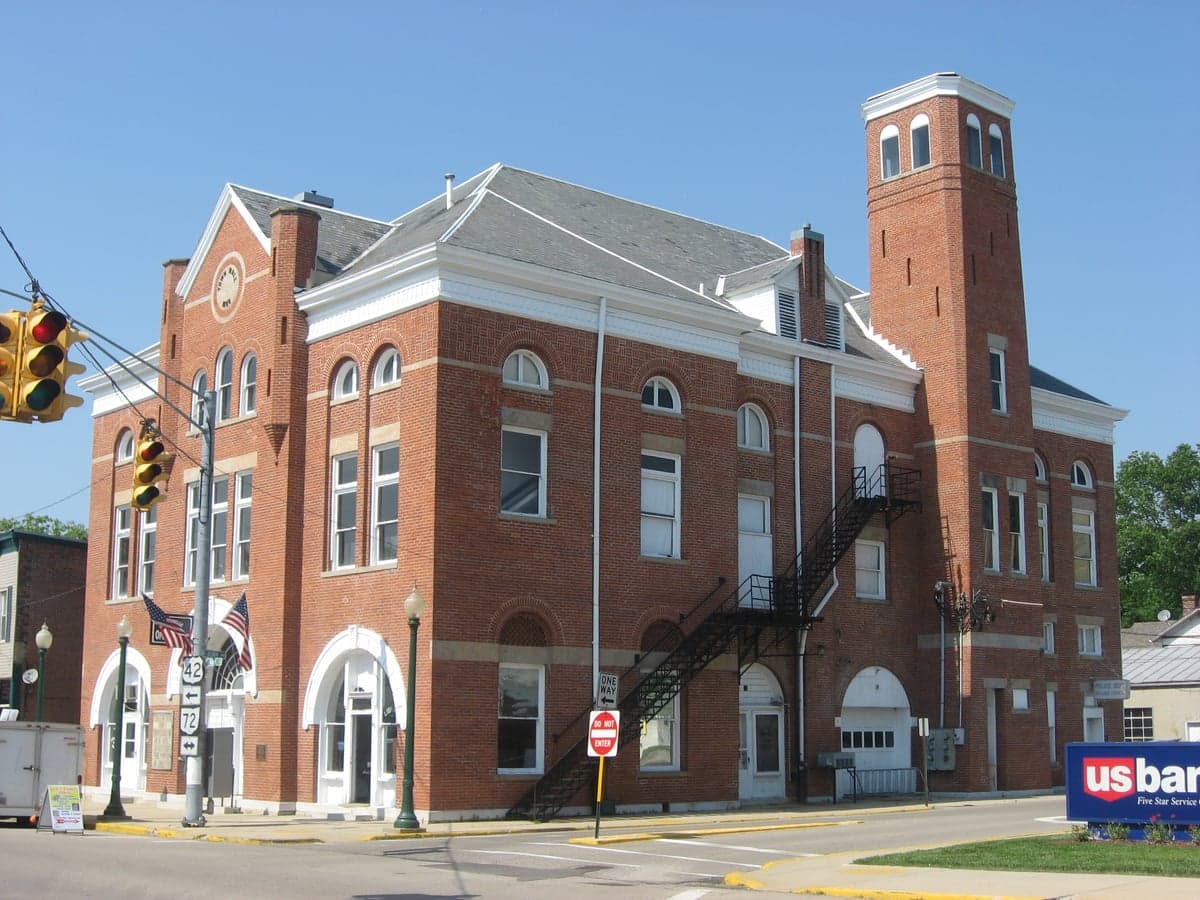
Photo: Wikipedia
Demographics of Cedarville, OH
Affluence Level in Cedarville, OH
A low-income area with significant economic hardship. Household wealth and educational attainment are well below national averages.
People of Cedarville, OH
Cedarville, Ohio, is a small, tight-knit village of 3,759 residents that blends a historic college-town character with a growing diversity shaped by its university and regional economy. The population is predominantly white (74.3%) but includes a notable Black community (15.6%) and rising shares of East/Southeast Asian (1.8%) and Indian-subcontinent (1.3%) residents, reflecting the draw of Cedarville University. With a foreign-born population of 5.8% and a college-educated rate of 38.8%, the village is more educated and diverse than many rural Ohio towns, yet retains a conservative, family-oriented identity rooted in its religious and agricultural heritage.
How the city was settled and grew
Cedarville’s human history begins with the Shawnee and Miami tribes, who used the area along Massie Creek for hunting and travel before European settlement. The village was formally platted in 1816 by John and William Simms, who were drawn by the fertile soils of the Little Miami River valley and the water power of Massie Creek. Early settlers were primarily Scotch-Irish and English farmers from Pennsylvania and Virginia, who established the Old Town district along Main Street (now Xenia Avenue) and built the first gristmills and sawmills. The founding of Cedarville College (now Cedarville University) in 1887 by the Reformed Presbyterian Church brought a wave of educated, religiously conservative families and faculty, who settled in the College Hill neighborhood around the campus. The late 19th and early 20th centuries saw a small influx of German and Irish immigrants who worked in the local limestone quarries and on the railroad, forming the Mill District near the creek. By 1950, the population was nearly entirely white, native-born, and Protestant, with a strong agricultural and academic base.
Modern era (post-1965)
The post-1965 era brought gradual demographic change, driven primarily by Cedarville University’s national and international recruitment. The 1970s and 1980s saw the first significant wave of Black students and faculty, many from urban centers in Ohio and the Midwest, who settled in rental housing near campus in the University Heights area and in the South Xenia Avenue corridor. The 1990s and 2000s brought a growing number of East/Southeast Asian students and faculty—particularly from South Korea and China—who concentrated in the Campus View apartments and newer subdivisions west of the university. Indian-subcontinent families, many in engineering and healthcare fields, began arriving in the 2000s, settling in the Woodland Hills subdivision. The Hispanic population (2.3%) grew more slowly, with families working in local agriculture and service industries, living primarily in the East Side neighborhoods near the industrial park. The Black population’s rise to 15.6% reflects both university recruitment and regional migration from nearby Dayton and Springfield, though the community remains largely integrated rather than segregated into distinct ethnic enclaves.
The future
Cedarville’s population is likely to continue diversifying, driven by Cedarville University’s ongoing international recruitment and the expansion of regional healthcare and logistics employers. The East/Southeast Asian and Indian-subcontinent shares are expected to grow modestly as the university strengthens ties with Asia and as families follow job opportunities in nearby Dayton’s tech and medical sectors. The Black population share may stabilize or increase slightly, as the area remains affordable compared to larger Ohio cities. The Hispanic share is projected to grow slowly, in line with statewide trends. New residential development is concentrated in the North Cedarville area along US-42 and in the Prairie Run subdivision, which are attracting younger families and university staff. The village’s cultural identity is likely to remain conservative and religiously grounded, but with a more visibly multiethnic character in public spaces, schools, and churches.
For someone moving in now, Cedarville offers a stable, safe, and family-oriented community with a strong educational anchor and a gradually diversifying population. The village is becoming more cosmopolitan in its university corridors while retaining its rural Ohio roots, making it a distinctive choice for those seeking a small-town environment with growing cultural variety and a conservative social fabric.

* Values derived from national, state, county, city and local statistics and may differ in a specific area. Last updated: 2026-08-19T02:05:25.000Z
Narrative content on this page is AI-generated and may contain mistakes. Verify any details that matter before acting on them.
ReloMaps may earn a commission from affiliate links at no extra cost to you.

