
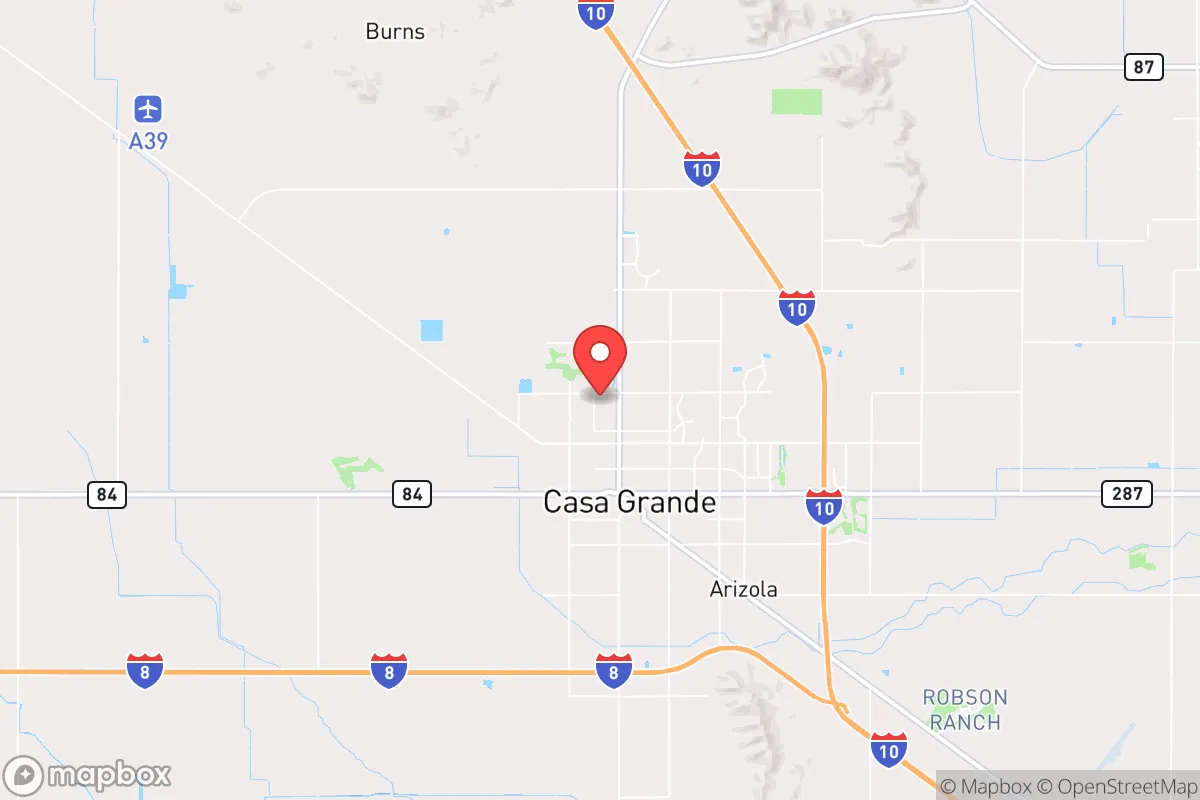
Photo: Wikipedia
Political ClimatePolitical Climate in Casa Grande, AZ
District shown is the primary district for this city’s centroid. Cities may span multiple districts.
Local Political AnalysisPolitical Analysis of Casa Grande, AZ
Casa Grande sits right in the political middle, literally and figuratively. Its Cook Partisan Voting Index (PVI) of EVEN means the city is a true toss-up, splitting almost exactly between red and blue voters in recent cycles. But if you’ve lived here as long as I have, you know that “even” is a recent development—this area used to lean reliably conservative, and the shift toward a purple balance has come with some real growing pains. The surrounding Pinal County still votes solidly Republican, but Casa Grande itself has seen an influx of new residents from Phoenix and Tucson, bringing more progressive attitudes that are slowly reshaping local elections and policy debates.
How it compares
Drive 20 minutes north to Coolidge, and you’ll find a town that still feels like the old Casa Grande—strongly conservative, with a focus on agriculture and family values. Head south toward Eloy, and it’s even more red. But Casa Grande is now the swing district in the region. In the 2024 presidential race, the city’s precincts were nearly dead even, while surrounding towns voted +15 to +20 points Republican. That contrast matters because it means Casa Grande’s local government is increasingly split between traditional fiscal conservatives and newer, more progressive voices who want higher spending on public transit, bike lanes, and social programs. For those of us who moved here to escape the high taxes and overregulation of Maricopa County, watching the city council flirt with those ideas is a real concern.
What this means for residents
For a conservative-leaning resident, the biggest worry is government creep. Casa Grande’s recent push for a city-wide rental inspection program and talk of expanding the local sales tax to fund “community wellness” initiatives are exactly the kind of overreach that drives people out of blue states. The city’s growth has brought more traffic, more noise, and more demands for government services—but the solution shouldn’t be more rules and higher taxes. The silver lining is that the Pinal County Board of Supervisors remains firmly conservative, so there’s still a check on the most aggressive ideas coming out of city hall. Long-term, if Casa Grande keeps attracting the same kind of transplants who turned Phoenix blue, we could see a permanent shift. But for now, the city is still a place where you can own a gun without a hassle, where the school board hasn’t gone full progressive, and where your property rights are generally respected—though you have to stay vigilant at the ballot box.
Culturally, Casa Grande still holds onto its Western roots. The annual O’odham Tash celebration and the strong presence of local ranching families remind you this isn’t some coastal suburb. But the new developments popping up along the I-10 corridor are bringing chain stores and apartment complexes that feel more like Phoenix every year. The biggest policy distinction right now is water rights—Casa Grande has been more aggressive than neighboring towns in pushing for new groundwater regulations, which some see as a necessary step and others view as government overreach into private property. My advice: keep an eye on the city council meetings. The character of this town is still up for grabs, and the next few election cycles will decide whether Casa Grande stays a conservative-friendly oasis or turns into another overregulated suburb.

State Political ClimatePolitical Climate in Arizona
State Political AnalysisPolitical Environment in the State
Arizona has transformed from a reliably red state into a purple battleground over the past two decades, with Republicans clinging to narrow majorities in statewide races while Democrats have made steady gains in Maricopa County and the Tucson metro. The state’s overall partisan lean now sits at roughly R+2 to R+3, a dramatic shift from the solidly conservative stronghold it was in the 2000s. This trajectory has been driven by massive in-migration from California and the Midwest, a growing Latino electorate, and the suburbanization of once-rural areas, creating a political landscape that feels increasingly volatile and unpredictable for those who remember the old Arizona.
Urban vs. rural divide
The political map of Arizona is starkly divided between its two major metro areas and the vast rural expanse. Maricopa County, home to Phoenix, Mesa, Chandler, and Scottsdale, now accounts for over 60% of the state’s vote and has become the epicenter of the state’s political shift. In 2020, Maricopa County flipped to Joe Biden by about 10,000 votes after going for Trump in 2016, a narrow margin that decided the entire state. Meanwhile, Pima County (Tucson) has been reliably blue for years, with Tucson itself and its suburbs like Oro Valley and Marana leaning left, while the rest of the county is more mixed. The rural counties—Yavapai (Prescott), Mohave (Kingman, Lake Havasu City), and Cochise (Sierra Vista)—remain deeply conservative, often voting 70-80% Republican. The real battleground is the suburban ring around Phoenix: Gilbert, Chandler, and Peoria have shifted from solid red to competitive, while places like Buckeye and Surprise remain conservative but are growing fast with new arrivals who may not share the old guard’s values.
Policy environment
Arizona’s policy environment is a mixed bag that reflects its purple status. The state has a flat income tax rate of 2.5% (passed in 2021), one of the lowest in the nation, and no estate tax, which appeals to conservatives. Property taxes are relatively low, averaging about 0.62% of home value. However, the state’s sales tax is high at 5.6% base, with local add-ons pushing it to 8-10% in some cities. On education, Arizona has a robust school choice system with universal Empowerment Scholarship Accounts (ESAs) that allow parents to use public funds for private or homeschool expenses—a major win for parental rights. But the state also has a progressive income tax credit system that some conservatives view as government overreach into family finances. Healthcare policy is a flashpoint: Arizona expanded Medicaid under the Affordable Care Act in 2013, a decision that still rankles many conservatives who see it as federal dependency. Election laws have been a battleground: the state passed voter ID requirements and a ban on ballot harvesting, but also has no-excuse mail-in voting, which remains controversial among those who worry about ballot security. The 2020 election audit in Maricopa County, while ultimately inconclusive, highlighted deep distrust in the system among many conservatives.
Trajectory & freedom
The trajectory of personal freedom in Arizona is a mixed picture, with some clear wins and some concerning trends. On the positive side, Arizona passed a constitutional carry law in 2010, allowing permitless concealed carry, and has strong preemption laws that prevent cities from enacting their own gun restrictions. The state also passed a parental rights law in 2022 that requires schools to notify parents about curriculum changes and medical services, a direct response to progressive overreach in education. However, the state has seen a steady erosion of property rights through zoning regulations, particularly in Phoenix and Tucson, where city councils have imposed rent control measures and density mandates that many conservatives view as government overreach. Medical autonomy took a hit in 2024 when the state legislature passed a law requiring parental consent for minors to receive gender-affirming care, which conservatives see as protecting children but progressives view as a restriction. The biggest freedom concern is the state’s water management: the 1980 Groundwater Management Act gives the state broad authority over water rights, and recent cuts to Colorado River allocations have led to fears of government control over property use in growing areas like Buckeye and Queen Creek. The trend is toward more state intervention in water, which could limit development and personal property rights.
Civil unrest & political movements
Arizona has been a hotbed of political activism, particularly around immigration and election integrity. The 2010 SB 1070 law, which required police to check immigration status during stops, sparked massive protests and boycotts, and the issue remains deeply divisive. In 2024, the state passed a new law allowing local police to enforce federal immigration laws, which has led to ongoing protests in Phoenix and Tucson. The “Stop the Steal” movement was particularly active in Arizona, with the 2021 Maricopa County audit drawing national attention and leading to ongoing distrust of election systems. On the left, groups like LUCHA (Living United for Change in Arizona) have organized around voting rights and immigrant protections, while on the right, the Arizona Freedom Caucus has pushed for stricter election laws and school choice. The state has also seen growing secessionist rhetoric in rural counties, with some activists in Mohave and Yavapai counties calling for a “New Arizona” separate from the Phoenix metro, though this remains fringe. The most visible flashpoint for a new resident would be the constant political ads and yard signs, especially in competitive suburbs like Gilbert and Chandler, where neighbors often have opposing views on display.
Projection
Over the next 5-10 years, Arizona is likely to become more competitive and potentially tilt blue in statewide races, driven by continued in-migration from California and the growth of the Latino electorate, which tends to lean Democratic. The suburban shift in Maricopa County is the key trend: as places like Queen Creek and Surprise fill up with new arrivals who are less tied to traditional conservative values, the state’s overall lean will move left. However, the rural counties will remain deeply red, and the state’s electoral college-like structure (with its 11 electoral votes) means that a few thousand votes in Maricopa County will continue to decide the state. The biggest wildcard is the water crisis: if the state imposes severe restrictions on new development, it could slow growth and preserve the current political balance, but if it doesn’t, the demographic shift will accelerate. A new resident moving in now should expect a state that is politically volatile, with close elections every cycle and a constant battle over cultural issues like education, immigration, and gun rights. The conservative advantage in the state legislature and governor’s office is fragile and could flip in the next decade.
For a conservative considering a move to Arizona, the bottom line is that you’re getting a state with low taxes, strong gun rights, and school choice, but you’re also moving into a political battleground where your vote matters more than in a deep red state. The freedom to live your life without government overreach is still strong in rural areas and many suburbs, but the Phoenix metro is increasingly divided, and the state’s trajectory is uncertain. If you value a place where your voice can make a difference in close elections, Arizona is a good bet—but don’t expect the solid conservative haven it was 20 years ago. Keep an eye on water policy and school board elections, as those will be the front lines of the freedom fight in the years ahead.
* Values derived from national, state, county, city and local statistics and may differ in a specific area. Last updated: 2026-04-21T18:25:23.000Z
Narrative content on this page is AI-generated and may contain mistakes. Verify any details that matter before acting on them.
ReloMaps may earn a commission from affiliate links at no extra cost to you.

