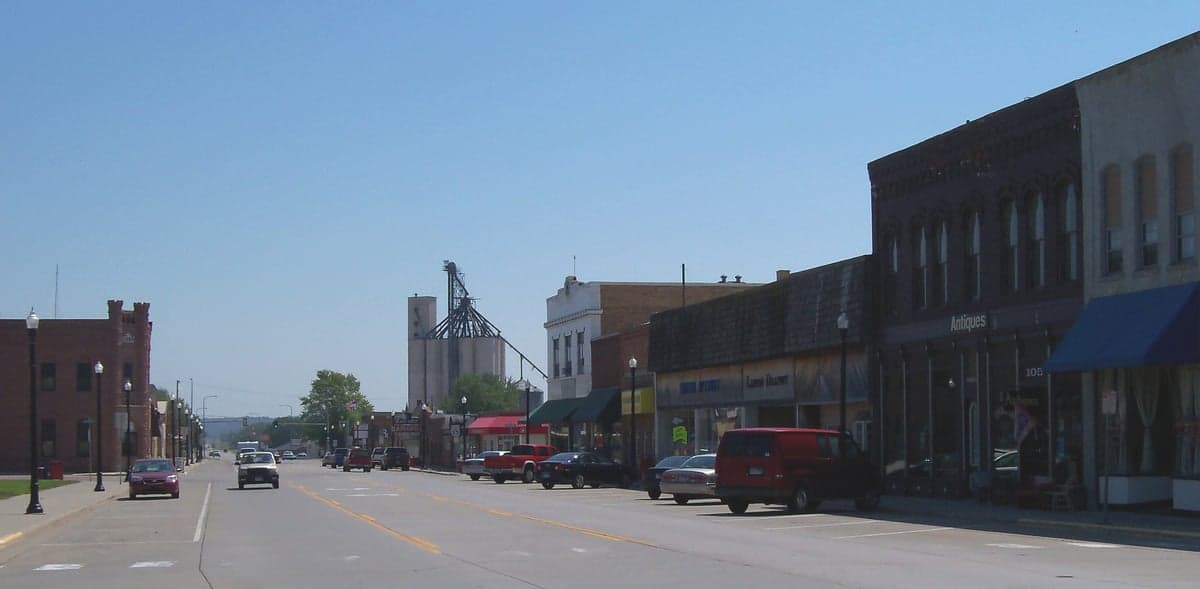
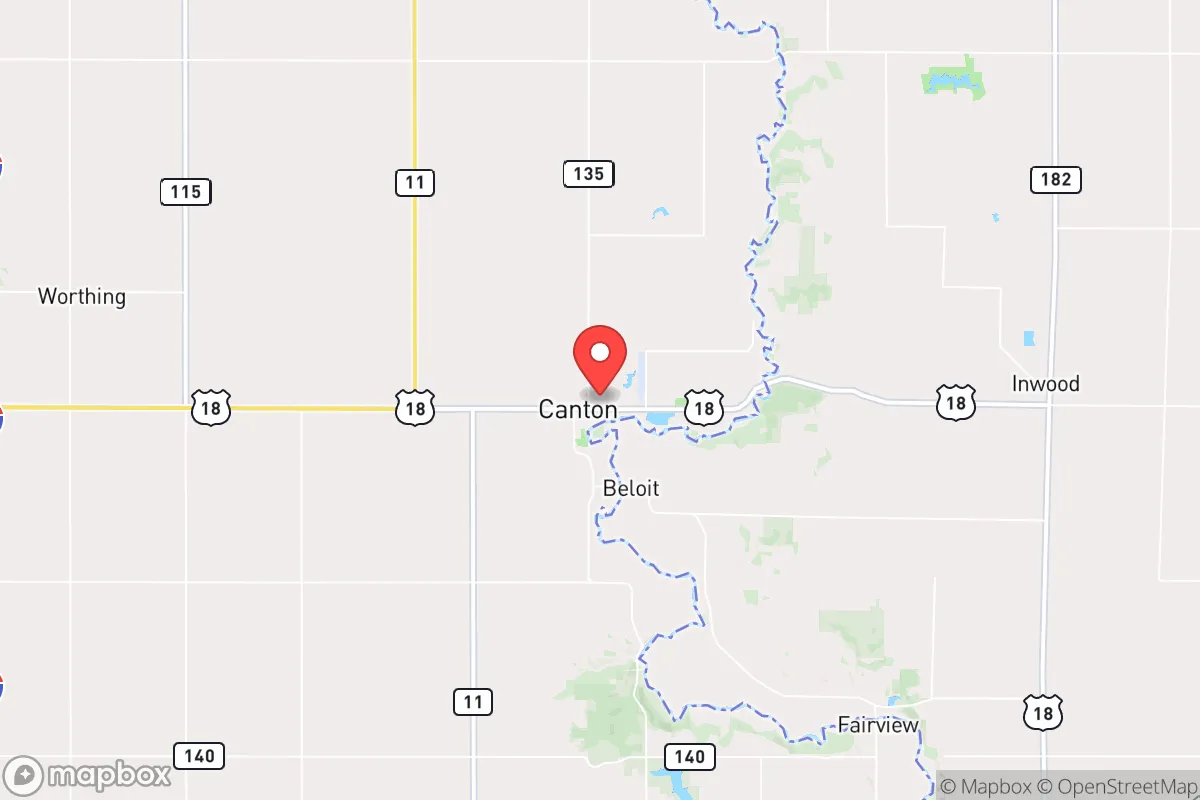
Photo: Wikipedia
Political ClimatePolitical Climate in Canton, SD
District shown is the primary district for this city’s centroid. Cities may span multiple districts.
Inherited from parent state — no local data available.
Local Political AnalysisPolitical Analysis of Canton, SD
Canton, South Dakota, sits squarely in deep-red territory, with a Cook PVI of R+15 that reflects generations of conservative values. This isn't a place that flirts with political uncertainty—it's a community where the Republican primary often decides the real election, and where folks take a dim view of government meddling in their daily lives. The trajectory here is steady: Canton has held its conservative line even as some nearby towns, like Sioux Falls to the north, have seen a slow drift toward more moderate or even progressive positions, especially among newer transplants. If you're looking for a place where personal freedom and local control still mean something, this is it.
How it compares
Drive 20 minutes north to Sioux Falls, and you'll feel the difference. That city's growth has brought a younger, more diverse population, and with it, a noticeable shift toward progressive policies on things like housing regulations and public spending. Canton, by contrast, has stayed grounded. The surrounding Lincoln County is reliably conservative, but even here, you'll see subtle contrasts: the county seat of Canton tends to be a bit more traditional than the rural farmsteads just outside town, where folks are even more skeptical of any new tax or ordinance. Compared to places like Brookings or Vermillion—college towns with a more liberal bent—Canton feels like a holdout for common-sense, limited government. The R+15 rating isn't just a number; it's a reflection of a community that votes against overreach, whether it's from Pierre or Washington.
What this means for residents
For the people who live here, the political climate translates into a lighter touch from government. You won't see the kind of zoning battles or business mandates that plague bigger cities. The local school board and city council are filled with folks who believe in local control, not state or federal dictates. That means fewer regulations on everything from home-based businesses to how you use your property. There's a real sense that if you want to put up a fence, start a side hustle, or keep a few chickens in the backyard, nobody's going to send a code enforcement officer after you. The downside? If you're hoping for big government programs or rapid social change, you'll be disappointed. But for most residents, that's a feature, not a bug. The community values stability and self-reliance, and the political culture reinforces that every election cycle.
Canton does have its own cultural quirks that set it apart. The strong Lutheran and Catholic heritage here means community life often revolves around church and family, not government services. You'll notice a deep skepticism of any new "safety" or "equity" initiatives that sound like they're imported from the coasts. The local paper and coffee shop chatter still focus on property taxes, school curriculum, and Second Amendment rights—not the culture war headlines you see elsewhere. That said, there's a quiet concern among long-time residents that the growth spilling out of Sioux Falls could eventually bring more progressive voters and their ideas. For now, Canton remains a place where personal freedom is the default, and government is expected to stay out of the way. If that changes, it won't be because the locals didn't see it coming.

State Political ClimatePolitical Climate in South Dakota
State Political AnalysisPolitical Environment in the State
South Dakota is a deeply conservative state, with Republicans holding a supermajority in the legislature and a +30-point lean in presidential elections, but the picture is more nuanced than the raw numbers suggest. The state has shifted rightward over the past 20 years, driven by rural out-migration and the influx of conservative-leaning transplants from California and the Midwest, but the eastern edge—particularly Minnehaha and Lincoln counties around Sioux Falls—has introduced a more suburban, business-friendly conservatism that sometimes clashes with the libertarian-populist streak in the western ranching counties. The 2024 election saw Donald Trump win the state with 63% of the vote, but the real story is the growing tension between the old-school, low-tax, low-regulation ethos and a newer wave of culture-war legislation that has made national headlines.
Urban vs. rural divide
The political map breaks into three distinct zones. Sioux Falls (Minnehaha County) and its booming suburb Harrisburg (Lincoln County) are the engine of the state’s economy and its most moderate Republican territory—these areas vote 55-60% Republican, with a strong libertarian streak on taxes but more tolerance for things like urban density and public-private partnerships. Rapid City (Pennington County) is reliably red but has a smaller, more transient population tied to Ellsworth Air Force Base and tourism; it votes about 60% Republican. The real red meat is in the rural counties: Harding County in the northwest voted 89% for Trump in 2024, and Jones County in the central part of the state hit 87%. The divide isn’t just urban vs. rural—it’s also east vs. west, with the Missouri River acting as a cultural boundary. The eastern counties, especially those along I-29, are more influenced by Midwestern pragmatism, while the west leans into a more independent, anti-federal government ethos. The only blue spot of note is Oglala Lakota County on the Pine Ridge Reservation, which voted 65% for Biden in 2020—but that’s a function of tribal politics and federal dependency, not a sign of broader liberal trends.
Policy environment
South Dakota’s policy environment is a mixed bag for conservatives. On the plus side, there’s no state income tax, no corporate income tax, and no personal property tax—a trifecta that draws retirees and remote workers from high-tax states like California and Illinois. Property taxes are moderate, averaging about 1.1% of assessed value, and the state has a right-to-work law. The regulatory climate is light: no state-level OSHA plan, minimal environmental permitting, and a business-friendly tort system. On education, the state has a robust school choice landscape—the 2016 “opt-out” law lets parents easily pull kids from public schools, and the 2023 expansion of the state’s voucher-like program (the “South Dakota Opportunity Scholarship”) now covers private school tuition for low- and middle-income families. Healthcare is a sore spot: the state expanded Medicaid under the 2022 ballot measure (Amendment D), which passed with 56% support despite Republican opposition, and the state-run insurance exchange has limited competition, driving up premiums in rural areas. Election laws are solid: voter ID is required, no-excuse absentee voting is allowed but not widespread, and the state has a clean voter roll system. The 2024 legislative session passed a law requiring citizenship verification for voter registration, which was signed by Governor Kristi Noem.
Trajectory & freedom
South Dakota is becoming more free in the traditional conservative sense—lower taxes, less regulation, and stronger property rights—but there’s a growing tension with the culture-war agenda that some see as government overreach. The 2023 “Parents’ Bill of Rights” (SB 127) codified the right to review curriculum and opt kids out of objectionable material, which was a win for parental freedom. The 2024 “Second Amendment Preservation Act” (SB 46) prohibits state enforcement of any future federal gun bans, a direct nullification-style move that passed with bipartisan rural support. On medical freedom, the state banned COVID-19 vaccine mandates for employers and schools in 2022 (SB 91), and in 2023 it passed a law prohibiting mask mandates in public schools (SB 53). But the flip side is the 2023 ban on nearly all abortions (HB 1215), which took effect after the Dobbs decision—this is popular with the base but has drawn legal challenges and created a small but vocal activist movement. The state also passed a 2024 law restricting transgender medical procedures for minors (SB 43), which has been a flashpoint. The net trajectory is toward more personal liberty on guns, education, and medical choice, but with a heavy hand on social issues that some libertarians find intrusive.
Civil unrest & political movements
South Dakota is not a hotbed of civil unrest, but there are visible flashpoints. The Pine Ridge Reservation has seen periodic protests over the Keystone XL pipeline and law enforcement jurisdiction, but these are localized and rarely spill into the rest of the state. The 2020 protests in Sioux Falls over George Floyd’s death drew about 500 people—small by national standards, but notable for a city of 200,000. The more active movement is on the right: the South Dakota Freedom Caucus, formed in 2023, has pushed for nullification of federal gun laws, school choice expansion, and a state-level immigration enforcement bill (HB 1057, 2024) that would allow local police to enforce federal immigration law. The “Mount Rushmore Society” and other conservative groups have organized rallies for election integrity, though the state’s voting system is widely trusted. The biggest political movement in recent years has been the anti-vaccine mandate protests at the state capitol in Pierre in 2021-2022, which drew thousands and directly influenced the passage of SB 91. There’s also a small but vocal secessionist movement in western South Dakota—the “State of Lakotah” proposal, which has no real political traction but reflects the deep distrust of federal authority in the region.
Projection
Over the next 5-10 years, South Dakota will likely become more conservative in the culture-war sense, but with a growing libertarian-populist split. The in-migration from blue states—especially California, Colorado, and Illinois—is accelerating, with Sioux Falls growing at about 2% annually and Rapid City at 1.5%. These newcomers are generally conservative on taxes and guns but less enthusiastic about social legislation like the transgender ban or the abortion law. The rural counties are depopulating, which will shift the political center of gravity toward the eastern suburbs. Expect more legislation on school choice (possibly a universal ESA), further tax cuts (the state has a $200 million surplus as of 2025), and continued fights over federal land management in the Black Hills. The biggest wild card is the Ellsworth Air Force Base expansion—the B-21 Raider program will bring thousands of new residents to Rapid City, many of them military families who tend to be conservative but may not align with the hardline social agenda. If the state’s leadership overplays the culture-war hand, it could alienate the suburban moderates who are driving growth. But for now, the trajectory is clear: more freedom on taxes and guns, less on social issues, and a state that remains one of the most conservative in the nation.
For a conservative-leaning individual or family moving to South Dakota, the bottom line is this: you’ll get low taxes, light regulation, strong gun rights, and a school system that respects parental authority. The trade-off is a state that is increasingly willing to use government power to enforce social conservatism, which may feel like overreach if you lean libertarian. The best bets for relocation are Sioux Falls for jobs and amenities, Harrisburg for the best schools and a suburban feel, or Rapid City if you want mountain access and a smaller-town vibe. Avoid the reservation counties unless you have a specific reason to be there, and be aware that the western half of the state is a 4-hour drive from the eastern cities—this is a big, spread-out place where local politics vary dramatically. If you value low taxes and personal freedom above all else, South Dakota is a top-tier choice. If you want a state that stays out of your personal life entirely, you might find the culture-war legislation a bit heavy-handed. Either way, you’ll be in good company—the state is growing fast, and most newcomers are here for the same reasons you are.
* Values derived from national, state, county, city and local statistics and may differ in a specific area. Last updated: 2026-04-23T09:18:02.000Z
Narrative content on this page is AI-generated and may contain mistakes. Verify any details that matter before acting on them.
ReloMaps may earn a commission from affiliate links at no extra cost to you.

