Photo: Wikipedia
Political ClimatePolitical Climate in Contra Costa County
Showing district-level results — no local-only data available.
Local Political AnalysisPolitical Analysis of Contra Costa County
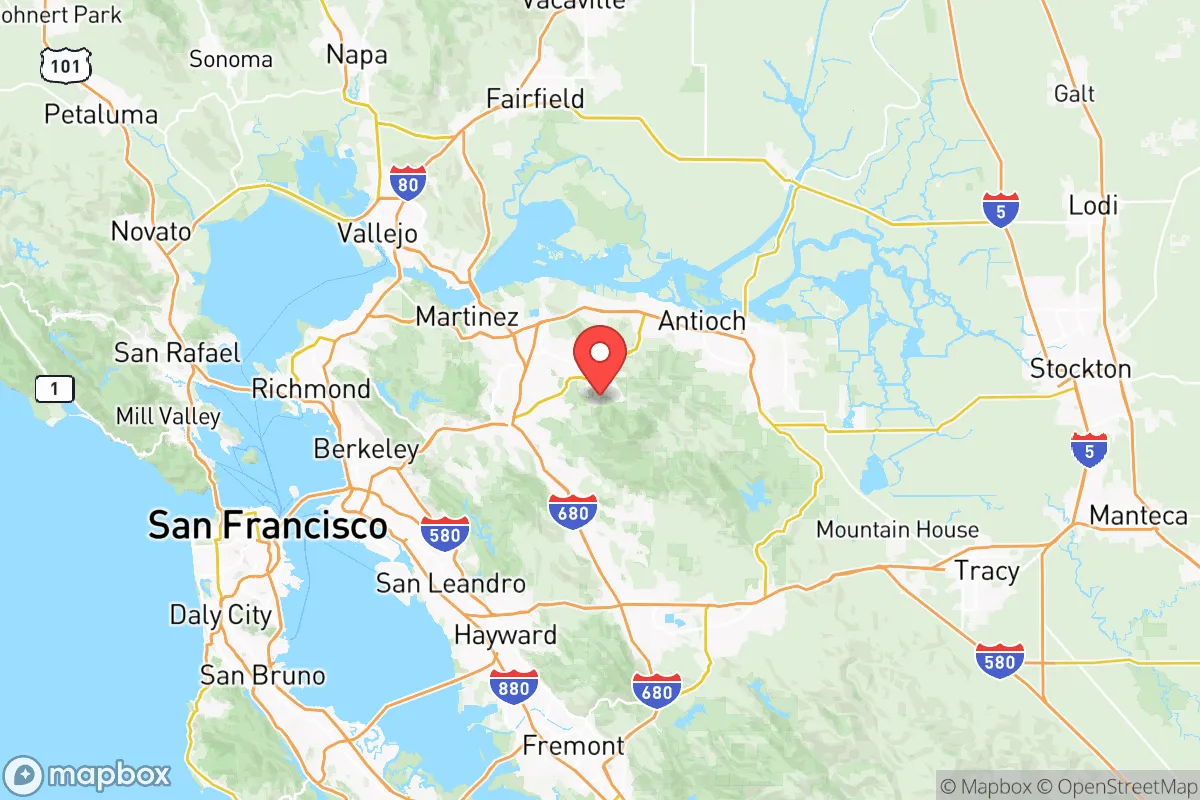
Contra Costa County is a solidly Democratic stronghold with a Cook PVI of D+18, meaning it votes about 18 points more Democratic than the national average. This makes it one of the more reliably blue counties in the broader Bay Area, though its politics are far from monolithic. The county has been trending leftward for decades, driven by the growth of its suburban and exurban communities and the influx of tech-adjacent professionals, but it still retains pockets of moderate and even conservative sentiment, especially in its eastern reaches.
How it compares
Compared to California as a whole, Contra Costa County is slightly more Democratic than the state average. While California's statewide Cook PVI is D+13, Contra Costa's D+18 puts it in the same league as Alameda and San Mateo counties. The real story, however, is the internal divide. The western half of the county—places like Walnut Creek, Lafayette, and Orinda—leans heavily blue, with precincts regularly delivering 70-80% of the vote to Democratic candidates. These are affluent, highly educated suburbs where environmentalism and social liberalism are the norm. In contrast, the eastern part of the county, including Antioch, Pittsburg, and Brentwood, is more politically mixed. These communities have larger working-class and Latino populations, and while they still vote Democratic overall, they show more support for moderate and even conservative positions, especially on housing and public safety. The swing precincts are often found in central Contra Costa, around Concord and Martinez, where older suburbanites and newer arrivals create a more competitive dynamic. In 2020, for example, Concord's precincts ranged from 55% Biden to 45% Trump, a far cry from the 80-20 splits seen in Orinda.
What this means for residents
For liberal residents, Contra Costa County is a comfortable place to live politically. Local government is overwhelmingly Democratic, and policies on climate, housing, and social services align with progressive values. For conservative residents, the experience is more nuanced. They are a clear minority in most of the county, but they are not voiceless. In eastern Contra Costa, conservative viewpoints on issues like property taxes, crime, and school curriculum are regularly represented on city councils and school boards. The county's political reality means that both sides must engage in coalition-building to get things done, especially on regional issues like transportation and affordable housing. The practical effect is that while the county's overall direction is leftward, local politics often feature genuine debate, particularly in the more competitive central and eastern areas.
Culturally, Contra Costa County stands apart from the more intense political activism of San Francisco or Oakland. The vibe here is more suburban and family-oriented, with a focus on quality-of-life issues like parks, schools, and traffic. You'll see fewer protest marches and more neighborhood association meetings. The county's policy distinctions include a strong emphasis on preserving open space—the East Bay Regional Park District is a major political force—and a cautious approach to high-density housing development, which has created tension between pro-growth and slow-growth factions. For a long-time resident, the biggest change has been the steady leftward drift: even traditionally moderate areas like Danville and San Ramon now vote solidly Democratic, a shift that mirrors the broader Bay Area transformation. But the county's internal diversity means it still feels like a place where different political tribes can coexist, even if they don't always agree.

State Political ClimatePolitical Climate in California
State Political AnalysisPolitical Environment in the State
California is a deeply blue state where Democrats hold every statewide office and supermajorities in both legislative chambers, but that monolithic label hides a far more complex reality. The state hasn't voted Republican in a presidential race since 1988, and the Democratic share of the vote has crept from about 54% in 2008 to roughly 60% in 2024. However, that 10-20 year arc is less about a leftward lurch and more about demographic consolidation—the GOP has been squeezed into a few inland strongholds while the coastal metros have become reliably Democratic. For a conservative relocator, the practical takeaway is that you'll be living under one-party rule at the state level, but your day-to-day experience will vary enormously depending on whether you land in Bakersfield, Orange County, or San Francisco.
Urban vs. rural divide
The political map of California is a study in extremes. The San Francisco Bay Area and Los Angeles County are the Democratic engine rooms, together accounting for nearly half the state's votes. In 2024, San Francisco County gave Biden 85% of the vote, while rural Modoc County in the far northeast gave Trump 78%. The Central Valley is the real battleground: Fresno and Bakersfield are reliably red, with Kern County voting +16 R in 2024, but the valley's growing Latino population is shifting some areas purple. The biggest story of the last decade has been Orange County—once the heartland of Reagan conservatism—flipping from red to blue. In 2016, Hillary Clinton became the first Democrat to carry Orange County since 1936, and it's stayed blue since. Meanwhile, San Diego County has moved from swing to solidly blue, while inland Riverside and San Bernardino counties remain competitive but trending left. The practical divide: if you're conservative, you'll feel at home in the Central Valley, the Sierra foothills, or the far north; if you're liberal, the coast is your territory.
Policy environment
California's policy environment is defined by high taxes, heavy regulation, and progressive social policy. The state has a progressive income tax with a top marginal rate of 13.3% (the highest in the nation), a state sales tax that averages 8.85% with local add-ons, and property taxes capped at 1% of assessed value under Proposition 13 (though reassessment on sale can be painful). The regulatory posture is famously business-unfriendly: the California Environmental Quality Act (CEQA) is used to block everything from housing to solar farms, and the state has its own strict emissions standards that effectively set national policy. On education, California spends roughly $23,000 per pupil (above the national average) but ranks near the bottom in reading and math proficiency—a fact that frustrates both conservatives and reform-minded liberals. Healthcare is heavily regulated, with the state running its own insurance exchange (Covered California) and expanding Medi-Cal to cover all low-income adults regardless of immigration status. Election laws are among the most liberal: universal mail-in ballots (mandated since 2020), same-day registration, and no voter ID requirement. For a conservative, this policy mix means higher costs and less local control, but the trade-off is world-class public universities and a safety net that's genuinely robust.
Recent policy direction
The last five years have seen California accelerate in a progressive direction across nearly every policy domain. On gun and self-defense law, the state now has some of the strictest regulations in the country: a 10-day waiting period, an "assault weapons" ban, a roster of approved handguns, and a 2023 law (SB 2) that effectively bans concealed carry in most public places by creating "sensitive places" that cover nearly everywhere. On parental and education rights, the state passed AB 1955 in 2024, which prohibits school districts from requiring parental notification when a child changes their gender identity—a direct response to conservative school boards in places like Temecula and Chino Hills that had passed parental notification policies. On speech and privacy, California has a strong consumer privacy law (CCPA) but has also cracked down on "hate speech" in ways that worry free-speech advocates, including a 2023 law that expands liability for online platforms hosting certain content. On medical and bodily autonomy, the state has become a "sanctuary" for abortion access, passing a 2022 constitutional amendment (Prop 1) that enshrines abortion rights and spending millions to fund travel for out-of-state patients. On property rights, the state has moved to weaken single-family zoning (SB 9, 2021) and allow ADUs by right, but CEQA remains a powerful tool for blocking development. On taxation, voters rejected a 2020 attempt to weaken Prop 13 (Prop 15), but the state continues to raise taxes through other means, including a new 2024 wealth tax proposal that's still being debated. On voting and ballot access, California has moved to automatic voter registration and universal mail-in ballots, but critics point to ongoing concerns about ballot harvesting and signature verification standards.
Civil unrest & political movements
California has been a flashpoint for political movements on both sides. The 2020 George Floyd protests in Los Angeles and Oakland were among the largest and most destructive in the country, with billions in property damage and a lasting impact on public safety politics. The homelessness crisis has spawned its own activist movements: groups like the "Yes in God's Backyard" (YIGBY) coalition push for more shelter, while "housing first" advocates clash with those who want more enforcement. On the right, the "Recall Newsom" movement in 2021 gathered 1.7 million signatures and forced a special election, though Newsom survived easily. The state's sanctuary law (SB 54, 2017) limits local law enforcement cooperation with federal immigration authorities, and cities like San Francisco and Los Angeles have doubled down on "sanctuary city" policies. Secession talk is mostly a fringe phenomenon—the "Calexit" movement has never gained real traction—but there's a persistent "State of Jefferson" movement in the far north (including Yreka and Redding) that wants to form a new state. Election integrity controversies have been muted compared to other states, but conservative activists in Orange County and the Central Valley have raised concerns about ballot drop-box security and signature verification, leading to some local lawsuits.
Projection
Over the next 5-10 years, California's political trajectory is likely to remain blue but with growing internal friction. The biggest demographic shift is the continued decline of the white working-class vote (historically the GOP base) and the rise of Latino and Asian-American voters, who are not reliably Democratic—in 2024, Trump made gains with Latino voters in the Central Valley, particularly in Kern County. The state's high cost of living is driving a net domestic out-migration of about 300,000 people per year, many of them middle-class families and conservatives heading to Texas, Arizona, or Idaho. This self-selection means the remaining population is increasingly liberal, reinforcing the state's blue lean. However, the housing crisis and homelessness epidemic are creating a backlash that could shift the Overton window. Expect more fights over zoning reform (YIMBY vs. NIMBY), more attempts to rein in CEQA, and continued tension between coastal progressives and inland moderates. The state's budget is structurally dependent on high-income earners and capital gains taxes, making it vulnerable to a recession—a downturn could force painful cuts that reshape the political landscape. For a conservative moving in now, expect to live in a state where your vote for president or Senate won't matter, but your local school board and city council races will be fiercely contested and increasingly consequential.
For a new resident, the bottom line is that California offers a world-class economy, natural beauty, and cultural dynamism, but at the cost of high taxes, heavy regulation, and a political environment that can feel hostile to conservative values. If you're moving to Bakersfield or Redding, you'll find like-minded neighbors and a lower cost of living, but you'll still be subject to state laws on guns, education, and taxes that you may disagree with. If you're moving to San Francisco or Los Angeles, you'll be in the heart of progressive governance, with all the benefits and frustrations that entails. The key is to choose your community carefully—California is less a single state than a collection of very different regions, and your experience will depend almost entirely on which one you call home.
* Values derived from national, state, county, city and local statistics and may differ in a specific area. Last updated: 2026-09-17T22:47:31.000Z
Narrative content on this page is AI-generated and may contain mistakes. Verify any details that matter before acting on them.
ReloMaps may earn a commission from affiliate links at no extra cost to you.

