Photo: Wikipedia
Demographics of Contra Costa County
Affluence Level in Contra Costa County
An upper-middle-class area. Household wealth, education levels, and homeownership run ahead of national benchmarks.
People of Contra Costa County
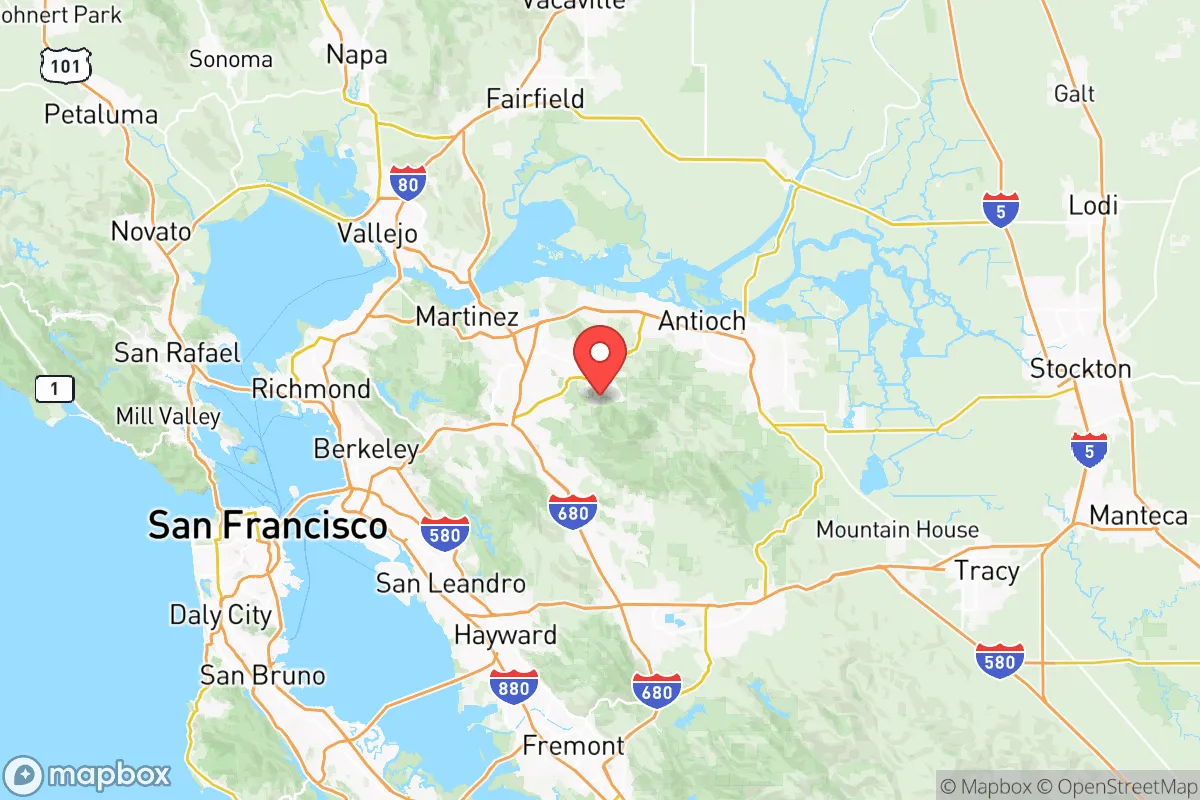
Today, Contra Costa County is home to 1,161,458 residents, making it the ninth-most populous county in California. Its population is characterized by significant racial and ethnic diversity, with no single group holding a majority: 39.3% of residents identify as White, 27.3% as Hispanic or Latino, 13.8% as East or Southeast Asian, 8.2% as Black, and 4.5% as Indian (subcontinent). The county is also highly educated, with 44.9% of adults holding a bachelor’s degree or higher, and it has a relatively low foreign-born share of 10.9%, reflecting a mix of long-established native-born families and newer immigrant communities. Geographically, the population is split between the more urban, transit-oriented western cities like Richmond and Berkeley-adjacent El Cerrito, and the sprawling, family-oriented suburbs of the central and eastern parts of the county, such as Walnut Creek, Concord, and Brentwood.
Settlement & growth (pre-1960)
Before European contact, the area now known as Contra Costa County was inhabited for thousands of years by the Bay Miwok, Ohlone (Costanoan), and Delta Yokuts peoples. These Native nations lived in small, semi-sedentary villages along the Carquinez Strait, the San Joaquin River delta, and the creeks feeding into the San Francisco Bay, relying on acorns, fish, and game. The Spanish colonial period began in 1772 with the establishment of Mission San Francisco de Asís (Mission Dolores), whose priests claimed the region for Spain and forcibly relocated many Native people to the mission system. The name "Contra Costa" — Spanish for "opposite coast" — referred to the land across the bay from San Francisco. After Mexican independence in 1821, large land grants (ranchos) were awarded to Mexican citizens, such as Rancho San Pablo and Rancho El Sobrante, which became the nuclei of later towns like San Pablo and Pinole.
The American period began in earnest after the 1848 Treaty of Guadalupe Hidalgo and the California Gold Rush. The first major wave of Anglo-American settlers were miners and farmers from the eastern United States, many of whom arrived in the 1850s and 1860s. They established agricultural communities along the fertile delta and valleys, growing wheat, barley, and later fruit orchards. The town of Martinez, founded in 1849, became the county seat in 1850, while nearby Concord (originally "Todos Santos") was settled in the 1860s by farmers from New England and the Mid-Atlantic. A significant number of Portuguese immigrants, mostly from the Azores, arrived in the 1870s and 1880s, drawn by the dairy and fishing industries; they concentrated in the communities of San Leandro (then part of Contra Costa) and Antioch, where their descendants remain a notable presence today.
The late 19th and early 20th centuries brought a wave of Italian immigrants, who worked in fishing, farming, and the emerging canning industry in Richmond and Pittsburg. The town of Pittsburg, originally called "New York of the Pacific," was renamed in 1911 to attract steel and manufacturing industries, and it drew a mix of Italian, Irish, and German laborers. The completion of the Southern Pacific Railroad in the 1870s and the opening of the San Francisco–Oakland Bay Bridge in 1936 accelerated suburbanization, with Walnut Creek and Lafayette growing as commuter towns for San Francisco and Oakland. During World War II, the Kaiser Shipyards in Richmond attracted a massive influx of workers from across the United States, including a significant number of Black Americans from the South (the Great Migration) and White migrants from the Dust Bowl states of Oklahoma, Arkansas, and Texas. By 1950, Richmond’s population had swelled to over 100,000, and the county’s Black population had grown from negligible to roughly 5%.
Modern era (post-1965)
The 1965 Hart-Cellar Act fundamentally reshaped Contra Costa County’s demographics, as it did across California. The most dramatic change has been the growth of East and Southeast Asian communities. Chinese and Filipino immigrants began arriving in the 1970s and 1980s, drawn by job opportunities in the tech sector and the broader Bay Area economy. They concentrated in San Ramon and Danville, where high-performing schools and large homes attracted middle-class and upper-middle-class families. By 2020, San Ramon’s population was over 40% Asian (East/Southeast Asian), with a strong presence of Chinese, Taiwanese, and Korean residents. Vietnamese immigrants, many of whom arrived as refugees after 1975, established a smaller but visible community in Richmond and San Pablo, often working in manufacturing and service industries.
The Indian (subcontinent) population, while smaller at 4.5% of the county total, has grown rapidly since the 1990s, driven by the tech boom. Indian professionals — particularly from Gujarat, Punjab, and the southern states — have settled in Fremont (which borders Contra Costa) and within the county in San Ramon and Pleasanton, where they work in software engineering, biotech, and finance. This community is highly educated, with a median household income well above the county average. The Hispanic population, which stood at roughly 10% in 1980, has more than doubled to 27.3% today. This growth is driven by both immigration from Mexico and Central America and higher birth rates among established families. Hispanic residents are concentrated in the older industrial cities of Richmond, San Pablo, and Antioch, where they work in construction, retail, and healthcare. The Black population, now 8.2%, has shifted geographically: many families who moved to Richmond during World War II have since relocated to Antioch and Pittsburg in search of newer housing and lower crime rates, a pattern of intra-county suburbanization that accelerated after 2000.
Domestic migration has also played a role. Since the 1990s, Contra Costa has seen an influx of families from San Francisco and the inner East Bay (Oakland, Berkeley) seeking more affordable housing and larger lots. This has driven rapid growth in the far eastern suburbs of Brentwood and Oakley, which were small farming towns as recently as the 1980s but now have populations exceeding 60,000 each. These areas are predominantly White and Hispanic, with growing Asian and Black minorities, and they lean more conservative politically than the western part of the county.
The future
Contra Costa County is projected to become more diverse in the coming decades, though the pace of change may slow. The White population, already a plurality rather than a majority, is expected to continue declining as a share, while the Hispanic and Asian (East/Southeast Asian) populations grow. The Indian (subcontinent) population will likely increase further, particularly in the San Ramon Valley, as tech employment remains strong. However, the county’s high housing costs — the median home price in 2025 exceeded $800,000 — are beginning to push lower-income families, especially Hispanic and Black residents, further east into San Joaquin County (Tracy, Stockton) or out of the Bay Area entirely. This could lead to a bifurcation: affluent, highly educated Asian and White families in the western and central suburbs, and a more working-class, Hispanic and Black population in the eastern cities. The county’s cultural identity is evolving from its agricultural and industrial roots toward a knowledge-economy hub, with a growing emphasis on tech, healthcare, and professional services.
For someone moving in now, Contra Costa County offers a mix of urban and suburban lifestyles, with strong schools in the San Ramon Valley and more affordable options in the east. The county is becoming more politically moderate overall, with the eastern suburbs trending Republican and the western cities remaining Democratic. The key trade-off is between proximity to San Francisco and Oakland (and higher costs) versus space and lower taxes in the east. The population is stable but aging, with a median age of 39, and new residents are likely to be families or professionals drawn by jobs in the Tri-Valley tech corridor. The county is not a boomtown, but a mature, diversifying suburb that offers a quieter alternative to the core Bay Area.

* Values derived from national, state, county, city and local statistics and may differ in a specific area. Last updated: 2026-09-17T22:47:31.000Z
Narrative content on this page is AI-generated and may contain mistakes. Verify any details that matter before acting on them.
ReloMaps may earn a commission from affiliate links at no extra cost to you.

