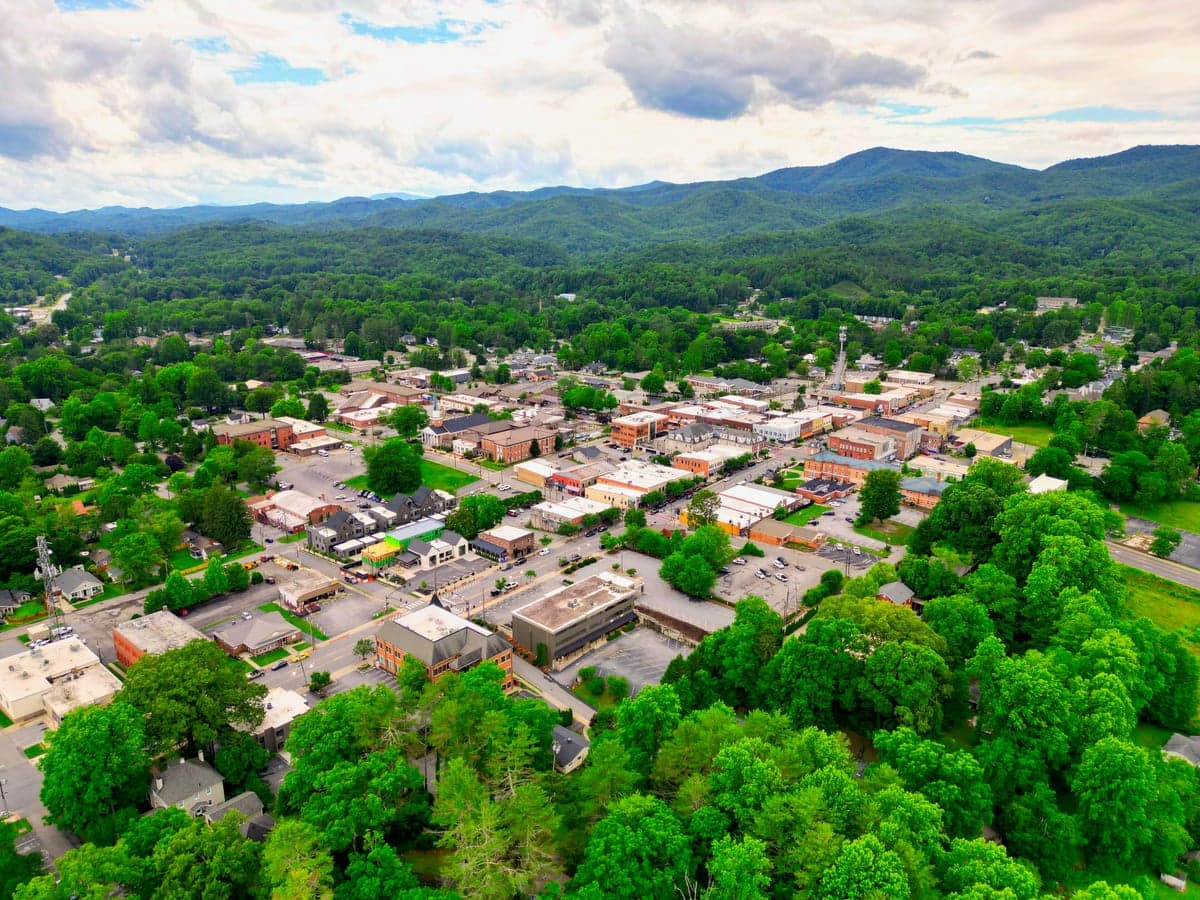
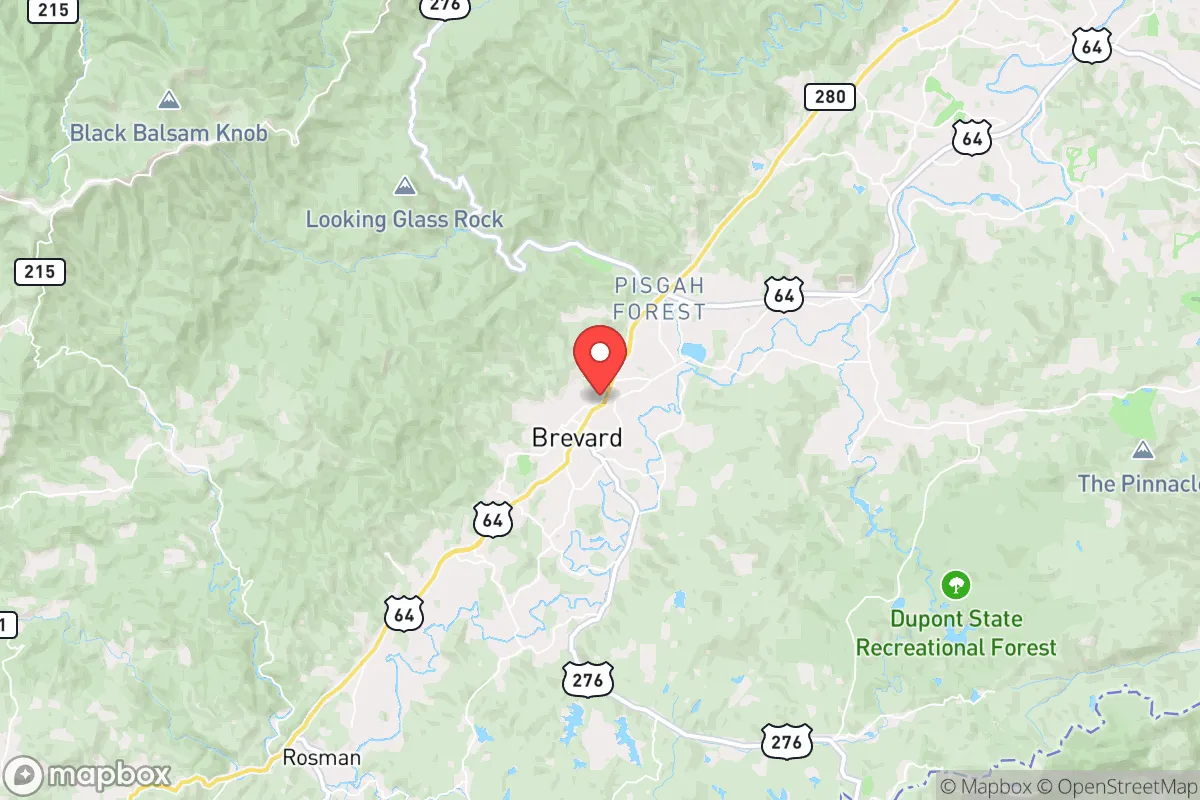
Photo: Wikipedia
Personal Sovereignty in Brevard, NC
Viable for self-reliance. Generally workable, though some barriers may limit total independence.
What does Personal Sovereignty tell us?
Personal Sovereignty measures your capacity for self-reliance and independence with minimal government friction. Higher scores mean fewer barriers between you and the way you want to live... but it assumes you have the space you need and good neighbors.
What does this tell us?
Personal Sovereignty measures your capacity for self-reliance and independence with minimal government friction. Higher scores mean fewer barriers between you and the way you want to live... but it assumes you have the space you need and good neighbors.
State Policy
Energy independence: Importer (15% of energy produced in-state)
Personal Liberty
Homesteading

Personal Liberty Analysis
Brevard, North Carolina, offers a notably high degree of personal sovereignty, rooted in North Carolina’s generally light-touch state governance and a local culture that prizes self-reliance. For individuals and families who prioritize autonomy—whether in financial decisions, self-defense, or lifestyle choices—the area provides a legal and regulatory environment that is permissive compared to many other parts of the Southeast, particularly the Northeast and West Coast. The key trade-offs involve balancing this freedom with the practical realities of a small mountain town, where community norms and limited local government capacity shape daily life more than heavy-handed regulation.
Tax burden and regulatory posture for individuals and families
North Carolina’s tax structure is a clear advantage for those seeking to keep more of their earnings. The state levies a flat personal income tax rate of 4.5% as of 2026, with a standard deduction of $12,750 for single filers and $25,500 for married couples filing jointly. There is no state-level tax on Social Security benefits, and a $2,000 deduction per child is available for dependents under 17. Property taxes in Transylvania County, where Brevard is located, are moderate: the county rate is approximately $0.53 per $100 of assessed value, with the city of Brevard adding roughly $0.32 per $100, for a combined rate around $0.85. This is well below the national average for incorporated areas. Sales tax is 6.75% (4.75% state, 2% local), which is competitive. The regulatory posture at the state level is consistently business-friendly and individual-liberty-oriented. North Carolina is a right-to-work state, has no state-level occupational licensing for many trades beyond basic requirements, and has preempted local governments from enacting their own minimum wage or paid leave mandates. At the county and city level, zoning is present but not aggressive. Brevard’s zoning code allows for a range of residential uses, including home-based businesses, with minimal permitting for low-impact activities. The overall regulatory environment is best described as light-touch but not absent—permits are required for major construction, but the process is straightforward and fees are low compared to states like California or New York.
Self-defense and gun law specifics in North Carolina
North Carolina is a strong Second Amendment state, and Brevard residents enjoy broad self-defense rights. The state is a shall-issue jurisdiction for concealed carry permits, meaning that if a resident meets the statutory requirements (age 21, no disqualifying criminal record, completion of a firearms safety course), the sheriff’s office must issue the permit. There is no permit required to openly carry a handgun or long gun, though local ordinances in Brevard do not restrict open carry in public spaces. Stand-your-ground laws are in effect: there is no duty to retreat before using deadly force if a person is lawfully present and reasonably believes force is necessary to prevent imminent death or great bodily harm. Castle doctrine protections extend to occupied vehicles and workplaces. The state also has preemption laws that prevent local governments from enacting their own gun control ordinances, meaning Brevard cannot ban firearms in parks or impose waiting periods beyond state law. For long guns, private sales between individuals do not require a background check, though handgun sales from private parties must go through a licensed dealer with a NICS check. Magazine capacity is not restricted, and there is no state-level assault weapons ban. For a family or individual prioritizing self-defense, Brevard offers a legal framework that is permissive and predictable, with no local barriers to carrying or storing firearms.
Self-reliance and homesteading viability: lot sizes, zoning, and off-grid feasibility
Brevard and its surrounding rural areas in Transylvania County are well-suited for a self-reliant lifestyle, though with some practical constraints. Within the city limits, minimum lot sizes are typically 0.25 to 0.5 acres, but most residential zoning allows for gardens, small livestock (chickens, rabbits), and even beekeeping with a simple permit. Outside city limits, in the county’s unincorporated areas, lot sizes commonly range from 1 to 5 acres, with many parcels available for under $10,000 per acre. Zoning in the county is minimal: there is no county-wide building code for agricultural structures, and no permit is required for fences, sheds under 200 square feet, or driveway construction. Off-grid feasibility is high. North Carolina has no state law prohibiting rainwater collection, and Transylvania County has no local restrictions. Solar panels are permitted without special zoning approval, and net metering is available through Duke Energy, the dominant utility. For those seeking to disconnect from the grid entirely, the county does not require a certificate of occupancy for a dwelling that is not connected to power or water, as long as it meets basic septic and well regulations. Composting toilets are legal with a county-approved system, and wood stoves are common for heating. The main regulatory hurdle is the state’s requirement for a septic permit (typically $200–$500) and a well permit (around $300). Overall, the area is one of the more permissive in the Southeast for homesteading, with the caveat that steep terrain and forested lots may require engineering for driveways and building pads.
Personal liberties: parental rights, medical autonomy, speech, and property
North Carolina’s legal framework supports a broad range of personal liberties that align with conservative values. Parental rights are strongly protected under state law: parents have the right to direct the education, healthcare, and religious upbringing of their children without state interference, unless there is a clear showing of abuse or neglect. The state has a robust school choice system, including charter schools, private school vouchers (the Opportunity Scholarship Program), and homeschooling with minimal regulation (no testing requirements, no curriculum approval, only a simple notice of intent). Medical autonomy is respected but not absolute. North Carolina has no state-level vaccine mandate for adults, and the state’s medical freedom law (passed in 2023) prohibits employers from requiring COVID-19 vaccination as a condition of employment unless they meet narrow exemptions. For children, the state requires certain vaccines for school attendance, but medical and religious exemptions are available and are not overly burdensome to obtain. Speech is protected under the First Amendment, and Brevard has no local ordinances restricting public expression, protest, or leafleting. Property rights are strong: North Carolina is a fee-simple state with no state-level property tax on personal property (vehicles are taxed annually, but at a low rate of about 0.5% of value). Eminent domain is limited to public use projects, and the state has a right-to-farm law that protects agricultural operations from nuisance lawsuits. The overall environment is one where individuals are trusted to make their own decisions in most areas of life, with the state stepping in only for clear public safety concerns.
Compared to other regions in the United States, Brevard and western North Carolina rank among the top tier for personal sovereignty. The combination of low taxes, permissive gun laws, minimal zoning for rural properties, and strong protections for parental and medical autonomy creates an environment where self-reliance is not just tolerated but actively supported by the legal framework. The main limitations are the state’s income tax (which is moderate but not zero) and the need for septic and well permits for off-grid living. For a conservative-leaning individual or family seeking a place where they can live largely on their own terms, Brevard offers a compelling balance of freedom, affordability, and community—without the extreme libertarian isolation of some Western states or the heavy regulation of the Northeast. The area’s sovereignty profile is best described as pragmatic and permissive, with a strong cultural expectation that residents take responsibility for their own lives and property.

* Values derived from national, state, county, city and local statistics and may differ in a specific area. Last updated: 2026-08-03T15:45:12.000Z
Narrative content on this page is AI-generated and may contain mistakes. Verify any details that matter before acting on them.
ReloMaps may earn a commission from affiliate links at no extra cost to you.

