Photo: Wikipedia
Demographics of Boyertown, PA
Affluence Level in Boyertown, PA
A middle-class area roughly in line with national averages across income, home values, education, and employment.
People of Boyertown, PA
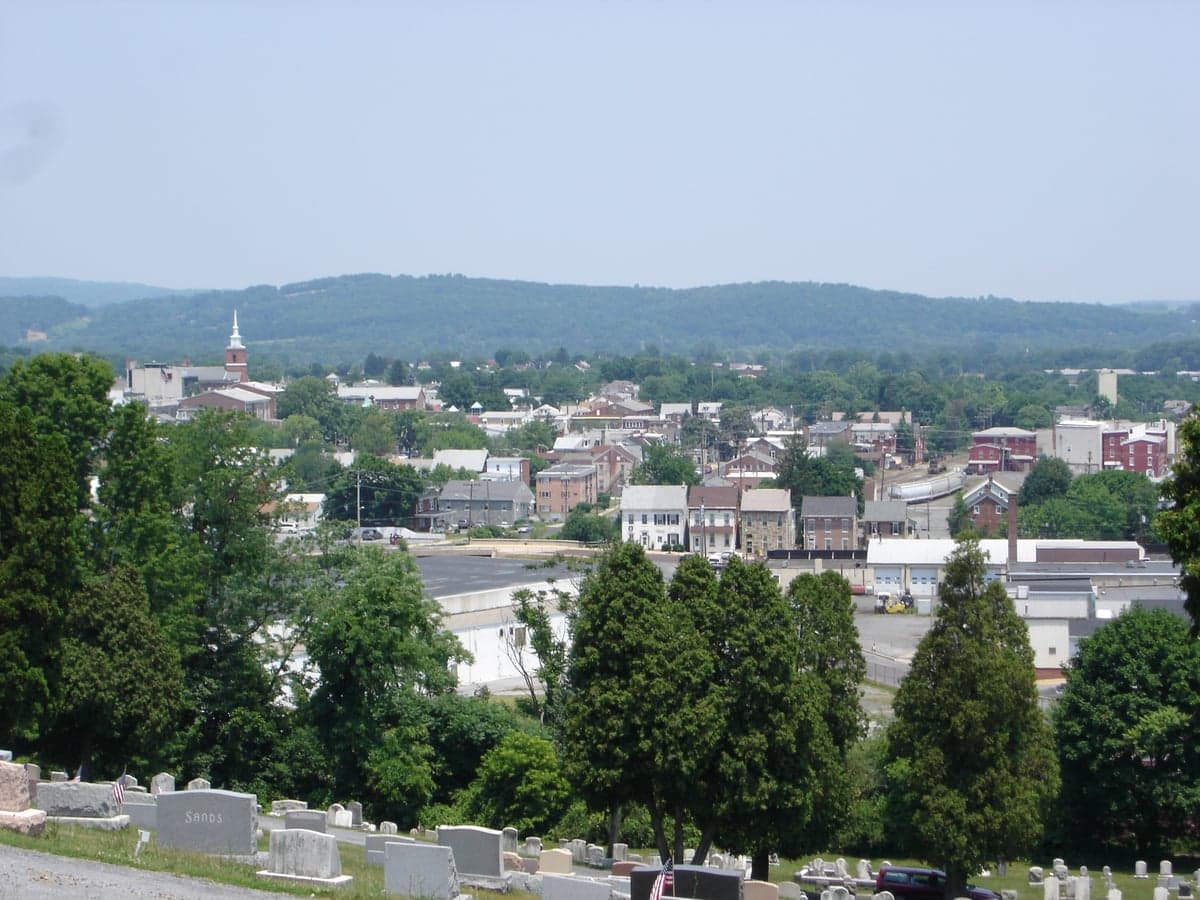
The people of Boyertown, Pennsylvania, today form a tight-knit community of 4,264 residents that is overwhelmingly white (88.7%) and notably lacking in foreign-born population (0.0%), making it one of the most ethnically homogeneous small towns in southeastern Pennsylvania. With a Hispanic share of 6.4% and a college attainment rate of just 15.9%, the town retains a distinctly working-class character rooted in its industrial past. Residents often describe Boyertown as a place where families have lived for generations, where church suppers and high school football games anchor social life, and where the pace remains slower than the nearby Philadelphia exurbs. The town’s identity is shaped less by newcomers and more by the persistence of old Pennsylvania German and Eastern European traditions.
How the city was settled and grew
Boyertown’s population history begins with Pennsylvania German farmers and ironworkers in the mid-18th century. The area was originally part of the Colebrookdale Township, settled by German-speaking Protestants—Lutherans and Reformed—who cleared the forested ridges for agriculture. The town itself was laid out in 1828 by Henry Boyer, a local mill owner, at the intersection of what is now Philadelphia Avenue and Reading Avenue. The real population surge came with the discovery of iron ore and the rise of the Boyertown Iron Works in the 1840s, which drew skilled German and Irish laborers. These workers built their homes in what is now known as the Foundry District, a cluster of brick row houses and worker cottages along the railroad tracks near the former furnace site. By the 1880s, the Boyertown Casket Company (later Boyertown Burial Casket Company) became the town’s largest employer, attracting a second wave of Eastern European immigrants—primarily Polish and Slovak families—who settled in the East End, a neighborhood of modest frame homes east of the main commercial corridor on Philadelphia Avenue. The town’s population peaked at roughly 4,500 in the 1950s, supported by manufacturing jobs that required little formal education, a pattern that explains the persistently low college attainment rate today.
Modern era (post-1965)
After the 1965 Hart-Cellar Act, Boyertown saw virtually no immigration—the foreign-born share remains 0.0%—a stark contrast to larger Pennsylvania cities like Allentown or Reading. Instead, the town’s demographic story since the 1970s has been one of domestic out-migration and gradual suburbanization. The closure of the Boyertown Casket Company in the 1990s and the decline of local manufacturing prompted many younger residents to leave for the Philadelphia or Reading job markets. Those who stayed or moved in were largely white families seeking affordable housing in a quiet, low-crime setting. The small Hispanic population (6.4%) is concentrated in the West End, a neighborhood of older single-family homes west of Reading Avenue, where a handful of Mexican-origin families arrived in the 2000s to work in local distribution centers and the remaining light industrial plants. The Black population (0.8%) is scattered, with no distinct neighborhood concentration. The most notable modern development is the growth of the Boyertown Crossing area, a commercial strip along Route 100 south of the historic core, where new townhouse developments and a Walmart Supercenter have drawn some younger families from the broader Berks County area, though these newcomers are overwhelmingly white and native-born.
The future
Boyertown’s population is projected to remain stable or decline slightly over the next decade, mirroring trends across rural Berks County. The town’s age structure is older than the national median, and the low college attainment rate (15.9%) suggests limited attraction for knowledge-economy migrants. The Hispanic share may grow modestly as Berks County’s overall Hispanic population (now roughly 20% countywide) filters into smaller towns, but Boyertown’s lack of rental housing stock and limited public transit will likely keep that growth slow. The Colebrookdale Trail, a rail-trail conversion running through the northern edge of town, has spurred some interest from retirees and outdoor enthusiasts, but new construction remains concentrated in the Boyertown Crossing corridor rather than the historic core. The town’s cultural identity—rooted in Pennsylvania German heritage, volunteer fire companies, and the annual Boyertown Community Fair—shows little sign of rapid change. For a mover, this means joining a community where most residents have deep local roots, where the school district (Boyertown Area School District) is a central institution, and where the social fabric is built on longstanding networks rather than newcomer integration.
For someone moving in now, Boyertown offers a stable, affordable, and culturally cohesive small town where the population is neither growing nor diversifying quickly. The trade-off is clear: residents gain safety, low cost of living, and a strong sense of place, but they join a community with limited ethnic diversity, a shrinking youth population, and an economy still dependent on commuting and remaining light industry. It is a town that has changed little in half a century—and that is precisely what its current residents value most.

* Values derived from national, state, county, city and local statistics and may differ in a specific area. Last updated: 2026-09-22T23:38:45.000Z
Narrative content on this page is AI-generated and may contain mistakes. Verify any details that matter before acting on them.
ReloMaps may earn a commission from affiliate links at no extra cost to you.

