Photo: Wikipedia
Demographics of Bothell, WA
Affluence Level in Bothell, WA
An upper-middle-class area. Household wealth, education levels, and homeownership run ahead of national benchmarks.
People of Bothell, WA
The people of Bothell, Washington today number 48,610, forming a densely populated, highly educated suburban city where 58.6% of adults hold a college degree. The city is notably diverse, with a White population of 62.6%, significant East and Southeast Asian communities at 10.6%, a substantial Indian subcontinent population at 8.5%, and a Hispanic share of 10.4%. Bothell’s identity is shaped by its rapid transformation from a small logging and farming town into a tech-oriented bedroom community for Seattle and Redmond, attracting a wave of highly skilled immigrants and domestic professionals since the 1990s.
How the city was settled and grew
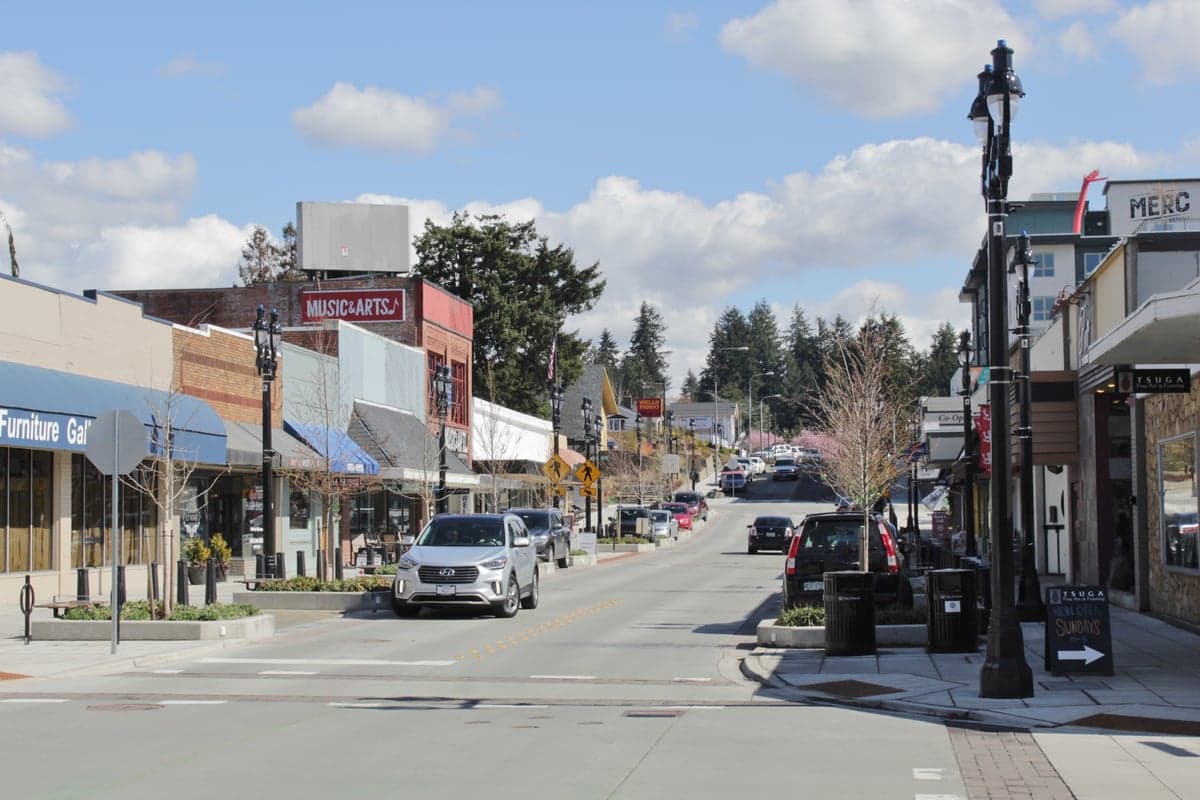
Bothell’s original population was drawn by the timber industry and the arrival of the Seattle, Lake Shore & Eastern Railway in 1887. The first European settlers, primarily of Scandinavian and German origin, established homesteads along the Sammamish River, founding what is now Downtown Bothell as a mill town. By the early 20th century, the city’s economy shifted to dairy farming and berry cultivation, attracting a second wave of Finnish and Swedish immigrants who settled in the North Creek area, where they established small farms. The population remained small and overwhelmingly White through the mid-20th century, reaching only about 5,000 residents by 1960. The city’s growth was modest and tied to local agriculture and the University of Washington’s Bothell campus, which opened in 1990 as a commuter satellite.
Modern era (post-1965)
The post-1965 era, particularly after the 1990s, brought dramatic demographic change driven by the expansion of the tech industry in nearby Redmond (Microsoft) and Seattle (Amazon). The 1990 opening of the University of Washington Bothell campus in the Bothell Way corridor accelerated in-migration of educated professionals. The largest influx came from East and Southeast Asian communities—Chinese, Korean, Vietnamese, and Filipino families—who settled in the Thrasher’s Corner and Beardslee Crossing neighborhoods, drawn by new housing developments and proximity to tech jobs. The Indian subcontinent population, primarily from India and Pakistan, grew rapidly after 2000, concentrating in the Maltby area and newer subdivisions near the Canyon Park business district. The Hispanic population, at 10.4%, is largely composed of Mexican and Central American families who arrived for construction and service jobs, settling in older, more affordable parts of Downtown Bothell and along the SR 522 corridor. The Black population remains very small at 0.9%, with no concentrated neighborhood. By 2020, the foreign-born share reached 12.1%, reflecting the city’s role as a gateway for skilled immigrants in the Puget Sound tech economy.
The future
Bothell’s population is trending toward greater ethnic diversity and higher educational attainment, but with distinct enclaves rather than full integration. The East and Southeast Asian communities are plateauing as a share of the population, as second-generation families assimilate and move to newer suburbs like Mill Creek and Lynnwood. The Indian subcontinent population, however, continues to grow, driven by ongoing H-1B visa holders and tech workers, and is likely to surpass the East/Southeast Asian share within the next decade. The Hispanic population is stable but aging, with younger families moving to more affordable areas in Snohomish County. The White population, while still the majority, is declining in share as older residents age in place and younger White families are priced out. The city is not homogenizing; instead, it is tribalizing into distinct ethnic neighborhoods—Thrasher’s Corner remains predominantly East/Southeast Asian, Maltby is increasingly Indian, and Downtown Bothell is becoming a mixed Hispanic and White enclave. Over the next 10-20 years, Bothell will likely become a majority-minority city, with the Indian subcontinent and East/Southeast Asian populations combined exceeding the White population by 2040.
For someone moving in now, Bothell is a rapidly diversifying, tech-driven suburb where educational attainment and income are high, but housing costs are steep and ethnic neighborhoods are becoming more defined. The city offers strong schools and proximity to major employers, but newcomers should expect a community where demographic change is accelerating, and where the character of each neighborhood—from the historic downtown to the newer subdivisions—varies significantly by the ethnic group that dominates it.

* Values derived from national, state, county, city and local statistics and may differ in a specific area. Last updated: 2026-04-21T11:16:35.000Z
Narrative content on this page is AI-generated and may contain mistakes. Verify any details that matter before acting on them.
ReloMaps may earn a commission from affiliate links at no extra cost to you.

