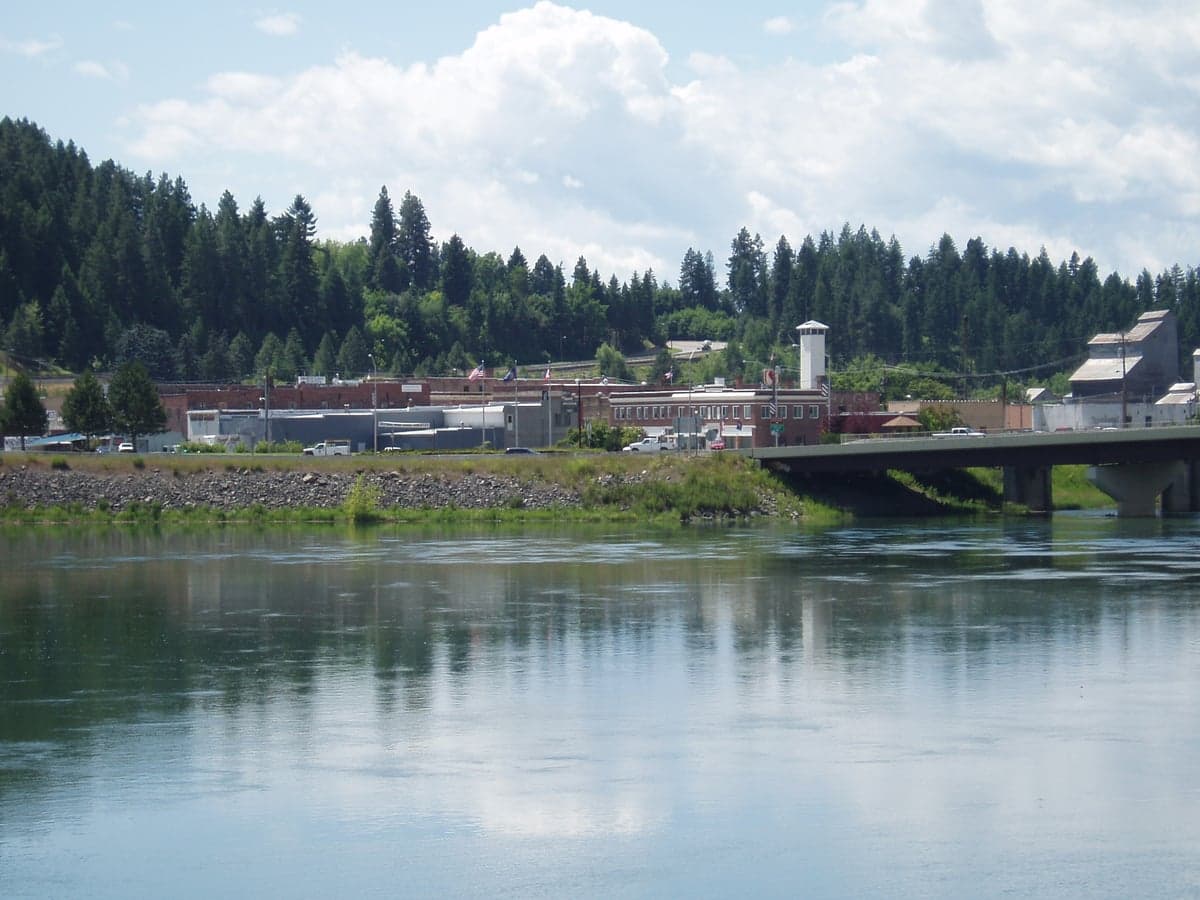
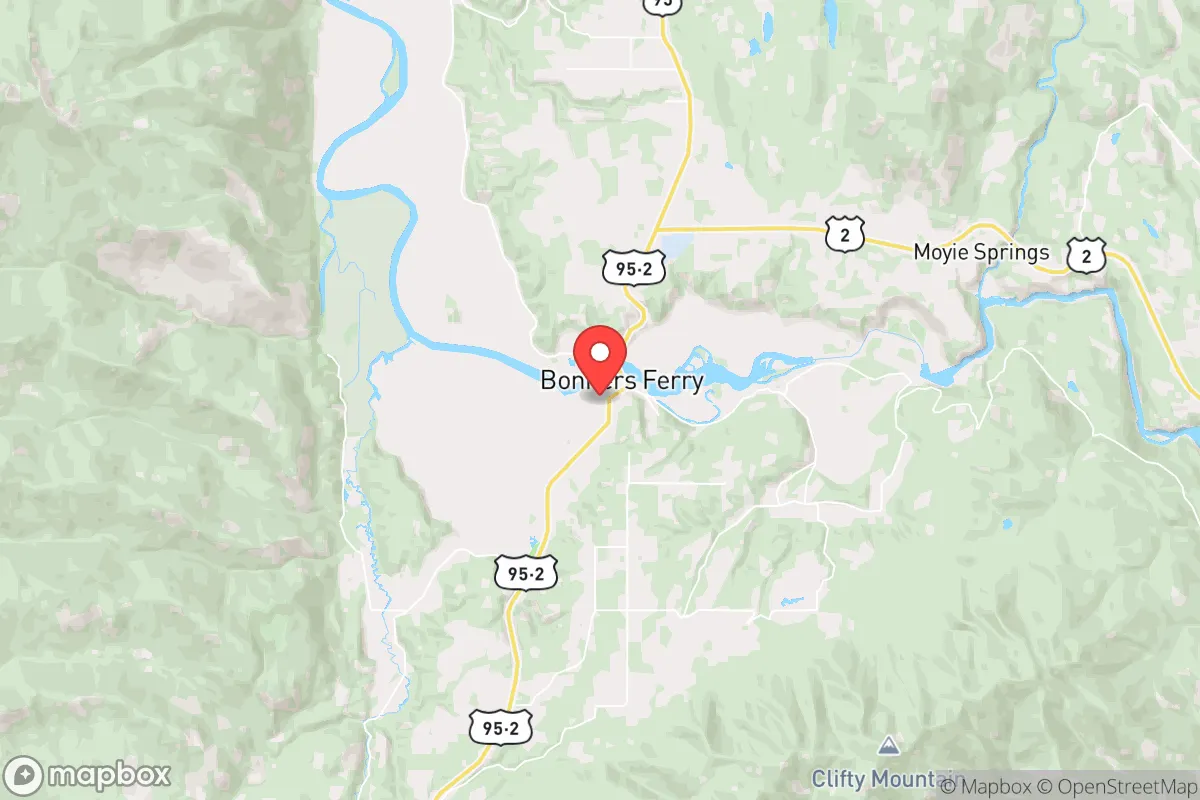
Photo: Wikipedia
Political ClimatePolitical Climate in Bonners Ferry, ID
District shown is the primary district for this city’s centroid. Cities may span multiple districts.
Inherited from parent county — no local data available.
* Lean and PVI are calculated from the surrounding county’s 2020 and 2024 presidential results, Cook-style — a finer measure here than its congressional district (ID-1).
Political rankings in Idaho
- Most Conservative Cities in Idaho
- Most Liberal Cities in Idaho
- Best Liberal-Leaning Towns in the Mountain West
- Safest Liberal-Leaning Towns in the Mountain West
- Safest Conservative-Leaning Cities in the Mountain West
- Affordable Small Towns for Conservatives
- Most Affordable Liberal-Leaning Small Towns in the U.S.
- Safest Conservative-Leaning Cities in the U.S.
- Most Conservative Counties in Idaho
- Most Liberal Counties in Idaho
Local Political AnalysisPolitical Analysis of Bonners Ferry, ID
Bonners Ferry is one of the most conservative small towns in the entire Pacific Northwest, and it’s been getting more so. The Cook Partisan Voting Index (PVI) here is a staggering R+33, meaning the area votes about 33 points more Republican than the national average. That’s a full 15 points redder than Idaho as a whole, which sits at R+18. If you’re looking at a map of Idaho’s political spectrum, Bonners Ferry is way out on the deep-red end, even compared to places like Coeur d’Alene (roughly R+20) or Sandpoint (R+25). The trajectory has been steady: the area has been reliably Republican for decades, but the margin has widened since 2020, driven by an influx of conservative-leaning newcomers from California and Washington seeking lower taxes and fewer regulations.
How it compares
Idaho’s statewide PVI of R+18 already makes it one of the most Republican states in the country—think of it as the political equivalent of a solidly red Texas or Utah. But Bonners Ferry’s R+33 puts it in a different league, more akin to rural counties in Wyoming or the Deep South. To get a sense of the contrast, drive 45 minutes south to Sandpoint, which is still conservative but has a noticeable liberal minority—especially around the lake and the arts scene. Bonners Ferry, by contrast, has virtually no organized Democratic presence. In the 2024 presidential election, Boundary County (where Bonners Ferry is the seat) gave Trump about 82% of the vote, while Idaho overall gave him about 67%. The nearest town with any real political diversity is probably Coeur d’Alene, an hour south, where you’ll find a small but vocal progressive community centered around the university and the resort economy. Even there, though, the county went about 65% Republican in 2024.
What this means for residents
For conservative residents, Bonners Ferry is about as comfortable as it gets. Local government, school boards, and law enforcement all lean heavily Republican, and there’s little to no friction over things like gun rights, property taxes, or land use. The county commission and city council are uniformly conservative, and ballot measures like school bonds or tax levies tend to pass or fail along predictable party lines. For liberal residents, the reality is more isolating. There’s no local Democratic Party chapter, no visible progressive advocacy groups, and social events can feel politically homogeneous. That said, most people here are neighborly regardless of politics—it’s a small town where you know your mail carrier and your kid’s teacher. But if you’re openly liberal, you’ll likely find yourself in the minority in most public conversations. The practical effect is that policy debates are narrow: the big issues are usually about limiting government growth, keeping taxes low, and preserving rural character, not about expanding services or social programs.
Culturally, Bonners Ferry is distinct even within Idaho. The area has a strong libertarian streak—many residents are less “party-line Republican” and more “leave us alone” conservatives. You’ll see more “Don’t Tread on Me” flags than “Trump 2024” signs, though both are common. The local economy is driven by timber, agriculture, and tourism, and there’s a palpable distrust of federal land management, especially around the Kootenai National Forest. This isn’t a place where you’ll find much interest in national political drama; the focus is on local issues like road maintenance, school funding, and keeping the county’s tax base stable. Looking ahead, the political trajectory seems set: as more conservative transplants arrive from blue states, Bonners Ferry will likely stay deep red, with the only real question being whether it shifts even further right or moderates slightly as the population grows. For now, it’s a place where the political climate is as clear as the mountain air—and just as unchanging.

State Political ClimatePolitical Climate in Idaho
State Political AnalysisPolitical Environment in the State
Idaho is one of the most reliably Republican states in the country, with a Cook Partisan Voting Index of R+18, meaning it votes about 18 points more Republican than the national average. Over the past two decades, the state has shifted from a more libertarian-leaning, Western independence brand of conservatism toward a harder, more culturally conservative Republican dominance, driven largely by an influx of out-of-state transplants from California, Washington, and Oregon. The Democratic Party has virtually no statewide elected presence, and the last Democrat to win a major statewide office was Cecil Andrus, who left the governor’s mansion in 1995.
Urban vs. rural divide
The political map of Idaho is starkly divided between a handful of growing urban centers and vast, deeply conservative rural expanses. Boise and its surrounding Ada County are the state’s political engine, but even Boise has shifted rightward in recent cycles — Ada County voted for Trump by a comfortable margin in 2024 after being a swing county in earlier years. Ketchum and Sun Valley in Blaine County remain the only reliably blue enclaves, with a strong Democratic tilt driven by a wealthy, outdoorsy, and arts-oriented population. Moscow, home to the University of Idaho, also leans left but is small and isolated. Meanwhile, Idaho Falls, Rexburg, and Coeur d’Alene are among the most conservative cities in the nation, with Rexburg’s Brigham Young University-Idaho anchoring a heavily LDS, socially conservative electorate. The rural counties — like Lemhi, Custer, and Owyhee — routinely vote 80-90% Republican, making the state’s overall partisan lean nearly impossible to overcome for Democrats.
Policy environment
Idaho’s policy environment is defined by low taxes, minimal regulation, and a strong cultural conservatism. The state has a flat income tax rate of 5.8% (recently cut from 6%), no corporate income tax on pass-through entities, and a relatively low sales tax of 6%. Property taxes are moderate, though they vary by county. Idaho is a right-to-work state and has some of the weakest labor protections in the country. Education policy is a flashpoint: the state has one of the lowest per-pupil spending levels in the nation, and the legislature has repeatedly rejected federal education funding and expanded school choice through charter schools and a new education savings account program. Healthcare policy is limited — Idaho did not expand Medicaid until 2020 via a ballot initiative, and the legislature has since tried to impose work requirements. Election laws are restrictive: Idaho requires a photo ID to vote, has no same-day registration, and has purged inactive voters aggressively. The state also has a near-total abortion ban, with no exceptions for rape or incest, and a trigger law that took effect after Dobbs.
Recent policy direction
The last few years have seen Idaho move decisively to the right on a broad range of issues. In 2023, the legislature passed House Bill 71, which banned nearly all abortions and included a provision allowing civil lawsuits against anyone who helps a resident obtain an abortion out of state. On guns, Idaho enacted constitutional carry in 2016 and has repeatedly blocked any local gun control ordinances — the state preempts all local firearm regulations. Parental rights have been a major focus: the 2023 Parental Rights in Education Act (similar to Florida’s “Don’t Say Gay” law) restricts classroom discussion of sexual orientation and gender identity. The state also passed a law banning transgender girls from participating in girls’ sports. On privacy and surveillance, Idaho has a weak data privacy law but has resisted federal surveillance programs. Property rights are generally strong, though the state has seen fights over water rights and public lands access. Ballot access is relatively restrictive — third parties face high signature requirements, and the state has no initiative process for constitutional amendments after the legislature effectively neutered it in 2021.
Civil unrest & political movements
Idaho has a long history of anti-government and militia movements, dating back to the Ruby Ridge standoff in 1992. In recent years, the Ammon Bundy-affiliated People’s Rights Network has been active, particularly in rural areas and in the Treasure Valley. Protests have been relatively small compared to other states, but there have been flashpoints: in 2020, Boise saw weeks of Black Lives Matter protests, and counter-protests from far-right groups like the Proud Boys were visible. Immigration politics are tense — Idaho has no sanctuary cities, and the legislature has passed laws requiring local law enforcement to cooperate with ICE. Canyon County, which includes Nampa and Caldwell, has seen rapid growth in its Hispanic population, and some local officials have pushed for stricter enforcement. Election integrity controversies have been minimal, though the state’s Republican secretary of state has defended the 2020 and 2022 results against fringe claims. The most visible political movement is the Idaho Freedom Foundation, a conservative think tank that has pushed for school vouchers, tax cuts, and anti-vaccine legislation.
Projection
Over the next 5-10 years, Idaho is likely to become even more Republican, but the nature of that conservatism may shift. The state is growing fast — it was the fastest-growing state in the nation in 2023 — and many new residents are coming from blue states like California, Washington, and Oregon. These transplants tend to be more moderate on economic issues but still vote Republican, which could push the state’s GOP toward a more suburban, business-friendly posture rather than the current hardline social conservatism. However, the rural counties are losing population, and the legislature is increasingly dominated by rural representatives who are more culturally conservative. This tension could lead to internal GOP fights over education funding, property taxes, and land use. Boise and Meridian are likely to become more competitive in local races, but the state’s overall partisan lean is unlikely to change — the Democratic Party is too weak and too concentrated in a few small areas. A new resident moving in now should expect a state that remains deeply Republican, with low taxes and limited government services, but with growing debates over how to manage rapid growth and an aging population.
For a new resident, the bottom line is straightforward: Idaho offers a low-tax, low-regulation environment with a strong conservative culture, but it also means limited public services, a near-total abortion ban, and a political climate where dissent is often marginalized. If you’re a conservative looking for a place where your values are the norm and your tax burden is light, Idaho will feel like home. If you’re a liberal, you’ll find a few small blue islands — Ketchum, Moscow, parts of Boise — but you’ll be in a clear minority, and state policy will often feel hostile. The state’s trajectory is toward more of the same, but with growing pains as newcomers reshape the political landscape in ways that are still being worked out.
* Values derived from national, state, county, city and local statistics and may differ in a specific area. Last updated: 2026-11-24T18:34:20.000Z
Narrative content on this page is AI-generated and may contain mistakes. Verify any details that matter before acting on them.
ReloMaps may earn a commission from affiliate links at no extra cost to you.

