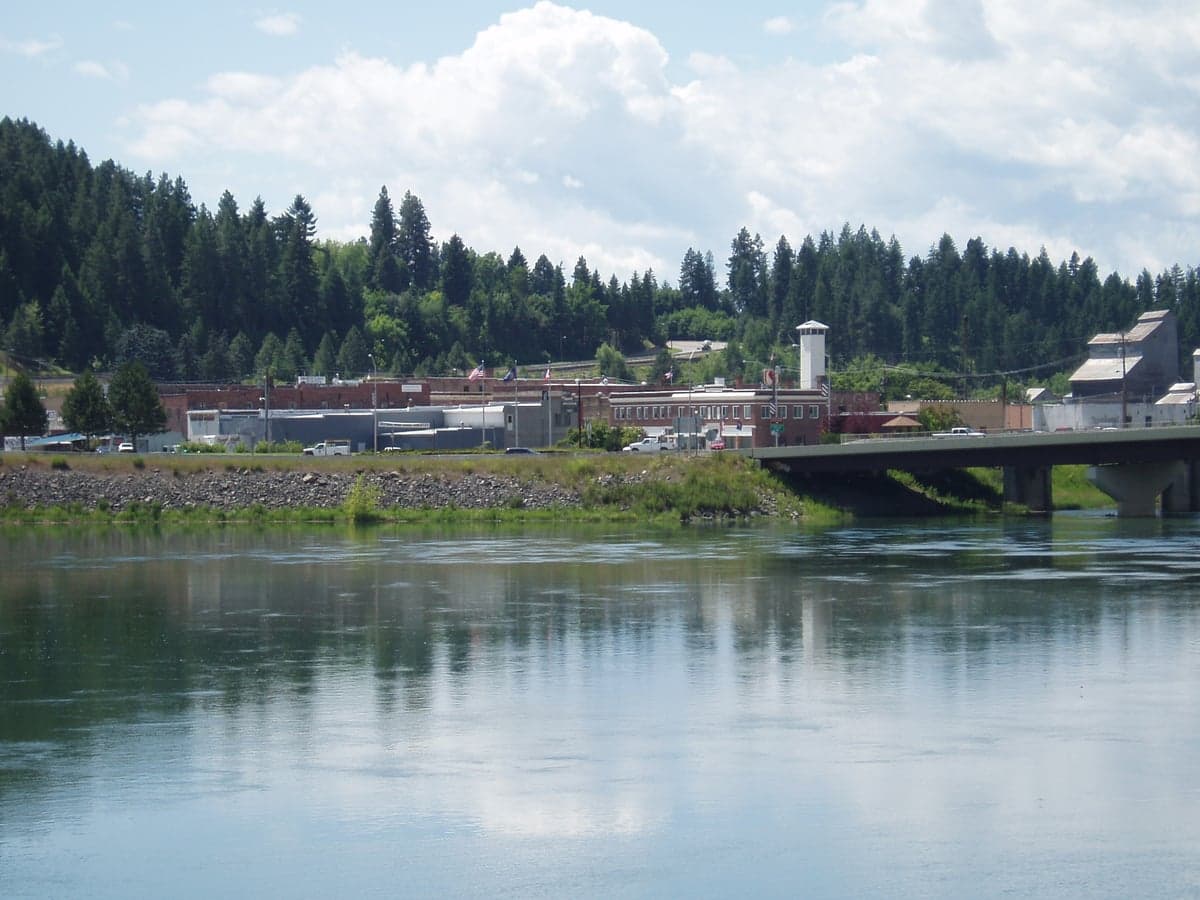
Photo: Wikipedia
Demographics of Bonners Ferry, ID
Affluence Level in Bonners Ferry, ID
A middle-class area roughly in line with national averages across income, home values, education, and employment.
People of Bonners Ferry, ID
Today, Bonners Ferry, Idaho, is a small, predominantly white community of 2,615 residents, with a distinctly rural and conservative character. The city’s population is notably less diverse than the national average, with 83.8% identifying as white alone, while the largest minority group is Hispanic or Latino at 6.6%. A significant 18.0% of adults hold a college degree, reflecting a modest but present professional class, while the foreign-born population stands at 6.2%, slightly below the national figure. The town’s identity is deeply rooted in its frontier history, logging and agricultural economy, and a strong sense of local independence.
How the city was settled and grew
Bonners Ferry was founded in the 1860s as a ferry crossing on the Kootenai River, serving miners and settlers heading to the gold fields of British Columbia. The original inhabitants were primarily Anglo-American homesteaders, drawn by the promise of cheap land under the Homestead Act and the region’s abundant timber. The arrival of the Great Northern Railway in the 1890s transformed the settlement into a supply hub, attracting a wave of Scandinavian and German immigrants who worked in the sawmills and logging camps. These early settlers built their homes in the Downtown Historic District, along Main Street, and in the River District near the ferry landing, where many of the original wood-frame houses still stand. By the early 20th century, a small but stable community of farmers and loggers had formed, with the population hovering around 1,000. The city’s growth remained slow and steady through the mid-20th century, driven by the timber industry and the establishment of the nearby Kootenai National Forest, which brought federal jobs and seasonal workers.
Modern era (post-1965)
After the 1965 Immigration and Nationality Act, Bonners Ferry saw little of the large-scale immigration that reshaped many American cities. The foreign-born population today is only 6.2%, and the community remains overwhelmingly white. The most notable demographic shift since the 1970s has been domestic in-migration from other parts of the Pacific Northwest and California, drawn by lower housing costs and a perceived slower pace of life. These new residents have concentrated in newer subdivisions like Moyie Meadows and Kootenai River Estates, both located on the outskirts of town, where larger lots and newer homes are available. The Hispanic population, now 6.6%, began to grow in the 1990s, primarily through families working in agriculture and the service industry, and they are most concentrated in the South Hill neighborhood, near the agricultural fields and the county fairgrounds. The Black population, at 3.3%, is a very recent arrival, largely tied to a small number of families relocating for work at the nearby Boundary County government offices or the local hospital. The Asian and Indian subcontinent populations are both recorded at 0.0%, meaning no measurable community of either group exists in the city.
The future
Bonners Ferry is projected to grow slowly, with the population likely reaching 3,000 by 2040, driven primarily by continued domestic migration from more expensive Western states. The city is not becoming more diverse in a broad sense; the white share is expected to remain above 80%, while the Hispanic share may edge up to 8-9% as families already in the area have children. New housing developments, such as the planned Northside Addition near the high school, are attracting younger families, but these are overwhelmingly white and middle-class. The cultural identity of the town is likely to remain conservative and rural, with a growing tension between long-time locals and newer arrivals who seek to preserve the area’s quiet character while demanding better services. For a newcomer, Bonners Ferry offers a stable, low-crime environment with a strong sense of community, but little racial or ethnic diversity.
Bonners Ferry is becoming a slightly more populous but still deeply homogeneous small town, where the dominant culture remains rooted in its logging and farming heritage. For someone moving in now, the city offers affordability and a tight-knit social fabric, but those seeking a diverse or rapidly changing community will not find it here. The future points to a slow, steady growth of a predominantly white, conservative population, with a small but stable Hispanic minority concentrated in the South Hill area.

* Values derived from national, state, county, city and local statistics and may differ in a specific area. Last updated: 2026-11-24T18:34:20.000Z
Narrative content on this page is AI-generated and may contain mistakes. Verify any details that matter before acting on them.
ReloMaps may earn a commission from affiliate links at no extra cost to you.

