 Popular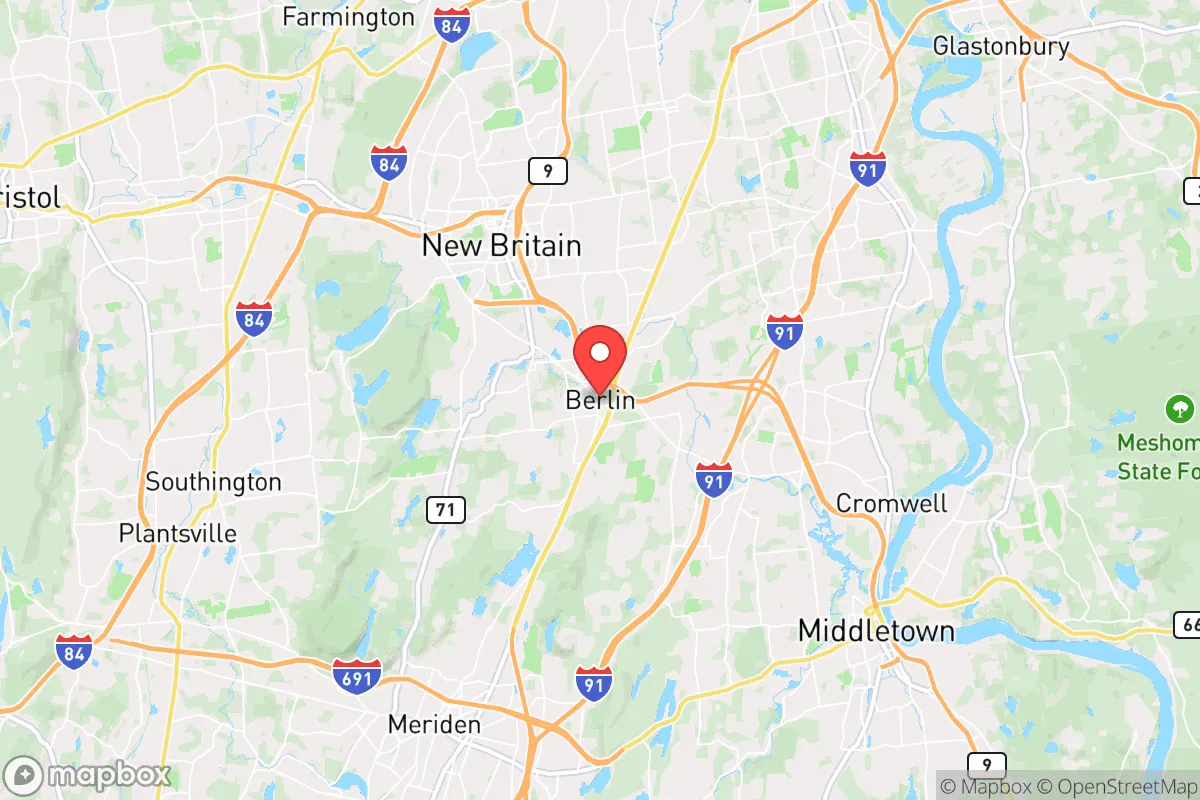
Photo: Wikipedia
Political ClimatePolitical Climate in Berlin, CT
District shown is the primary district for this city’s centroid. Cities may span multiple districts.
Local Political AnalysisPolitical Analysis of Berlin, CT
Berlin, Connecticut, leans solidly Democratic, with a Cook Partisan Voting Index (PVI) of D+12, making it significantly more liberal than the state of Connecticut as a whole, which sits at D+8. This isn't a recent shift; the town has been a reliable blue stronghold for decades, though the margin has widened in the last two presidential cycles as the surrounding suburbs have trended leftward. If you're moving here, you're stepping into a community where Democratic candidates routinely win by double digits, but it's not a monolith—there's a noticeable, if quiet, Republican minority, especially in the more rural fringes near the Meriden line.
How it compares
Berlin's D+12 rating places it to the left of Connecticut's statewide D+8 average, but it's not the most liberal town in the region. Neighboring New Britain, a post-industrial city with a large Puerto Rican population, is even more Democratic, while towns like Southington (roughly D+5) and Farmington (D+10) are slightly less blue. The real contrast is with towns to the east, like Colchester or Hebron, which lean Republican. In practice, this means Berlin's local elections are often decided in the Democratic primary, and the town council typically has a Democratic majority. The Republican presence is strongest in the town's more rural sections, particularly around the Kensington neighborhood, where you'll see a few more Trump signs in yards during election season.
What this means for residents
For liberal residents, Berlin's political climate means their values are reflected in local policy—things like funding for public schools, support for renewable energy initiatives, and a generally progressive stance on social issues. Conservative residents, while in the minority, aren't marginalized; they have a voice on the town council and in local debates, but they're unlikely to see their preferred candidates win many local races. The practical effect is that Berlin's government tends to be stable and predictable, with less of the partisan gridlock you see in more evenly split towns. Taxes are moderate for the region, and the town's budget debates are usually about how much to spend, not whether to spend at all.
Culturally, Berlin's political lean is reflected in its community priorities. The town has a strong public library system, well-funded parks, and a school district that consistently ranks among the top in the state. You won't find the same level of political activism you'd see in a college town like Storrs or a city like Hartford, but there's a quiet, steady commitment to progressive governance. The biggest policy distinction from more conservative towns in Connecticut is Berlin's approach to development: it's more welcoming to multi-family housing and transit-oriented projects near the train station, which aligns with the state's broader push for denser, more sustainable growth. For newcomers, this means a community that's politically engaged but not polarized, where you can have a reasonable conversation about local issues regardless of your party affiliation.

State Political ClimatePolitical Climate in Connecticut
State Political AnalysisPolitical Environment in the State
Connecticut has a solid Democratic lean, with a Cook PVI of D+8, but don’t let that number fool you into thinking it’s a uniform blue state. The reality is a sharp urban-suburban-rural split, where the Democratic strongholds of Hartford, New Haven, and Bridgewater drive the statewide results, while the eastern and northwestern corners of the state remain reliably Republican. Over the last 10-20 years, the state has shifted leftward, but it’s been a slow, grinding move driven by demographic change and suburbanization, not a sudden flip. If you’re a conservative considering a move here, you’ll find plenty of like-minded communities, but you’ll also be living under a state government that’s increasingly progressive on taxes, gun laws, and social policy.
Urban vs. rural divide
The political map of Connecticut is a tale of three regions. The urban core—Hartford, New Haven, and Bridgeport—is deeply Democratic, with margins often exceeding 70-80% in presidential elections. These cities are home to large minority populations, union households, and a heavy concentration of state employees and university faculty. The suburbs of Fairfield County, like Stamford and Greenwich, are more moderate but still lean Democratic, driven by commuters to New York City and a professional class that tends to vote blue on social issues. The real Republican strongholds are in the eastern part of the state—towns like Ledyard, Stonington, and Killingly—and the Litchfield Hills in the northwest, where places like Litchfield and Kent have a more rural, libertarian-leaning conservative streak. The 2020 presidential election saw Trump win in 80 of Connecticut’s 169 towns, but those towns are mostly small and rural, so they don’t move the needle much statewide. The divide isn’t just about party; it’s about lifestyle. In the cities, you’ll see more density, public transit, and progressive activism. In the rural towns, it’s pickup trucks, gun shops, and a fierce independence from Hartford.
Policy environment
Connecticut’s policy environment is a mixed bag that leans heavily progressive on social issues and taxation, but with some surprising pockets of moderation. The state has a progressive income tax with a top marginal rate of 6.99%, and property taxes are among the highest in the nation, often exceeding 2% of assessed value. There is no sales tax on most clothing and footwear under $50, but the general sales tax is 6.35%. On education, Connecticut spends more per pupil than almost any other state, but the results are uneven—wealthy suburbs like Westport and Darien have top-tier schools, while urban districts in Hartford and New Haven struggle with chronic underperformance. Healthcare is heavily regulated, and the state runs its own health insurance exchange, Access Health CT. Election laws are relatively liberal: same-day voter registration is available, no-excuse absentee voting was expanded during COVID and made permanent, and early voting was approved by voters in 2022. For conservatives, the biggest sticking points are the tax burden and the regulatory climate, which can feel stifling for small businesses. For liberals, the state’s safety net and education spending are major draws.
Recent policy direction
Over the past five years, Connecticut has moved decisively left on several fronts. In 2023, the legislature passed a sweeping gun control package that expanded the state’s existing assault weapons ban, raised the minimum age to purchase a firearm to 21, and required safe storage of firearms. Self-defense laws are restrictive; there is no “stand your ground” statute, and the state has a “duty to retreat” in public spaces. On parental rights, the state has moved in the opposite direction of many red states: in 2021, it passed a law requiring schools to adopt policies that affirm transgender students’ identities, including allowing them to use bathrooms and locker rooms matching their gender identity, without parental notification. On abortion, Connecticut has become a safe haven, with a 2022 law protecting providers and patients from out-of-state lawsuits. Property rights are generally respected, but zoning laws in wealthy suburbs are notoriously exclusionary, making it hard to build affordable housing. On voting, the state has expanded access, with early voting beginning in 2024 and no-excuse absentee ballots now permanent. For a conservative relocator, the direction is clear: the state is tightening gun laws, expanding LGBTQ+ protections, and making it easier to vote. If those are dealbreakers, you’ll want to think carefully.
Civil unrest & political movements
Connecticut isn’t known for the kind of dramatic protests you see in Portland or Seattle, but it has its flashpoints. The Black Lives Matter protests in 2020 were large and sustained in Hartford and New Haven, with some property damage and clashes with police. On the right, the state has a small but vocal Second Amendment movement, with groups like the Connecticut Citizens Defense League holding regular rallies at the state capitol. Immigration politics are relatively quiet compared to border states, but Connecticut is a sanctuary state, with a 2013 law (TRUST Act) that limits local police cooperation with federal immigration enforcement. There have been periodic controversies over election integrity, mostly from Republican activists questioning the expansion of absentee voting, but no major scandals have emerged. The most visible political movement in recent years has been the push for affordable housing, with activists in towns like Glastonbury and Manchester fighting zoning reforms that would allow more multifamily housing. It’s a classic NIMBY vs. YIMBY battle, and it’s playing out in town halls across the state. For a new resident, you won’t see daily protests, but you’ll hear the political arguments at dinner parties and town meetings.
Projection
Over the next 5-10 years, Connecticut is likely to become more Democratic, not less. The state’s population is aging and slowly declining, but the people moving in are disproportionately from New York City and other blue areas, bringing their politics with them. The rural towns that vote Republican are losing population, while the suburbs of Hartford and New Haven are becoming more diverse and more liberal. The state’s fiscal situation is precarious—pension obligations are massive, and the tax base is shrinking—so expect continued pressure to raise taxes or cut services. On social policy, the trend is toward more progressive legislation, especially on gun control and LGBTQ+ rights. For conservatives, the outlook is grim in terms of statewide elections, but local control remains strong. If you move to a town like Ledyard or Litchfield, you can live in a conservative bubble, but you’ll still be subject to state laws on guns, taxes, and education that you may not like. The wild card is the housing crisis: if the state successfully forces suburbs to build more apartments, it could accelerate the demographic shift toward a more urban, Democratic electorate.
For a new resident, the bottom line is this: Connecticut is a blue state with a red underbelly. If you’re a conservative, you can find a community that shares your values, especially in the eastern and northwestern towns, but you’ll be fighting an uphill battle on state policy. If you’re a liberal, you’ll find a state that largely aligns with your views, especially on social issues, but you’ll pay for it in taxes. The practical takeaway is to choose your town carefully—your local school board, zoning commission, and town council will have more impact on your daily life than the governor in Hartford. And if you’re moving for a job, know that the economy is driven by insurance, finance, and healthcare, with a growing bioscience sector in New Haven. It’s a state of trade-offs, and the best advice is to visit, talk to locals, and decide if the trade-offs are worth it for you.
* Values derived from national, state, county, city and local statistics and may differ in a specific area. Last updated: 2026-07-22T18:23:19.000Z
Narrative content on this page is AI-generated and may contain mistakes. Verify any details that matter before acting on them.
ReloMaps may earn a commission from affiliate links at no extra cost to you.

