Photo: Wikipedia
Demographics of Berkeley Springs, WV
Affluence Level in Berkeley Springs, WV
A below-average socioeconomic profile. Incomes, home values, and educational attainment trail the U.S., with higher poverty and unemployment.
People of Berkeley Springs, WV
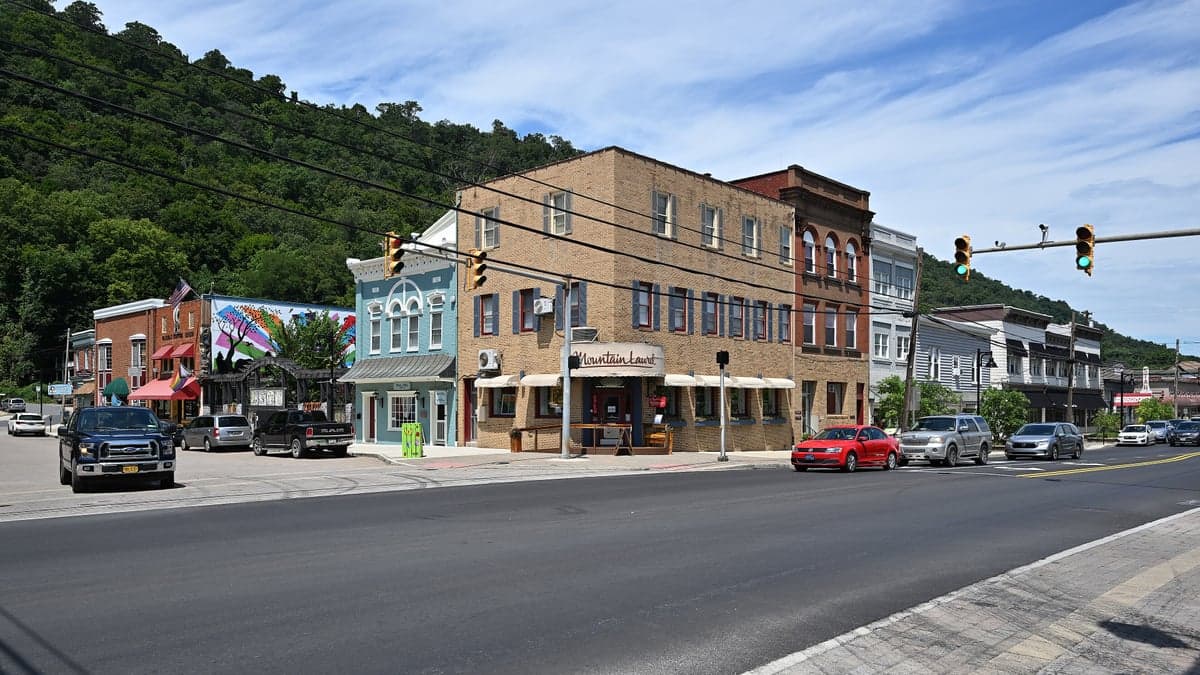
Berkeley Springs, West Virginia, is a small, predominantly white town of 899 residents where nearly a quarter of adults hold a college degree, a figure that outpaces many rural West Virginia communities. The town’s population is overwhelmingly native-born, with 0.0% foreign-born residents, and its racial makeup is 80.6% white, 6.7% Hispanic, and negligible shares of Black (0.2%) and East/Southeast Asian (0.3%) residents. Known for its historic mineral springs and arts scene, Berkeley Springs retains a tight-knit, family-oriented character that appeals to those seeking a slower pace and lower cost of living. Its identity is shaped by deep Appalachian roots, a growing retiree and remote-worker influx, and a cultural conservatism that aligns with much of Morgan County.
How the city was settled and grew
Berkeley Springs’ human history begins with Native American peoples—primarily the Shawnee and Delaware—who used the warm mineral springs for centuries before European contact. The first permanent white settlers arrived in the mid-1700s, drawn by land grants from Lord Fairfax and the promise of fertile valleys along the Potomac River’s tributaries. The town, originally called Bath, was formally established in 1776 around the springs, which quickly became a resort destination for wealthy planters from Virginia and Maryland seeking the waters’ reputed healing properties. The early population was almost entirely of English, Scots-Irish, and German descent, and they built the core of what is now the Historic Bath District, centered on Washington Street and Fairfax Street, where 18th-century stone buildings still house shops and inns. A second wave came in the 19th century with the arrival of the Baltimore and Ohio Railroad in the 1840s, which brought Irish laborers who settled in the Railroad Avenue area near the depot, and later German immigrants who worked as stonemasons and hotel staff. The town’s population peaked around 1,200 in the early 1900s, then declined as the resort trade waned and younger residents left for industrial jobs in Baltimore and Washington, D.C.
Modern era (post-1965)
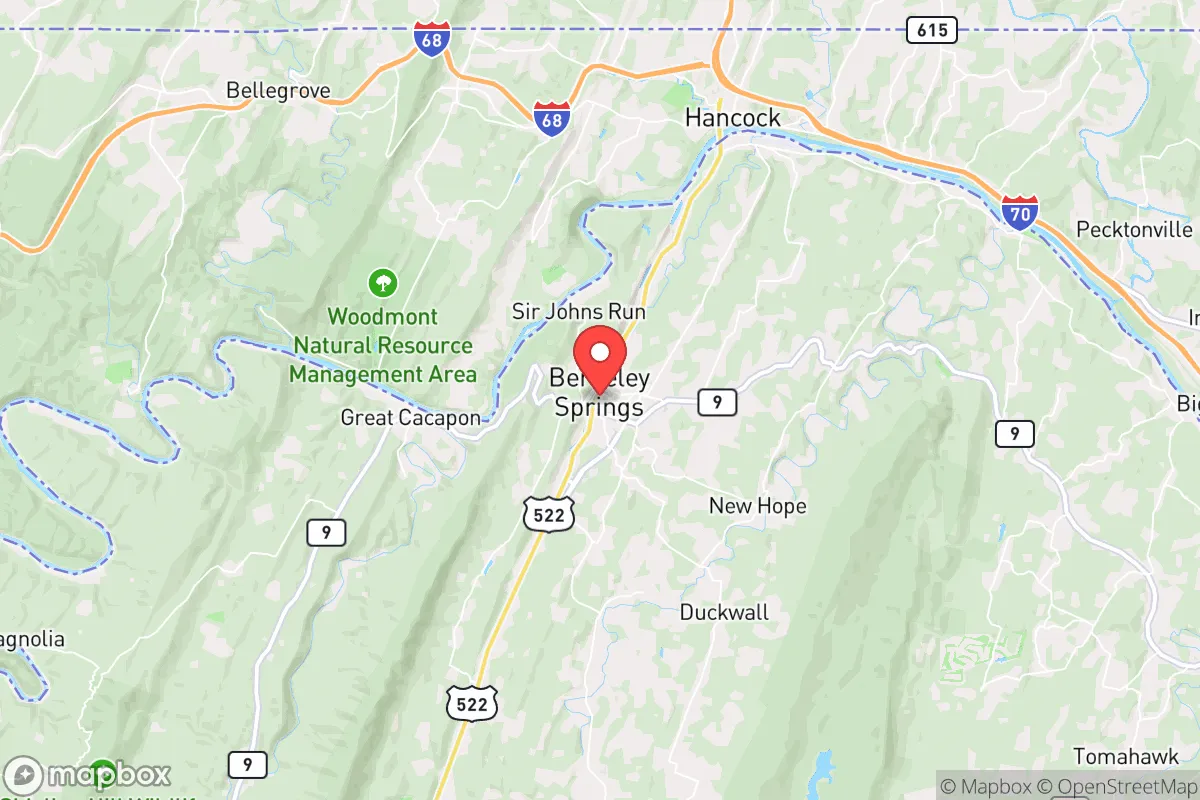
After the 1965 Immigration and Nationality Act, Berkeley Springs saw virtually no international immigration—its foreign-born population remains 0.0% today. Instead, the modern era has been defined by domestic in-migration from the Washington, D.C., and Baltimore metropolitan areas, beginning in the 1970s and accelerating after 2000. These newcomers—often retirees, second-home buyers, and remote workers—were drawn by lower home prices, the rural landscape, and the town’s historic charm. They concentrated in newer subdivisions on the town’s outskirts, particularly Cold Run Valley and Sir John’s Run, where large-lot homes and mountain views are common. The Hispanic population, now 6.7%, grew primarily in the 1990s and 2000s as migrant laborers arrived for seasonal work in apple orchards and nurseries in the surrounding county; most settled in the Warm Springs Ridge area and along Route 9 west of town. The Black population has remained below 1% since the 1960s, reflecting the broader racial homogeneity of the Eastern Panhandle outside the Martinsburg urban corridor. The East/Southeast Asian community (0.3%) is tiny and largely consists of a few families who own restaurants or work in healthcare, with no distinct neighborhood concentration.
The future
Berkeley Springs’ population is projected to remain small and predominantly white, with modest growth driven by continued domestic in-migration from the D.C. region. The town’s housing stock—limited by steep terrain and historic district restrictions—will likely keep growth below 1% annually. The Hispanic share may rise slowly as agricultural and service-sector jobs attract more families, but the foreign-born population is expected to stay near zero. New residential development is concentrated in the Berkeley Springs Estates subdivision and along Mountain Lake Road, where builders are targeting remote workers with fiber-optic internet and acreage. The cultural identity is evolving from a sleepy resort town into a hybrid of Appalachian traditionalism and exurban commuter lifestyle, with tensions between long-time locals and newcomers over development and property taxes. The college-educated share (24.7%) is likely to increase as more professionals relocate, but the town will remain far less diverse than the D.C. suburbs many are leaving.
For someone moving in now, Berkeley Springs offers a stable, safe, and culturally conservative community where neighbors know each other and the pace of life is deliberate. The population is not diversifying rapidly, and the town’s future hinges on balancing preservation of its historic character with the demands of new residents seeking rural connectivity. It is becoming a haven for those who want Appalachian scenery and small-town values within striking distance of a major metro area, but not a place of demographic transformation.

* Values derived from national, state, county, city and local statistics and may differ in a specific area. Last updated: 2026-11-06T03:03:01.000Z
Narrative content on this page is AI-generated and may contain mistakes. Verify any details that matter before acting on them.
ReloMaps may earn a commission from affiliate links at no extra cost to you.

