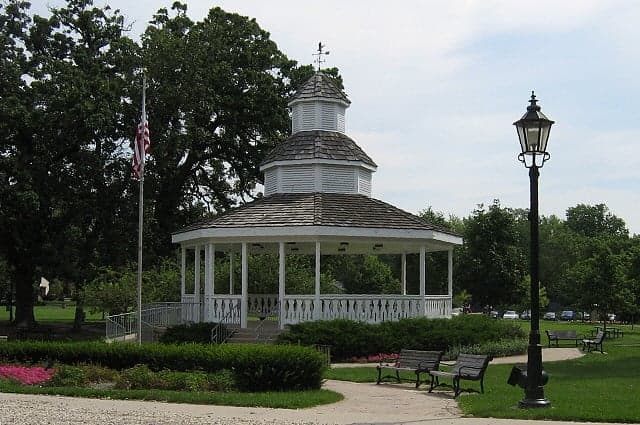
Photo: Wikipedia
Personal Sovereignty in Bartlett, IL
Viable for self-reliance. Generally workable, though some barriers may limit total independence.
What does Personal Sovereignty tell us?
Personal Sovereignty measures your capacity for self-reliance and independence with minimal government friction. Higher scores mean fewer barriers between you and the way you want to live... but it assumes you have the space you need and good neighbors.
What does this tell us?
Personal Sovereignty measures your capacity for self-reliance and independence with minimal government friction. Higher scores mean fewer barriers between you and the way you want to live... but it assumes you have the space you need and good neighbors.
State Policy
Energy independence: Importer (45% of energy produced in-state)
Personal Liberty
Homesteading

Personal Liberty Analysis
Bartlett, Illinois, presents a mixed picture for those prioritizing personal sovereignty, where the day-to-day autonomy of a suburban lifestyle is increasingly constrained by a state-level governance structure that leans heavily into regulation, taxation, and progressive social policy. For a survivalist or prepper mindset, the immediate environment offers solid community stability and decent property, but the long-term trajectory of state-level overreach into personal freedoms—from gun rights to medical decisions—creates a strategic liability. The key question for a relocation decision is whether the local advantages of a well-run village can outweigh the growing burden of living under Springfield’s authority, which consistently ranks among the most restrictive in the nation for individual liberty.
Tax burden and regulatory posture: How Illinois state policy impacts your wallet and freedom
The single largest drag on personal sovereignty in Bartlett is Illinois’s aggressive tax and regulatory environment. The state’s flat income tax rate of 4.95% is moderate, but the real burden comes from property taxes, which in DuPage and Cook Counties routinely exceed 2.5% of assessed value—among the highest in the country. For a homeowner on a typical $400,000 property, that means over $10,000 annually in property taxes alone, a permanent drain on resources that could otherwise fund self-reliance projects like solar panels, water storage, or land improvements. The state also imposes a 6.25% sales tax (higher in Cook County) and a gas tax that is the second-highest in the nation at $0.67 per gallon. This fiscal posture reflects a government that views personal income as a public resource, not a private right. For the prepper, this means every dollar earned is subject to heavy extraction before it can be redirected toward preparedness. Regulatory burdens are equally heavy: Illinois mandates strict building codes, environmental permits for even minor land alterations, and a complex business licensing system that discourages small-scale entrepreneurship like home-based food production or repair services. The state’s pension debt—over $140 billion—signals that tax increases are a near-certainty, not a possibility. Bartlett’s local government is more fiscally conservative, but it operates within a state framework that consistently prioritizes government expansion over individual economic freedom.
Self-defense and gun law specifics: What Illinois’s restrictive environment means for your right to bear arms
For anyone serious about self-defense and the right to keep and bear arms, Illinois is a hostile jurisdiction, and Bartlett is not exempt. The state requires a Firearm Owner’s Identification (FOID) card for possession of any firearm or ammunition—a process that involves fingerprinting, a background check, and a wait that can stretch months due to processing backlogs. Concealed carry is permitted only with a separate Illinois Concealed Carry License (CCL), which mandates 16 hours of training, a live-fire qualification, and a $150 fee. Even then, carry is prohibited in a long list of “sensitive places” including public parks, libraries, and any establishment that serves alcohol, which effectively guts the utility of the permit for daily life. In 2023, Illinois passed a ban on so-called “assault weapons” and high-capacity magazines, making it illegal to purchase or transfer AR-15s, many semi-automatic rifles, and magazines holding more than 10 rounds (15 for handguns). Existing owners were required to register them with the state police—a registry that many gun rights advocates view as a precursor to confiscation. For the prepper, this means your defensive rifle is either illegal to acquire new or must be registered, and your magazine capacity is capped. Home defense is still possible with handguns and shotguns, but the legal environment is designed to make armed self-reliance difficult. Bartlett’s local police are professional, but they operate under state law that criminalizes standard defensive equipment. If you value the Second Amendment as a check on government overreach, this is a significant negative factor.
Self-reliance and homesteading viability: Lot sizes, zoning, and off-grid feasibility in Bartlett
Bartlett’s suburban character limits the potential for serious homesteading or off-grid living. Typical residential lots range from one-quarter to one-half acre, with some larger parcels in the village’s older sections, but the vast majority of housing is on standard subdivision plots. Zoning regulations are strict: keeping chickens is allowed on lots of at least 20,000 square feet with a permit, but goats, pigs, or larger livestock are prohibited in residential zones. Beekeeping is permitted with registration, but the village code requires hives to be at least 10 feet from property lines. Rainwater collection is not explicitly banned, but Illinois state law restricts it to non-potable uses and requires a permit for systems over 1,000 gallons. Solar panels are allowed but subject to homeowner association (HOA) approval in many subdivisions, and net metering is available but with diminishing returns as utilities push for fixed charges. For the prepper seeking true self-reliance—growing a significant portion of food, storing water, generating power off-grid—Bartlett is not viable. The village is designed for commuters, not homesteaders. The best option for a more self-reliant lifestyle would be to look at unincorporated areas of Kane or McHenry Counties to the west, where lot sizes are larger and zoning is looser. Within Bartlett itself, the focus must be on urban preparedness: stockpiling, community networking, and defensive hardening of a standard suburban home, not land-based independence.
Personal liberties: Parental rights, medical autonomy, speech, and property in a blue-state suburb
On personal liberties, Bartlett reflects the broader Illinois trend of expanding government authority into areas traditionally reserved for individual and family decision-making. Parental rights are under active pressure: Illinois law allows minors aged 12 and older to consent to mental health treatment and substance abuse counseling without parental notification, and the state’s 2023 “SAFE-T Act” eliminated cash bail, which some parents view as reducing accountability for juvenile crime. The state also mandates comprehensive sex education in public schools, including LGBTQ+ inclusive content, which has led some conservative parents to opt their children out or seek alternative schooling. Medical autonomy is similarly constrained: Illinois has some of the most permissive abortion laws in the country, with no parental notification requirement for minors, and the state has actively resisted any COVID-19 vaccine mandates but still allows employers and schools to impose their own. For the prepper concerned about medical freedom, the state’s aggressive public health powers and lack of religious or philosophical exemptions for certain mandates are a red flag. Free speech is protected under the First Amendment, but Illinois has a strong anti-SLAPP law that can be used against critics of government or corporations, and the state’s hate crime statutes are broadly defined. Property rights are the most secure area: eminent domain is constrained by state law, and Bartlett’s zoning is predictable, but the high property tax effectively functions as a perpetual rent to the state. Overall, personal liberties in Bartlett are best described as “managed”—the state allows a range of choices but reserves the right to override them for policy goals, which is antithetical to a sovereignty mindset.
In the broader landscape of personal sovereignty, Bartlett offers a stable, safe community with good schools and low local crime, but it sits within a state that is actively hostile to many pillars of individual freedom—gun rights, tax autonomy, medical choice, and parental authority. For the survivalist or prepper, this creates a strategic dilemma: the immediate environment is comfortable, but the long-term trajectory of state policy is toward greater control and higher extraction. Compared to areas in Texas, Florida, or even rural Indiana, Bartlett ranks low on sovereignty metrics. It is a viable option only if you are willing to accept a defensive posture—focusing on community resilience and legal compliance—rather than an offensive one of building true independence. For those who prioritize freedom over convenience, the suburbs of Chicago are a compromise that requires constant vigilance and a clear exit plan.

* Values derived from national, state, county, city and local statistics and may differ in a specific area. Last updated: 2026-04-30T00:16:39.000Z
Narrative content on this page is AI-generated and may contain mistakes. Verify any details that matter before acting on them.
ReloMaps may earn a commission from affiliate links at no extra cost to you.

