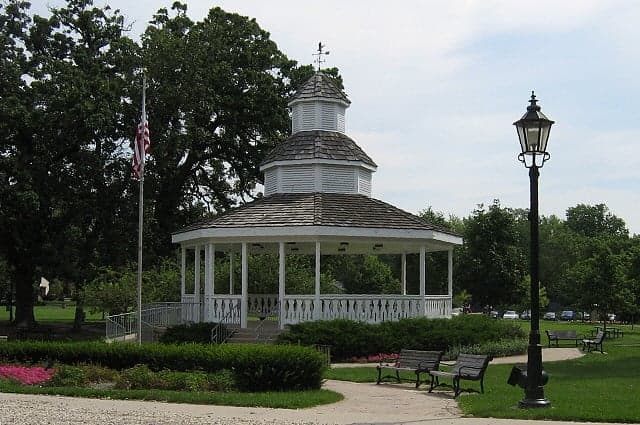
Photo: Wikipedia
Demographics of Bartlett, IL
Affluence Level in Bartlett, IL
An upper-middle-class area. Household wealth, education levels, and homeownership run ahead of national benchmarks.
People of Bartlett, IL
The people of Bartlett, Illinois, today form a densely settled suburban community of 40,531 that blends a historically white, middle-class foundation with a rapidly diversifying population driven by Indian-subcontinent and Hispanic growth. The city is characterized by its family-oriented character, high educational attainment (48.5% college-educated), and a notably high share of Indian-subcontinent residents (11.9%) that distinguishes it from many neighboring suburbs. Bartlett’s identity is one of a stable, upwardly mobile suburb where newer immigrant communities are reshaping the demographic landscape while the city maintains a strong sense of local pride and civic engagement.
How the city was settled and grew
Bartlett’s original population was drawn by the railroad and the promise of fertile farmland. The city was founded in the 1850s when the Galena and Chicago Union Railroad extended its line through the area, and the first settlers were primarily German and Irish immigrants who worked as farmers, railroad laborers, and tradesmen. These early families built the core of what is now the Historic Bartlett District, centered around the original train depot on Oak Avenue and the surrounding blocks of Ontario Street and West Bartlett Avenue. The village incorporated in 1891, and for the next half-century, the population remained small—hovering around a few hundred—as agriculture dominated the local economy. The Ontario Street corridor and the area near Bartlett Park became the heart of the original settlement, with modest frame houses and a handful of commercial buildings serving the farming community. By the mid-20th century, the population had only reached about 1,000, as the village remained a quiet, rural outpost on the edge of the Chicago metropolitan area.
Modern era (post-1965)
The post-1965 era transformed Bartlett from a sleepy farm town into a booming Chicago exurb. The passage of the Hart-Celler Act in 1965 opened the door for new immigration streams, but the city’s modern growth was initially driven by domestic in-migration—white families from Chicago and inner-ring suburbs seeking larger homes and newer schools. The 1970s and 1980s saw explosive development, with the population surging past 10,000 by 1980 and reaching 23,000 by 1990. This wave settled into master-planned subdivisions like Apple Orchard (north of Stearns Road) and Country Oaks (south of Route 59), which offered single-family homes on quarter-acre lots. By the 1990s and 2000s, Bartlett began attracting a more diverse population. The Indian-subcontinent community, now the largest non-white group at 11.9%, began arriving in significant numbers during the 2000s, drawn by the strong school system (Bartlett High School and the U-46 district) and proximity to tech and professional jobs in the Schaumburg-Hoffman Estates corridor. These families concentrated in newer developments like Westridge (near Bartlett and Stearns Roads) and the Bartlett Lakes subdivision, where larger homes and cul-de-sac layouts appealed to multigenerational households. The Hispanic population, now 14.7%, grew steadily from the 1990s onward, settling in more affordable areas such as the Bartlett Commons apartment complexes and the older housing stock near the Bartlett Train Station. The East/Southeast Asian community (5.9%) and Black population (4.0%) are smaller but present, with Asian families often choosing the same newer subdivisions as Indian families. The white share has declined from over 90% in 1980 to 60.8% today, reflecting the city’s rapid diversification.
The future
Bartlett’s population is heading toward continued diversification, but the pattern is one of distinct enclaves rather than full integration. The Indian-subcontinent community is the fastest-growing segment, driven by both new immigration and natural increase, and is likely to approach 15-18% of the population within the next decade. This group is highly concentrated in the newer subdivisions of Westridge and Bartlett Lakes, where home values and school ratings are highest. The Hispanic population is growing more slowly but steadily, with a younger age profile that will sustain its share. The white population is aging and declining in absolute numbers, as younger white families often choose newer exurbs farther out. The city is not homogenizing; rather, it is tribalizing into distinct neighborhoods defined by ethnicity and income. The older Historic Bartlett District and the Ontario Street area remain predominantly white and older, while the newer subdivisions are increasingly Asian and Indian. The apartment complexes near the train station are the most diverse, with a mix of Hispanic, Black, and younger white renters. For a newcomer, Bartlett offers a stable, well-run suburb with strong schools and low crime, but the social landscape is one of parallel communities rather than a melting pot. The next 10-20 years will likely see the Indian-subcontinent share continue to rise, the Hispanic share stabilize, and the white share fall below 50%, making Bartlett a majority-minority suburb by the mid-2030s.
Bottom-line: Bartlett is becoming a more diverse, more stratified suburb where the old white middle-class foundation is giving way to a new Indian-subcontinent professional class, while Hispanic and other groups occupy distinct niches. For a conservative-leaning family or individual moving in now, the city offers excellent schools, low taxes relative to Cook County, and a safe environment, but the social fabric is increasingly defined by ethnic enclaves rather than a unified community identity.

* Values derived from national, state, county, city and local statistics and may differ in a specific area. Last updated: 2026-04-30T00:16:39.000Z
Narrative content on this page is AI-generated and may contain mistakes. Verify any details that matter before acting on them.
ReloMaps may earn a commission from affiliate links at no extra cost to you.

