
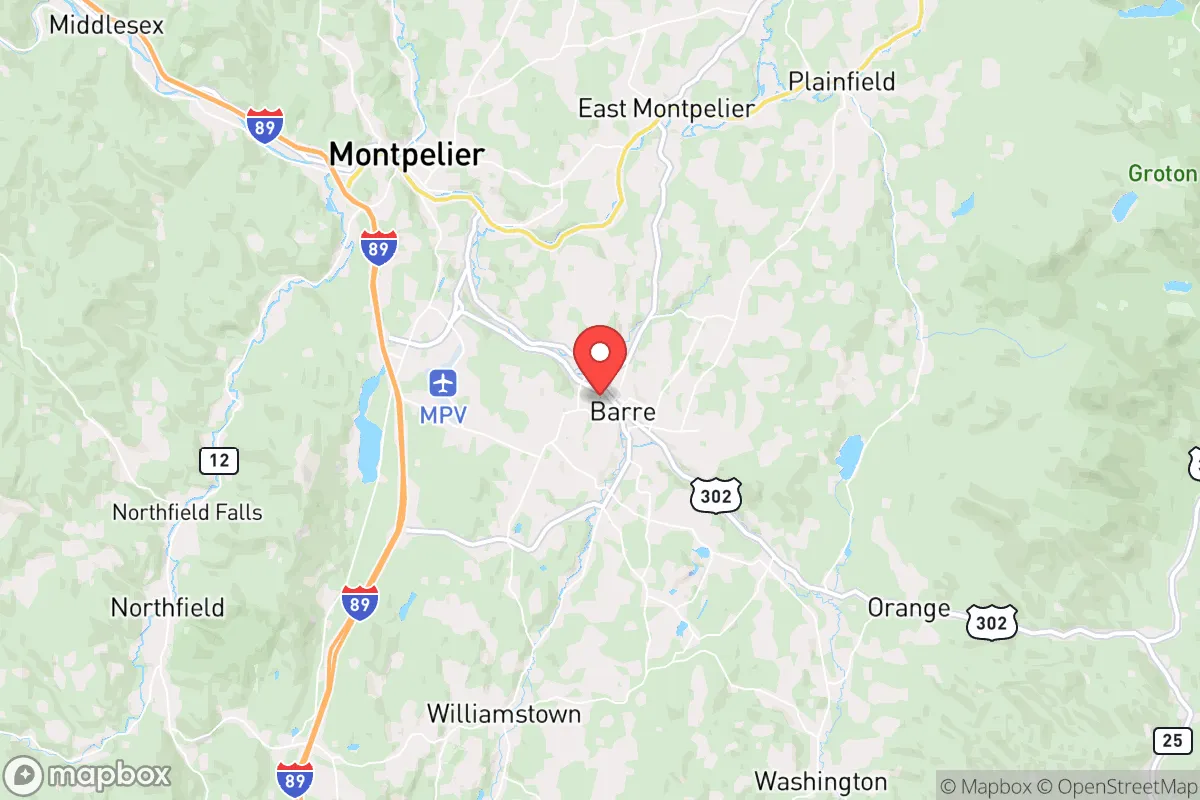
Personal Sovereignty in Barre, VT
Moderate friction. Expect trade-offs in some aspect of personal liberty and independence.
What does Personal Sovereignty tell us?
Personal Sovereignty measures your capacity for self-reliance and independence with minimal government friction. Higher scores mean fewer barriers between you and the way you want to live... but it assumes you have the space you need and good neighbors.
What does this tell us?
Personal Sovereignty measures your capacity for self-reliance and independence with minimal government friction. Higher scores mean fewer barriers between you and the way you want to live... but it assumes you have the space you need and good neighbors.
State Policy
Energy independence: Importer (15% of energy produced in-state)
Personal Liberty
Homesteading

Personal Liberty Analysis
Barre, Vermont, presents a complex and often contradictory landscape for personal sovereignty, one that demands a clear-eyed, strategic assessment rather than a simple thumbs-up or thumbs-down. While the state’s rural character and independent Yankee tradition offer genuine opportunities for self-reliance, these are increasingly counterbalanced by a state-level policy environment that leans heavily into regulatory oversight and progressive social mandates. For the conservative-leaning individual or family prioritizing maximum autonomy—particularly those with a survivalist or prepper mindset—Barre is a place where you can carve out a degree of personal freedom, but only if you are prepared to navigate and resist a growing web of government involvement in your daily life. The core tension here is between the practical, hands-on lifestyle the area enables and the legal and tax framework that seeks to direct it.
Tax burden and regulatory posture: what it costs to live free in central Vermont
Vermont’s tax burden is consistently ranked among the highest in the nation, and Barre residents feel this acutely. The state’s progressive income tax structure, with rates climbing to 8.75% on higher earners, directly reduces the capital you can retain for your own preparedness projects, land improvements, or savings. Property taxes are also a significant factor, with Vermont’s effective rate hovering around 1.8% of a home’s assessed value—well above the national average. This means that owning land and a home in Barre, while providing physical space for self-reliance, comes with a recurring, substantial cost to the state. On the regulatory front, Vermont’s Act 250 land-use law is a major point of friction. This state-level permitting process can apply to even modest development projects, including building a new home, expanding a driveway, or starting a small-scale commercial operation on your property. For someone seeking to build a self-sufficient homestead with workshops, outbuildings, or alternative energy systems, Act 250 can introduce significant delays, costs, and bureaucratic hurdles. The state’s regulatory posture is one of active management, not laissez-faire, meaning that any significant alteration to your property will likely involve state approval.
Self-defense and gun law specifics: navigating a restrictive landscape
For those who view the Second Amendment as a cornerstone of personal sovereignty, Vermont’s current legal environment is a source of deep concern. While the state has a strong historical tradition of gun ownership and does not require a permit to carry a concealed firearm—a remnant of its libertarian past—the legislature has passed several restrictive measures in recent years. In 2023, a significant gun control package was enacted that raises the minimum age to purchase a firearm to 21, bans the sale of many semi-automatic firearms (often referred to as "assault weapons"), and prohibits magazines capable of holding more than 10 rounds of ammunition for long guns and 15 rounds for handguns. These laws directly impact the types of firearms a prepper or survivalist would consider essential for defense, hunting, and long-term resilience. Furthermore, the state has a "red flag" law (Extreme Risk Protection Order) that allows for the temporary seizure of firearms based on a court order, without a criminal conviction. For an individual concerned about government overreach, this represents a clear mechanism by which the state can disarm a citizen based on a subjective assessment of risk. While enforcement in rural Washington County may be less aggressive than in Burlington, the legal framework is now firmly restrictive.
Self-reliance and homesteading viability: lot sizes, zoning, and off-grid feasibility
This is where Barre and its surrounding area offer the most tangible advantages. The rural townships around Barre—such as Berlin, Orange, and Williamstown—feature large, affordable parcels of land. It is entirely feasible to find a 5-to-20-acre lot with woods, a stream, and southern exposure for under $100,000, providing the physical foundation for a serious homesteading operation. Zoning in these unincorporated areas is generally permissive, allowing for livestock, gardens, workshops, and the construction of outbuildings without the onerous permitting seen in more suburban towns. However, the off-grid feasibility is a mixed bag. Vermont has a strong net-metering policy for solar, and many rural residents rely on private wells and septic systems, which are largely unregulated beyond initial installation. Wood heat is the norm, not an exception, which is a major plus for energy independence. The critical catch is the state’s building code. While not always aggressively enforced in remote areas, the state does have a residential building code that can complicate the construction of a truly off-grid, owner-built dwelling. A "tiny house" or a non-traditional shelter may face legal challenges, and the state’s health department has strict requirements for wastewater systems. The land is available and affordable, but building a completely independent, code-avoiding homestead requires careful research and a willingness to operate in a legal gray area.
Personal liberties: parental rights, medical autonomy, speech, and property
On the spectrum of personal liberties, Vermont leans heavily toward state-directed outcomes. Parental rights have been a flashpoint, with the state passing laws that affirm a student’s right to make decisions about their gender identity without parental consent, a direct challenge to traditional family authority. The state also mandates a comprehensive sex education curriculum that many conservative parents find objectionable. Medical autonomy was severely tested during the COVID-19 pandemic, where Vermont had some of the most prolonged and stringent mandates in the country, including a universal school mask mandate that lasted into 2022. The state’s public health apparatus retains significant emergency powers, a fact that should give any liberty-minded individual pause. On the positive side, property rights are generally respected in the rural areas, with minimal interference in how you use your land, provided you stay within the bounds of Act 250 and local health codes. Free speech is protected by the First Amendment, but the dominant political culture in the state is overwhelmingly progressive, meaning that expressing dissenting views on topics like government mandates or critical race theory can lead to social ostracism, particularly in more organized community settings. The legal protections for speech are strong, but the social cost of exercising them can be high.
In the final analysis, Barre, Vermont, offers a deeply contradictory environment for personal sovereignty. The land, the climate, and the remnants of a self-sufficient Yankee culture provide a genuine foundation for a life of self-reliance and preparedness. You can own acreage, heat with wood, grow food, and live a relatively independent existence. However, this physical autonomy is constantly under pressure from a state government that taxes heavily, regulates land use intrusively, restricts firearm ownership significantly, and asserts authority over family and medical decisions. Compared to a state like New Hampshire, which has no income tax, no sales tax, and a much stronger culture of "Live Free or Die," Barre falls short on nearly every measure of personal liberty. Compared to a deep-blue state like California or New York, it offers more practical space and a lower cost of entry for land ownership. For the strategic relocator, Barre is best viewed as a high-effort, high-reward proposition: you can build a sovereign life here, but you will be doing it in a state that is philosophically opposed to the very concept, requiring constant vigilance and a willingness to push back against the system.

* Values derived from national, state, county, city and local statistics and may differ in a specific area. Last updated: 2026-04-22T22:58:48.000Z
Narrative content on this page is AI-generated and may contain mistakes. Verify any details that matter before acting on them.
ReloMaps may earn a commission from affiliate links at no extra cost to you.

