 Popular
Photo: Wikipedia
Demographics of Ashland, KY
Affluence Level in Ashland, KY
A low-income area with significant economic hardship. Household wealth and educational attainment are well below national averages.
People of Ashland, KY
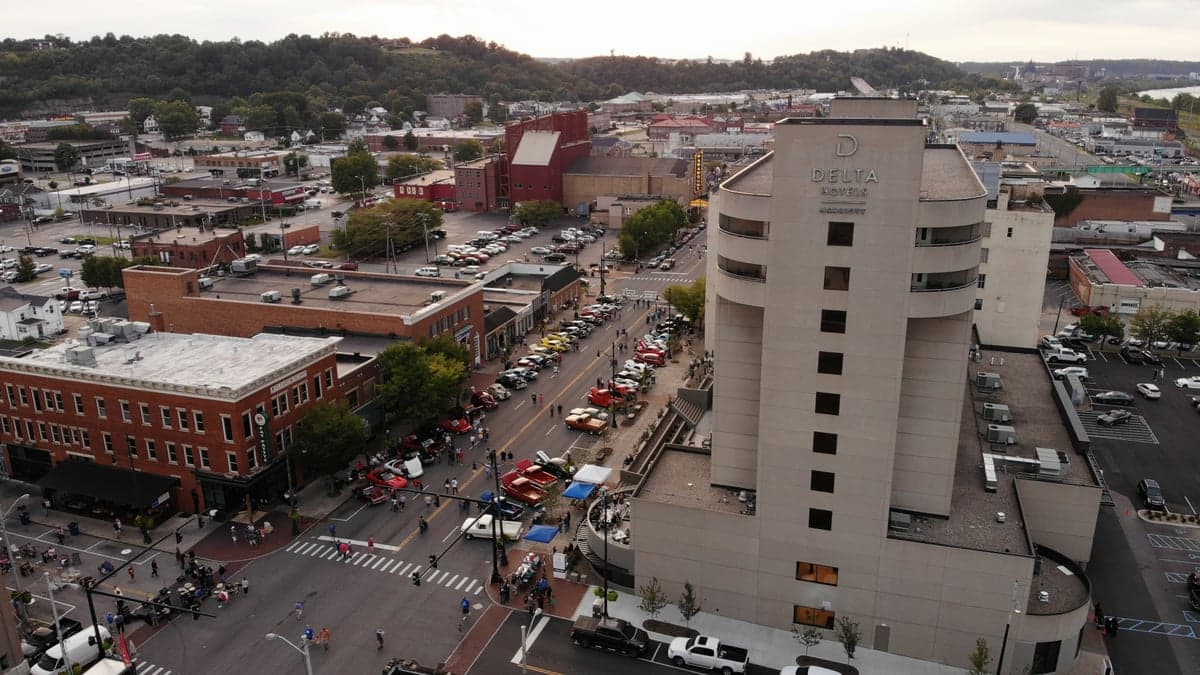
Ashland, Kentucky, is a small, predominantly white, working-class city of 21,405 residents, shaped by a century of industrial boom and subsequent decline. Its population is notably homogeneous—91.5% white, with a foreign-born share of just 1.0%—and less college-educated (24.6%) than the national average. The city’s identity is rooted in a proud, self-reliant Appalachian and Rust Belt heritage, where family ties and local institutions like the Ashland Oil company have long defined community life. Today, Ashland feels like a place holding steady, with a population that is aging and slowly shrinking, but with a core of long-established families who remain deeply connected to the Ohio River valley.
How the city was settled and grew
Ashland’s population story begins not with colonial settlement but with the industrial revolution. Founded in 1854 as a planned industrial town by the Kentucky Iron, Coal and Manufacturing Company, the city was deliberately built to exploit the region’s rich iron ore, coal, and timber resources. The first major wave of settlers were native-born white Americans from the surrounding Appalachian hills and from the Ohio River valley, drawn by jobs at the blast furnaces and rolling mills. These early workers and their families settled in the Central Park and South Ashland neighborhoods, building modest frame houses near the riverfront industries. A second, smaller wave came in the late 19th and early 20th centuries, when the railroads—particularly the Chesapeake and Ohio—made Ashland a regional hub. This brought a trickle of European immigrants, mostly German and Irish, who clustered in the Bellefonte neighborhood, where St. Joseph Catholic Church became a community anchor. By 1900, Ashland’s population had reached roughly 8,000, and it was overwhelmingly white and native-born. The city’s growth peaked in the mid-20th century, fueled by the rise of Ashland Oil (founded in 1924), which became the city’s dominant employer and a source of stable, middle-class jobs. The Fairview and Wilder neighborhoods expanded during this era, filled with the ranch-style homes of oil company managers and skilled tradesmen. Ashland never experienced a large-scale African American migration; the Black population has always been small (1.5% today), concentrated historically in a small area near the railroad tracks in South Ashland.
Modern era (post-1965)
After the 1965 Hart-Cellar Act, Ashland saw virtually no new immigration. The city’s foreign-born population today is just 1.0%, and there is no established enclave for any immigrant group. The post-1965 story is one of domestic out-migration and suburbanization. As the steel and oil industries began to contract in the 1970s and 1980s, younger workers left for larger cities like Lexington and Columbus. Those who stayed tended to be older, white, and rooted in the local economy. The Westwood neighborhood, once a thriving middle-class area near the Ashland Oil headquarters, saw gradual decline as the company downsized. Meanwhile, the Summit area—a newer, more suburban development on the city’s western edge—attracted some families seeking newer housing and better schools, but growth there was modest. The Hispanic population, at 2.3%, is the only non-white group to have grown slightly since 2000, largely through domestic migration from other parts of Kentucky, but it remains too small to form a distinct neighborhood. The Asian population (East/Southeast Asian) is 0.5%, and the Indian subcontinent population is 0.0%, reflecting no significant post-1965 immigration from those regions. Ashland’s demographic trajectory since 1965 has been one of gradual homogenization, as the small non-white populations that existed have largely assimilated or moved away.
The future
Ashland’s population is heading toward further aging and slight contraction. The city lost about 5% of its population between 2010 and 2020, and projections suggest a continued slow decline. The population is not tribalizing into distinct ethnic enclaves—there simply aren’t enough newcomers to create them. Instead, the trend is toward homogenization: the small Black and Hispanic populations are geographically dispersed and culturally assimilated, with no growing immigrant communities to reverse the trend. The next 10-20 years will likely see Ashland become even whiter and older, as younger adults continue to leave for job markets elsewhere. The city’s future population will be sustained primarily by retirees and by families who inherit homes in established neighborhoods like Bellefonte and Fairview. There is no sign of a significant influx of any new ethnic or national group.
For someone moving in now, Ashland is becoming a stable, low-diversity, aging community where the population is more likely to shrink than grow. It is a place for those seeking quiet, affordable living in a tight-knit, historically white working-class environment, not for those looking for demographic change or a vibrant immigrant culture. The city’s character is set, and the people who live there are the descendants of the industrial workers who built it—a population that is holding on, not transforming.

* Values derived from national, state, county, city and local statistics and may differ in a specific area. Last updated: 2026-04-21T09:16:49.000Z
Narrative content on this page is AI-generated and may contain mistakes. Verify any details that matter before acting on them.
ReloMaps may earn a commission from affiliate links at no extra cost to you.

