
Photo by goodrich kingrey on Unsplash
Political ClimatePolitical Climate in St Francis County
Showing district-level results — no local-only data available.
Local Political AnalysisPolitical Analysis of St Francis County
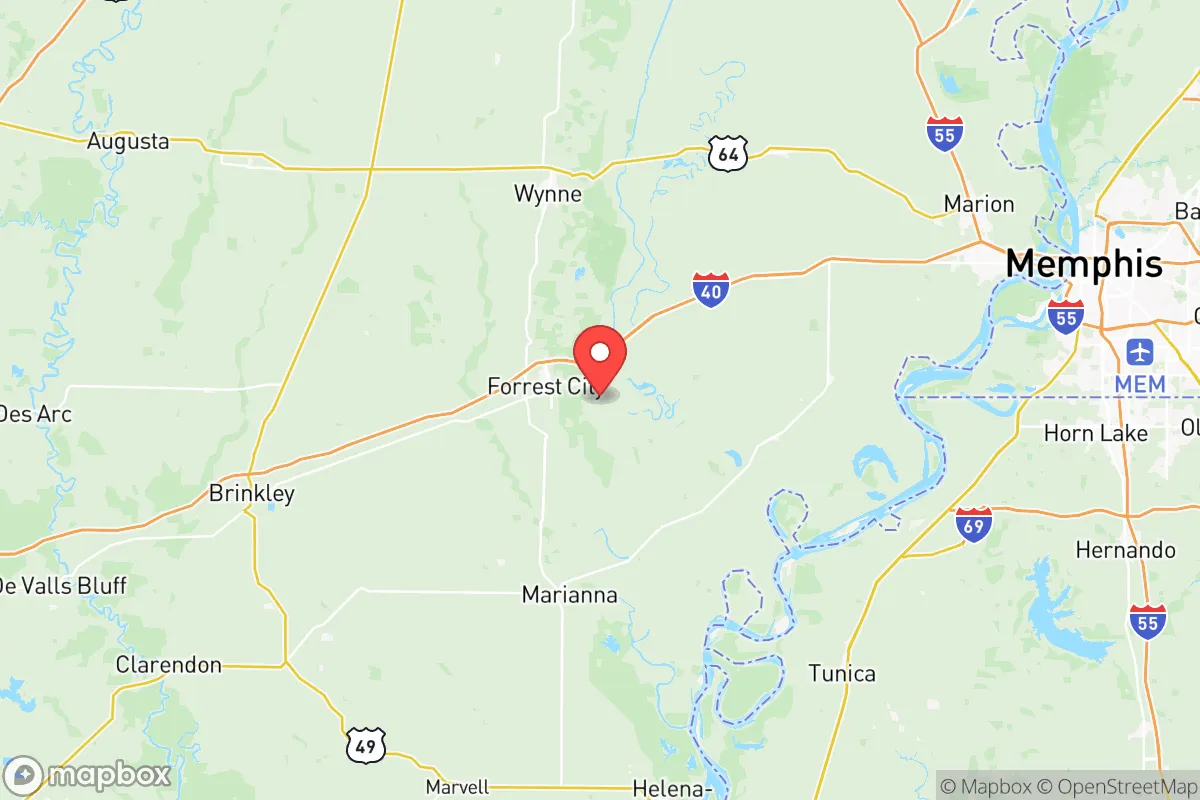
St Francis County, Arkansas, is a deeply conservative area with a Cook Partisan Voting Index (PVI) of R+23, making it one of the most reliably Republican counties in the state. This isn't a recent shift; the county has been trending red for decades, with the 2024 presidential election seeing Donald Trump carry the county by a margin that far exceeded his statewide performance. The county's political identity is rooted in its rural character, agricultural economy, and a strong tradition of evangelical Christianity, which together create a solid base for GOP candidates. However, the political landscape isn't entirely monolithic, with subtle variations between the county's small towns and unincorporated communities.
How it compares
St Francis County's R+23 PVI is significantly more Republican than Arkansas's statewide PVI of R+16. This means the county is about 7 points more conservative than the state average. To put it in perspective, while Arkansas as a whole is a solidly red state, St Francis County is a deep red stronghold within it. The county's voting patterns are more akin to the state's rural, northwestern regions than to the more moderate or Democratic-leaning areas like Pulaski County (Little Rock) or the Mississippi Delta counties. In the 2024 election, for example, the county's Republican vote share was roughly 10-15% higher than the state average, reflecting a more intense partisan alignment. This difference is driven by a combination of factors: a higher concentration of white, non-college-educated voters, a lower population density, and a stronger cultural attachment to traditional conservative values.
What this means for residents
For conservative residents, St Francis County is a comfortable and affirming environment. Local elections are almost always decided in the Republican primary, and the county's elected officials—from the county judge to the sheriff—are reliably conservative. Policy debates tend to focus on issues like agricultural regulations, property taxes, and local infrastructure, rather than the more divisive national culture wars. For liberal residents, the political climate can feel isolating. There is no organized Democratic Party presence in the county, and progressive viewpoints are rarely represented in public discourse. However, the county's small size means that personal relationships often transcend political differences, and most residents are respectful of differing opinions in day-to-day interactions. The key takeaway is that while the political environment is overwhelmingly conservative, it is not hostile; it's simply a place where conservative values are the default, and anyone moving here should be comfortable with that reality.
One of the more interesting cultural distinctions in St Francis County is the subtle political variation between its towns. Forrest City, the county seat and largest town, is the most politically diverse area, with a significant African American population that tends to vote Democratic. While the city council is still majority-Republican, there are a few Democratic-leaning precincts in the city's older neighborhoods. In contrast, Hughes and Madison are overwhelmingly Republican, with little to no Democratic presence. Caldwell and Wheatley are more swing-like, with local elections often decided by a handful of votes, but they still lean heavily red in national contests. This variation is largely driven by demographics: the more rural and white the community, the more conservative it is. The county's political trajectory is unlikely to change in the near future, as the factors driving its conservatism—rurality, religion, and economic reliance on agriculture—are deeply entrenched. If anything, the county is likely to become even more Republican as younger, more conservative residents replace older, more moderate ones.

State Political ClimatePolitical Climate in Arkansas
State Political AnalysisPolitical Environment in the State
Arkansas is a deeply red state with a Cook PVI of R+16, meaning it votes about 16 points more Republican than the national average in presidential elections. Over the past 20 years, the state has shifted hard right — in 2004, George W. Bush won it by 9 points; by 2024, Donald Trump carried it by over 30. The dominant coalition is rural, white, and evangelical, concentrated in the Ozarks, the River Valley, and the southern timberlands, with the northwest corner (Bentonville, Rogers, Fayetteville) supplying the economic and population growth that keeps the state's politics conservative. The Delta counties along the Mississippi River, once a Democratic stronghold, have either flipped or shrunk in population, accelerating the statewide trend.
Urban vs. rural divide
The political map is stark. Pulaski County (Little Rock) is the only reliably blue urban center, voting for Biden by 17 points in 2020 and for Harris by a similar margin in 2024 — but it's surrounded by deep-red suburbs and exurbs like Conway and Bryant that vote 20-30 points Republican. Washington County (Fayetteville) has trended purple as the University of Arkansas and Walmart's corporate migration bring in younger, more educated voters; it went for Trump by only 4 points in 2024, down from 15 in 2016. Benton County (Bentonville, Rogers) remains solidly red despite explosive growth, voting +22 R in 2024, driven by a mix of corporate transplants and native conservative voters. The rest of the state — the Ozarks, the River Valley around Fort Smith, the southern pine woods around El Dorado and Texarkana, and the Delta — votes 30-50 points Republican. There are no swing counties left in the old sense; the closest thing is Garland County (Hot Springs), which went +18 R in 2024, down from +30 in 2016, as retirees and tourism workers shift it slightly left.
Policy environment
Arkansas has one of the lowest tax burdens in the country. The state income tax was cut from a top rate of 5.9% to 4.4% in 2025, with further cuts to 3.9% scheduled by 2027. There is no state property tax — that's levied at the county level, typically 0.5-0.8% of assessed value. Sales tax is 6.5% state, plus local add-ons that can push it to 10% or more in some cities. The regulatory posture is light-touch: no state-level OSHA, no certificate-of-need laws for healthcare facilities, and a right-to-work law that has kept union density below 4%. Education policy is dominated by the LEARNS Act (2023), which created universal school vouchers worth roughly $7,000 per student, expanded charter schools, and banned "critical race theory" and "indoctrination" in public classrooms. Healthcare is a mixed bag: Arkansas expanded Medicaid under the private-option model (Arkansas Works), but the state has some of the strictest abortion laws in the nation — a near-total ban with no exceptions for rape or incest, only for the life of the mother. Election laws require a photo ID to vote, limit drop boxes to one per county, and ban ballot harvesting. Early voting is generous — 15 days — but absentee voting requires an excuse.
Recent policy direction
The last three legislative sessions have pushed the state decisively right on nearly every front. On guns, Arkansas became a permitless carry state in 2021, and in 2023 it passed a law prohibiting state and local law enforcement from enforcing federal gun regulations that don't have a state equivalent — a "Second Amendment Sanctuary" statute. On parental and education rights, the LEARNS Act (2023) also banned "social-emotional learning" curricula and required schools to post all instructional materials online for parental review. On speech, a 2023 law prohibits public universities from requiring diversity statements in hiring, and a 2025 law targets "viewpoint-based" content moderation by social media platforms. On privacy and surveillance, the state passed a broad data privacy law in 2023 (the Arkansas Data Privacy Act) giving residents the right to access, correct, and delete personal data held by large companies, but it exempts government agencies. On medical and bodily autonomy, the abortion ban is total, and a 2023 law banned gender-affirming care for minors, including puberty blockers and hormone therapy. On property rights, Arkansas is a strong "private property rights" state — no statewide rent control, no inclusionary zoning mandates, and a 2021 law limits the ability of cities to regulate short-term rentals like Airbnb. On voting, a 2021 law shortened the absentee ballot application window and required a copy of the voter's ID with the application. The overall direction is toward maximum individual liberty on economic and self-defense issues, combined with tight government control on social and medical issues.
Civil unrest & political movements
Arkansas doesn't see the kind of large-scale protests that hit bigger states, but there have been flashpoints. In 2020, Black Lives Matter protests in Little Rock and Fayetteville drew hundreds, not thousands, and were largely peaceful. The most organized activist movements are on the right: the Arkansas State Rifle Association is one of the most effective state-level gun lobbies in the country, and local county Republican committees in Benton County and Faulkner County (Conway) are heavily influenced by the state's "constitutional conservative" wing, which pushes nullification rhetoric around federal gun and environmental regulations. Immigration politics are less heated than in border states — Arkansas's foreign-born population is only about 5% — but a 2025 law requires local law enforcement to cooperate with ICE detainers, and there's a small but vocal "sanctuary city" debate in Springdale, where the Marshallese and Hispanic populations are growing. Election integrity controversies flared after 2020, with the state GOP pushing for hand-count audits and paper ballot mandates, but no major fraud was ever documented. The most visible political tension a new resident would notice is the cultural divide between the fast-growing, corporate-friendly northwest and the slower, more traditional rest of the state — it's less about left vs. right and more about what kind of conservative you are.
Projection
Over the next 5-10 years, Arkansas will likely stay R+16 or move slightly redder. The northwest corridor — Bentonville, Rogers, Fayetteville — will continue to grow, bringing in a mix of out-of-state professionals from California, Texas, and the Midwest. Some of those transplants are moderate Republicans or independents, which could nudge Washington County toward swing status, but they're balanced by the continued out-migration from the Delta and the rural south, which depresses Democratic turnout. The state's tax cuts and light regulation will keep attracting business relocations — Walmart, Tyson Foods, J.B. Hunt, and Dillard's are all headquartered here, and the supply chain and logistics sector is booming. The biggest wild card is education: if the LEARNS Act's voucher system accelerates the decline of rural public schools, it could hollow out the civic infrastructure in small towns and further polarize the state. A new resident moving in now should expect a decade of stable Republican control, low taxes, minimal regulation, and a social environment that is increasingly restrictive on abortion and transgender issues, but permissive on guns, property, and business. The state is not going to flip or even become competitive at the presidential level — it's a safe bet for anyone who wants a reliably conservative policy environment with a growing economy.
For a new resident, the bottom line is this: Arkansas delivers what it promises on paper — low taxes, light regulation, strong gun rights, and a conservative social framework. If you're a conservative, you'll find a state government that is actively moving in your direction on almost every issue. If you're a liberal, you'll find a small but resilient community in Little Rock and Fayetteville, but you'll be living under laws you likely oppose, especially on abortion and education. The practical takeaway is that Arkansas is a state where your vote in local primaries matters more than your vote in November — the real decisions are made in the Republican primary, and that's where the political energy is. If you're comfortable with that reality, the state offers a high quality of life at a low cost, with a political climate that is stable, predictable, and unlikely to surprise you.
* Values derived from national, state, county, city and local statistics and may differ in a specific area. Last updated: 2026-07-24T14:55:44.000Z
Narrative content on this page is AI-generated and may contain mistakes. Verify any details that matter before acting on them.
ReloMaps may earn a commission from affiliate links at no extra cost to you.

